Planet Ocean: Using Local Collections to Celebrate Global Climate Action

Written by Sarah Marden, Curator of Natural History at The Box, Plymouth.

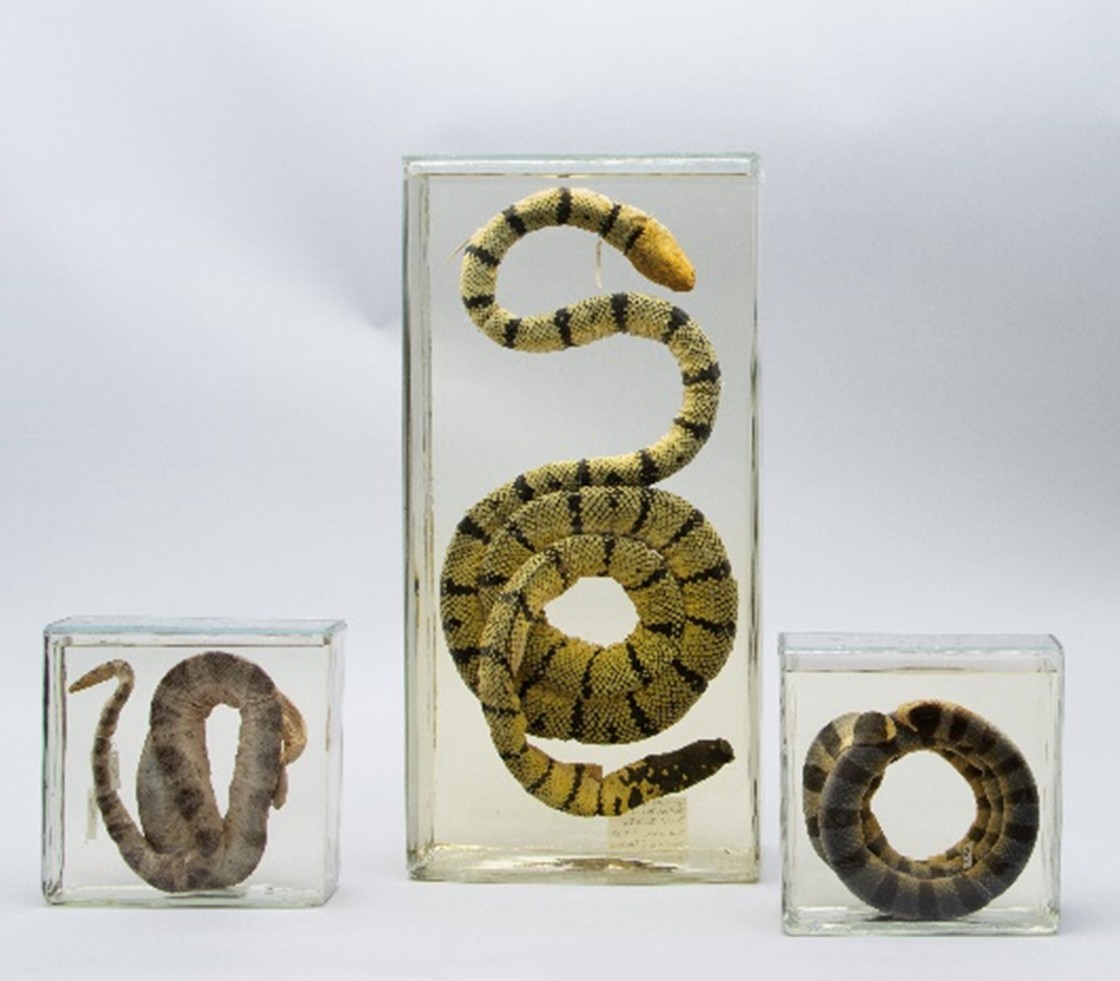
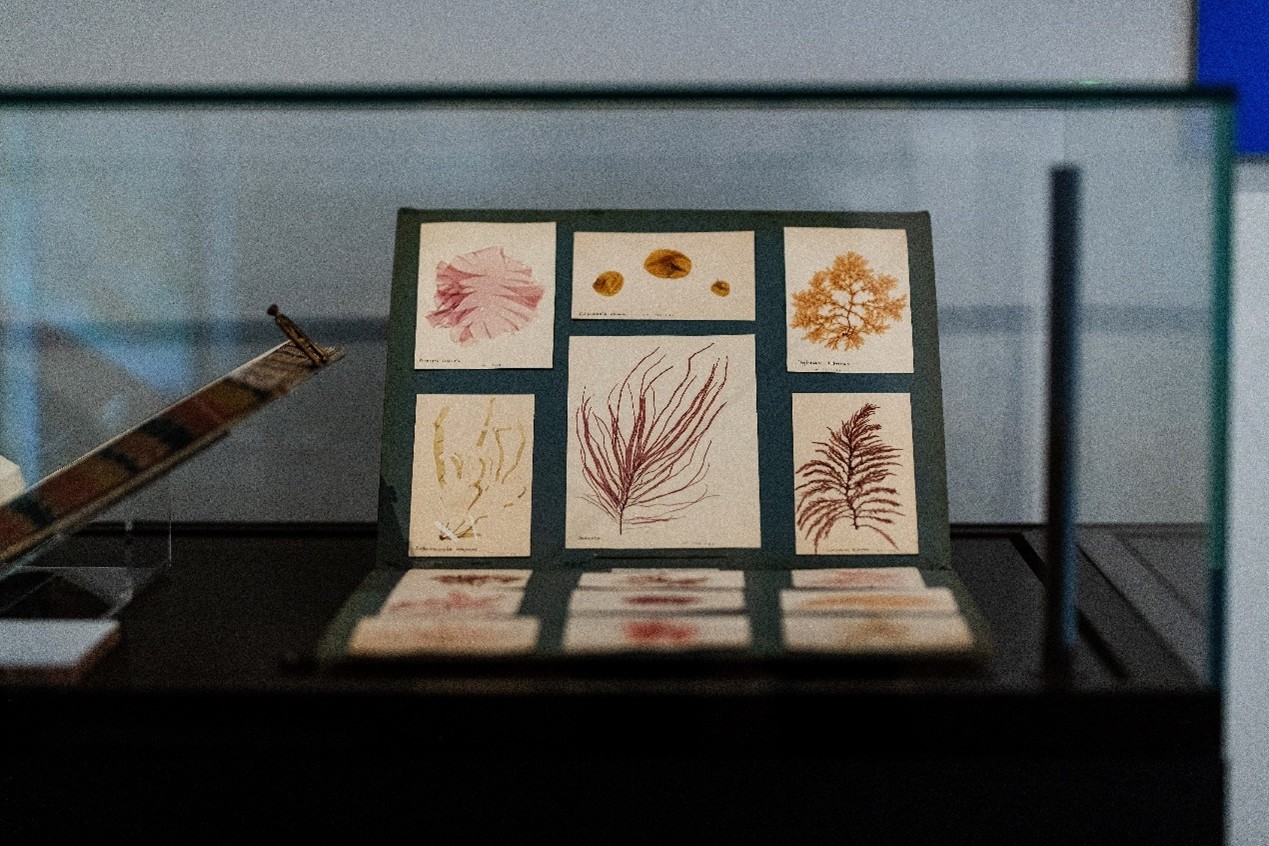
From March 2024 to April 2025, a new exhibition at The Box called Planet Ocean explored Plymouth’s marine heritage and contemporary identity as “Britain’s Ocean City”. Specimens from our natural history collections, including spirit-preserved marine invertebrates, molluscs, corals, mounted sea birds and seaweed folios were displayed alongside art, world cultures collections, image and film and loan material from local partners.

Flowers of the Sea folio by Emily Johns, © Dom Moore

Taking inspiration from science fiction writer and undersea explorer Arthur C Clarke who said “how inappropriate to call this planet Earth when it is clearly ocean”, we explored why the ocean is so important- the fact that we literally couldn’t survive without it as it gives us around half the oxygen we breathe, but also that it sustains and supports us locally with food, jobs, leisure, health and wellbeing. Alongside this quote, the entrance wall of the exhibition featured a moving graphic created collaboratively with Plymouth Marine Laboratory. It used one of the oldest datasets in existence of changing ocean temperatures recorded in Plymouth Sound. This data was input into a globe representing our ocean planet that changed and distorted according to the human impact of climate change over time. This was the first example of science meeting art and partnerships that we developed throughout the exhibition.

Continue reading

A Hundred Feet Through the Door – A Chance Encounter with some Centipedes set me on a Curatorial Path…

Written by Dan Gordon, Keeper of Biology, The Great North Museum: Hancock.

So, how did I get started in museums? Like perhaps many people, it began with a stroke of luck.

I’d decided to study Biology at university—I suppose I’d vaguely pictured myself at some point in the future, white-coated in the lab, pouring over spectrophotometer readings or agar plates. But by the end of the first year, I found myself staring out of the window during practicals. Nineteen-year-old me was slowly becoming disillusioned: Botany was biochemistry; Zoology was elegant mathematics; even Ecology was really an intricate forest of statistics, not trees. There was beauty in the numbers, but it was all a long way from my childhood passion for birdwatching, rock pooling and reading travel books. One day, peering at smudges on a petri dish and trying to work out if I’d just induced gene expression, I realised I might not be cut out for that imagined future. I was fascinated by the soul of the subject, but the finer points of its language were losing their magic.

Continue reading

5 Top Tips on How to Decant your Museum

By Eimear Ashe, Collections Moves Project Manager, National Museum of Ireland

Having recently completed a major decant of Natural History collections in the National Museum of Ireland, I thought it a perfect opportunity to share my learnings with fellow NatSCA colleagues.

National Museum of Ireland – Natural History

Tip 1. Start with the staff!

  • What skills do you need to recruit in or increase capacity in?
  • Recruit new temporary staff. Training should be provided in the following areas: hazards in collections, manual handling, object handling, photography (if part of the workflow), condition assessment, object packing, transfer documentation procedures, integrated pest management (IPM), and the collections management system.
  • If you cannot recruit new staff, you will have to use existing resources. Agree with management that the permanent staff team will not be able to carry on their regular duties during the period of decant. You should also make the public aware of this reduction in capacity and service provision.
Continue reading

NatSCA Digital Digest – May 2025

Compiled by Ellie Clark, Collections Moves Team Leader at the Natural History Museum, London.

Welcome to the May edition of NatSCA Digital Digest

Digital Digest is a monthly blog series featuring the latest on where to go, what to see and do in the natural history sector including jobs, exhibitions, conferences, and training opportunities. We are keen to hear from you if you have any top tips and recommendations for our next Digest, please drop an email to blog@natsca.org.

Sector News

Registration Now Open for SHNH International Summer Meeting

We are pleased to announce that registration is now open for the two-day international meeting ‘A Sense of Nature’. The conference will explore the intersections of the senses – including sight (vision), sound (hearing), smell (olfaction), taste (gustation) and touch (tactile perception) – with the history of natural history.

The event will be at Kelvin Hall, Glasgow on 19th June and 20th June 2025. The conference will feature 12 papers across six sessions, as well as collections tours and an optional conference dinner.

Full details are available here. Registration will close at 6pm (BST) on 28th of May 2025.

Continue reading

A Time Capsule of Extinction: Scotland’s Iconic Wildlife

Written by Caitlin Jamison, Museum Collection Technician, Montrose Museum: ANGUSalive.

Montrose Museum in Angus, northeast Scotland, houses an impressive natural history collection. Everything from taxidermy to fossils to rare minerals are housed in a modest, Greek-revival style museum off the high street. Built in 1842, it is one of the first purpose-built museums in Scotland.

Sadly, due to changing public interest (and the challenging funding situation facing many local authority museums) the collection has been somewhat forgotten since it was catalogued onto neat pink index cards in the late 1970s.

Montrose Museum’s 1970s card catalogue (author’s own photo)
Continue reading