Crispy, Brown and Far Too Delicate – Are Herbarium Specimens Just Too Difficult to Use?

Written by Clare Brown, Leeds Museums and Galleries.

Taking a walk through a forest, running through fields of wheat or even just gazing at trees, all a far-cry from dealing with the sheets of pressed, long-dead dried plants you come across in museum collections. Good taxidermy at least looks like the original animal.

Other problems with plant specimens include their need for low light, extremely careful handling and, occasionally, mercuric chloride. Despite being phenomenally important to researchers, for everything from tracking climate change to curing cancer, plant collections are not at the top of many people’s lists when it comes to exhibitions, events and workshops.

So, what public-facing engagement can you do with herbarium specimens? Here I’ve looked at a few great case studies where creative collections are delivering brilliant botany… Continue reading

Making a Green Gallery – A Leeds Story

By Sara Merritt, Audience Development Officer at Leeds Museums & Galleries.

Us: We want to retro-fit a permanent gallery! As sustainably as possible! With £40k! In two months! And we want to keep the space open to visitors!

Them: Umm, are you sure that’s a good…

Us: Great! We’ll get cracking.

2022 saw us undertake the retro-fit of our permanent Life on Earth gallery at Leeds City Museum, with the aim of making it as sustainable as possible. The gallery required an overhaul to meet current visitor expectations, with innovative design ideas and production methods to reflect our greater understanding of climate change, the biodiversity crisis, and Britain’s colonial history.

Our objectives were threefold and carefully considered:

  • To manage and deliver a sustainable retro-fit with the addition of creating a carbon calculator to measure our C02 output
  • To ensure the interpretation was relevant, and that we had a strong idea of our target audience to attract visitors who were already engaged in making climate-positive changes.
  • To identify robust materials and production methods which would stand up to visitors pulling, prodding, and everything in between.

We were used to working with greener materials for temporary exhibitions and knew the implications around material availability, longevity of eco materials, and higher associated costs. We therefore needed to keep the project resource light and put our efforts into the interpretation, rather than dramatic object moves. We took the bones of what we had, large cases and great objects, and retold the story with the emphasis on using our objects to inspire our visitors to live more sustainably.

Continue reading

How a Giant Panda – possibly called Grandma – ended up at Leeds City Museum.

Written by Clare Brown, NatSCA Membership Secretary & Curator of Natural Science, Leeds Museums and Galleries, Leeds Discovery Centre.

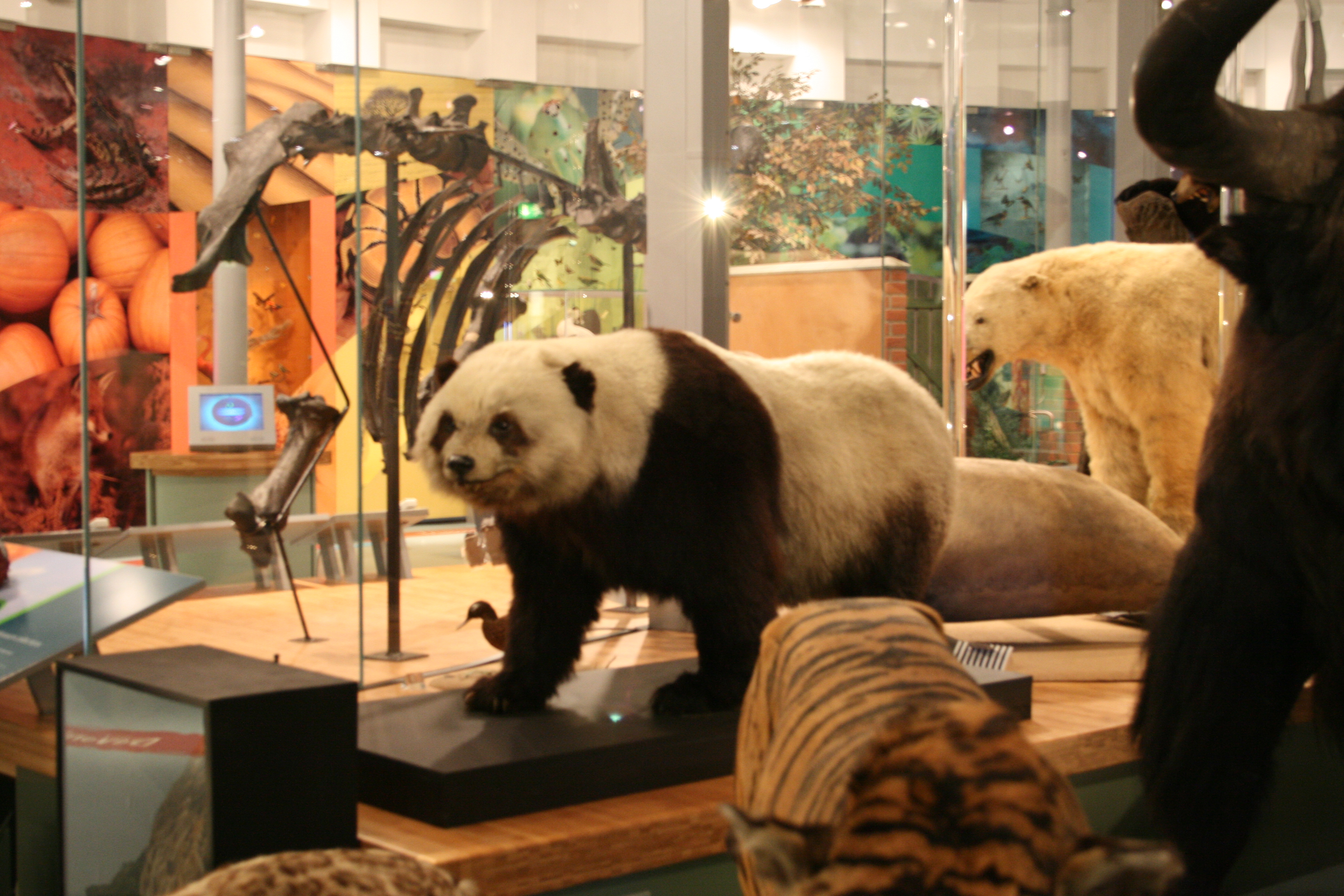
On display in the basement gallery of Leeds City Museum is a stuffed Giant Panda. We’ve always known and referred to her as “Grandma”, the panda that died only a few days after arriving in London in 1938.

Photograph of a taxidermy giant panda at Leeds Museum.
‘Grandma’ the Giant Panda ©Leeds Museums and Galleries.

Grandma, named as she was the oldest of the group, and her compatriots Happy, Grumpy, Dopey and Baby (Snow White was released in March that year) were the first live Giant Pandas to arrive in the UK. They had taken a long and complicated journey out of central China. Trapped in the forests above Weizhou, Sichuan, the pandas were initially kept at Chengdu under the care of Elizabeth and Floyd Tangier Smith.

Over several weeks, paperwork was prepared and plans were put in place for moving six pandas across the country during a Japanese invasion. It was then Elizabeth who, leaving a poorly Floyd to catch a plane, navigated her way to the Hong Kong Society for Prevention of Cruelty to Animals’ Dogs Home, a journey of some 1400km. One panda died en route.

Continue reading

Many Hands Make Light Work

Written by Milo Phillips, Assistant Curator of Entomology at Leeds Museums and Galleries.

The past couple of years have seen a significant shift toward digital alternatives throughout the museum sector, from online exhibitions to webinars and remote conferencing, with our collections and their stories reaching a potentially global audience, more so than ever before. While much is being done to boost engagement with collections in new and exciting ways, museums on the whole have yet to harness the power of this shift when it comes to collections management.

The value of our natural science collections lies in their accessibility, in how open they are to this growing audience, from our local schools to researchers around the world and everyone in-between.

As our collections grow and our technology improves, digitization has become an important part of maintaining natural history collections. Using a citizen science approach, and bringing museum audiences on-board, we can turn collection management into a way of improving our collections, while simultaneously facilitating a deeper and more meaningful level of engagement with our objects and their stories.

Zooniverse is a free online platform built to facilitate a crowdsourced approach to large data sets and, while traditionally used by academic research groups, is an ideal solution to tackling tasks with much more efficiency than lone curators or even dedicated teams might be able to achieve. Projects can either be restricted to a specific group of users or opened up to the public for anyone to contribute their time to.

Continue reading

Mo Koundje: How Gorilla Histories Can Help Decolonise Our Collections

Presented by Rebecca Machin, Leeds Museums and Galleries.

Abstract

Mo Koundje (‘Mok’) is a Western Lowland Gorilla in the collections of Leeds Museums and Galleries (LMG). His taxidermied skin is displayed at Leeds City Museum, while his skeleton is in the store at Leeds Discovery Centre. At present, his remains are used as an example of ‘gorilla’ in the Life on Earth gallery, but they have the potential to tell us so much more. Using archives from the Zoological Society of London, the Natural History Museum, and the Archives Nationales d’Outre Mer, as well as French and British press archives, I have found out more about Mok’s life. His story touches on domestic life in French colonies, the interaction between colonists and colonised communities, and the illegal hunting and trade in gorillas, which continues today. The remains of animals from once colonised countries have the potential to reveal stories not only of their own experiences, but of the people whose lives were affected by colonisation. By entering colonial homes, gorillas enable us to look at racial and gendered hierarchies imposed by European colonisers from a new perspective. We can, and should, use these stories to engage our audiences with a range of political and environmental issues still relevant today.

This presentation contains distressing images.

Continue reading