Splits and Distortion of a “Hisstoric” Snakeskin: Humidification as Part of Remedial Conservation Treatment of a Boa constrictor Skin”

Written by Claire Kelly, Conservator at Natural History Museum, London.

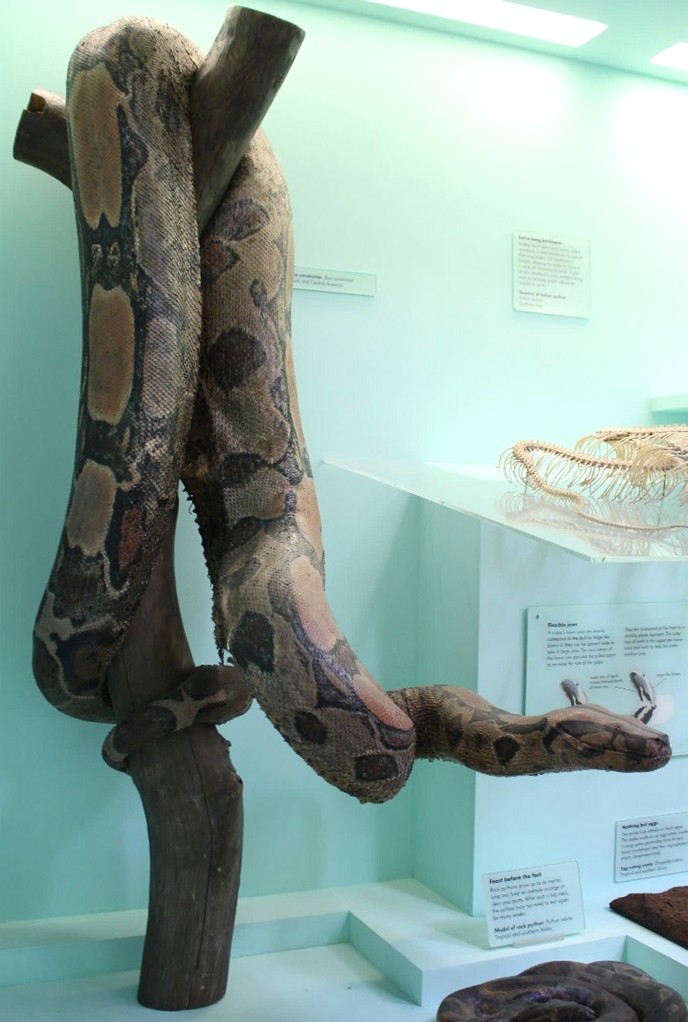
Boa Constrictor in Fishes, Amphibians and Reptiles Gallery at NHM ©The Trustees of the Natural History Museum

A Boa Constrictor on display in the Fishes, Amphibians and Reptiles Gallery at the Natural History Museum in London, UK was removed to undergo a considerable amount of remedial conservation treatment.

The taxidermy skin, dating from around the late 19th century, is mounted over a plaster form that was placed onto a wooden trunk. The skin exhibited severe deterioration with multiple splits in various areas located throughout the length of the specimen. The entire ventral seam had opened along with skin distortion and lifting around the splits without any stitched seam to hold it in situ. Most of the damage was at the ventral area of the specimen but some splits and distortion were visible whilst on display, along with material shed on to the case base.

Continue reading

Moving a ‘Monster’ – the Ups and Downs of Exhibiting a Japanese Spider Crab

Written by Hannah Clarke – Assistant Curator (Collections Access), University of Aberdeen.

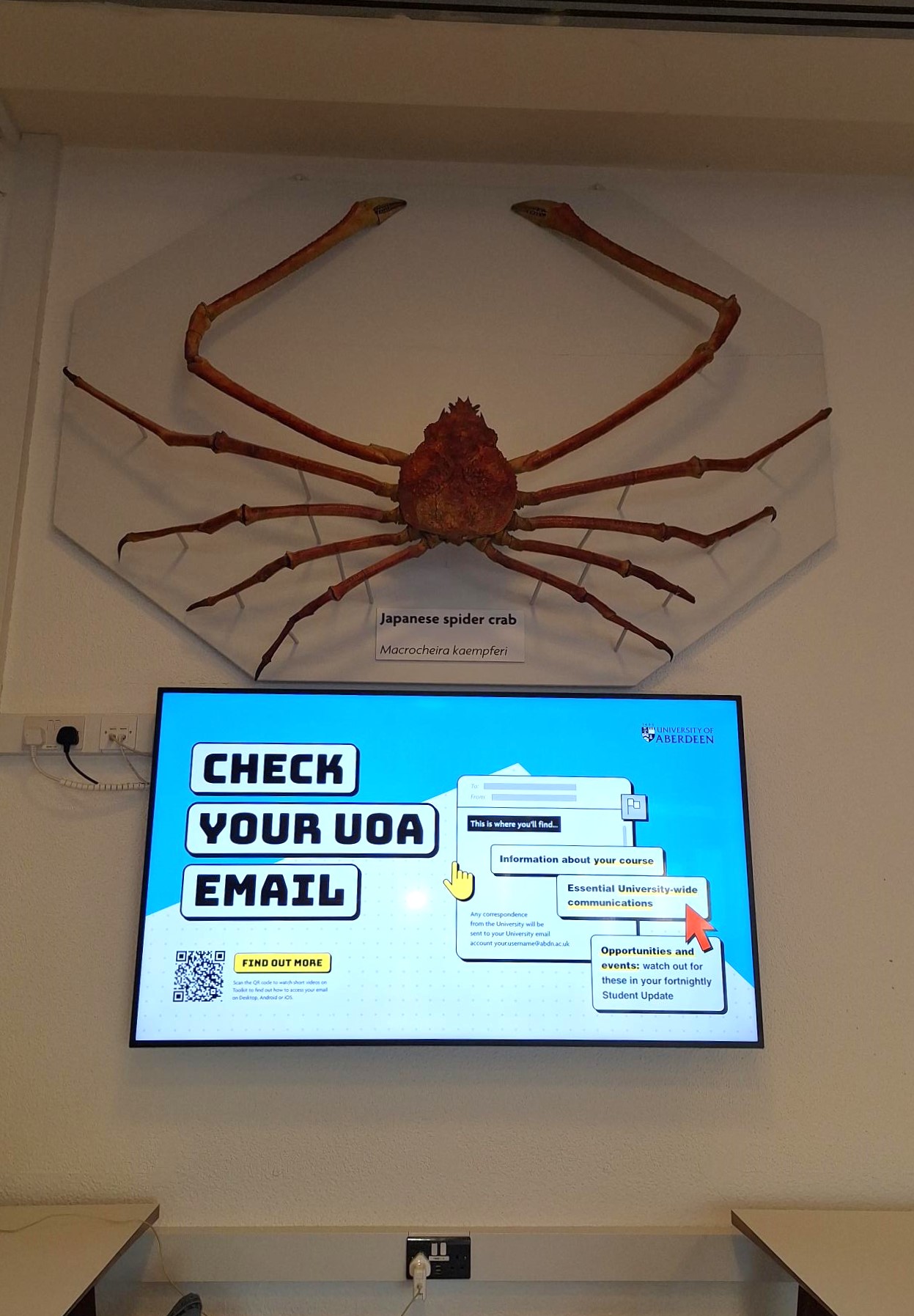
In May this year, I was given the slightly terrifying task of overseeing the removal and transportation of Aberdeen University’s much-loved Japanese Spider Crab (Macrocheira kaempferi) specimen. The crab, who is usually proudly displayed in the foyer of the University’s Zoology Building, had been requested for loan by Aberdeen Art Gallery & Museums, for their exciting new exhibition ‘Monsters of the Deep.’

The crab had previously been removed during renovation work in 2019, without hiccup, so recalling how ‘straightforward’ this had been last time, I was confident that we could get the crab removed, cleaned, packed, and ready for transport in just under three days.

Continue reading

NatSCA Digital Digest – June 2025

Compiled by Olivia Beavers, Assistant Curator of Vertebrate Zoology at World Museum, National Museums Liverpool.

Welcome to the June edition of NatSCA Digital Digest.

A monthly blog series featuring the latest on where to go, what to see and do in the natural history sector including jobs, exhibitions, conferences, and training opportunities. We are keen to hear from you if you have any top tips and recommendations for our next Digest, please drop an email to blog@natsca.org.

Sector News

NatSCA Annual Conference & AGM 2025 Recording 

On May 8th and 9th 2025, NatSCA hosted ‘Making a Difference: Showing the Positive Impact of Natural History Collections’, the 2025 NatSCA Conference at the Manchester Museum. This conference was recorded and can now be viewed online on our YouTube channel here.

Society for the History of Natural History Summer Meeting 2025 – online registration open

The SHNH are offering an online attendance option for this year’s summer meeting, ‘A Sense of Nature’ on 19th and 20th June 2025. Registration for in-person attendance has now closed.

The conference will explore the intersections of the senses – including sight (vision), sound (hearing), smell (olfaction), taste (gustation) and touch (tactile perception) – with the history of natural history. The programme will feature 12 papers across six sessions.

Continue reading

Packing the Blaschka Glass Models 

Written by Julian Carter, Principal Conservator Natural Sciences, Amgueddfa Cymru – Museum Wales, Cardiff

During the late 19th century, Leopold Blaschka (1822-1895) and his son Rudolf (1857-1929) produced thousands of beautifully detailed glass models of a wide range of sea creatures, and other animals, for natural history museums and aquaria all over the world. The work has since been hailed as “an artistic marvel in the field of science and a scientific marvel in the field of art”. The work of the Blaschka’s remains remarkably contemporary today, working as they did on the cusp of design, craft, and industry. Crossing the boundaries of science and art, the surviving models today have a value that makes them irreplaceable. 

The idea for making lifelike renditions of sea creatures out of glass arose from the difficulty of preserving and displaying soft-bodied animals such as jellyfish, marine worms, and sea anemones. Preserving such animals in a lifelike way is difficult as techniques such as fluid preservation cause colours to quickly fade and shapes to become distorted. Leopold Blaschka devised a solution to this problem by using his glass working skills to accurately model these animals out of glass and other materials available to him and went on to establish a successful business supplying glass models to museums worldwide during the latter half of the 19th century. 

The model of the sea anemone Actinia mesembryanthum (right) based on a plate (left) from Phillip Henry Gosse’s Actinologia britannica. A history of the British sea-anemones and corals which Leopold Blaschka used for the early sea anemone models that he built.
Continue reading

Conservation Matters in Wales – Christmas Conference 2023

Written by Sebastien Lherondel-Davies, 2nd year BSc student, Swansea University, whilst on placement at National Museum Cardiff and Swansea Museum.

On Wednesday 13th December 2023, conservators and curators from all over Wales gathered in Swansea for the first in-person Conservation Matters Wales Christmas Conference since the pandemic. Conservation Matters Wales is a collaboration between Amgueddfa Cymru – National Museum Wales, the Federation of Museums and Art Galleries in Wales, and Cardiff University. The event, hosted by the delightful Swansea Museum, was an opportunity for professionals in the museum collections conservation sector to come together and share the wide range of projects they have been working on. The conference provided us with the chance to present our research project on a historic Lepidoptera collection. 

Swansea Museum
Continue reading