The Curious Case of a Historical Seed Collection

Written by Hideko Yamamoto (former Volunteer, Natural History Museum, London) with input from Jovita C. Yesilyurt (Senior Curator, General Herbarium, Natural History Museum, London).

For centuries, a quiet corner of the Natural History Museum has concealed a secret: a previously undocumented historical seed collection. Hidden in locked cabinets, hundreds of small paper packets hold botanical specimens—and unanswered questions. This article offers a glimpse into this overlooked collection, the detective work behind its investigation, and the exciting possibilities that still lie ahead. The mystery remains unsolved—for now.

A Vast Botanical Treasure

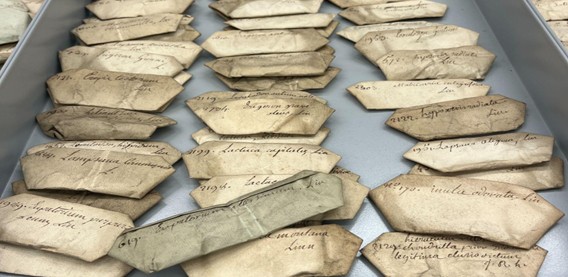
The Natural History Museum’s botany collection contains more than five million specimens gathered worldwide over 300 years. These range from herbarium sheets and carpological (fruit) collections to microscopic slides, wet specimens, and seeds (Fig. 1). Ideally, each specimen carries detailed scientific and historical information, allowing researchers to reconstruct past ecosystems, track species distributions, and study evolutionary and climate-related change over time.

Figure 1: Tray with one of the sets of the seed collections

Equally important is the historical context: who collected the specimen, under what circumstances, and how it entered the Museum. Such information brings collections to life, revealing the people, motivations, and networks behind scientific discovery. Yet many specimens lack this documentation. Among them are seed packets stored quietly in locked cabinets of the herbarium.

Continue reading

An Inspired Approach to Tail Repair: The Conservation of an Arctic Fox Mount

Written by Madalyne Epperson, Assistant Conservator, Milwaukee Public Museum (MPM).

The Milwaukee Public Museum (MPM), located in downtown Milwaukee, is Wisconsin’s natural history museum. It opened to the public in 1884 and houses more than four million objects. The Museum is currently undertaking a multi-year effort to pack its extensive collections and relocate to a newly constructed building, due to open in 2027. I joined the MPM team in September 2025 to prepare roughly two thousand objects for display in the new building, which will be called the Nature & Culture Museum of Wisconsin. One of my first assignments was to stabilize a full body arctic fox and ptarmigan predation mount.

Continue reading

The Life and Work of Botanist Catherine Muriel Rob – New Herbarium Exhibition at the Yorkshire Museum

Written by Anna Robson, Associate Collections Curator – Biology, York Museums Trust

A new foyer case exhibition titled ‘The Life and Work of Botanist Catherine ‘Kit’ Rob: An insider’s look at the Yorkshire Museum’s Herbarium’ is now on display at the Yorkshire Museum. This exhibition displays the herbarium in a new light, being one of the only times the museum has exhibited the dried plant specimens to the public. It is also a special exhibit of material from Kit’s personal paper archive which has been kindly loaned by the University of York’s Borthwick Institute for Archives.

The Yorkshire Museum’s herbaria contain thousands of specimens, with its origins in the Yorkshire Philosophical Society (YPS) which was founded near 200 years ago. The YPS herbaria was first catalogued by Henry J. Wilkinson, Honorary Curator of Botany (1892 – 1933), and is still used as a reference guide by researchers interested in the museum’s herbarium and by curators.

Continue reading

A New Generation of Bolton Field Naturalists.

Written by Lauren Field, Curator of Natural History, Bolton Museum

In 1895 The Borough of Bolton Botanical Society was formed. This group concerned itself, as the name implies, with botany alone but eventually a feeling emerged among naturalists in Bolton that other aspects of natural history should be covered.

On February 7th 1907 a group of keen local naturalists met at the Chadwick Museum (Bolton Museum’s first building). The group included members of the Botanical Society as well as ornithologists, entomologists and others representing natural history from astronomy to geology – from the heights of the sky to the depths of the earth.

They soon settled on the name Bolton Field Naturalists’ Society.

Continue reading

The Rediscovery of a Challenger Expedition Specimen in William Herdman’s Zoology Museum Collection at the University of Liverpool (and how digitisation is transformative).

Written by Leonie Sedman, Curator of Heritage & Collections Care, University of Liverpool.

Along with many other NatSCA members, I care for a mixed collection, meaning that one inevitably becomes something of a ‘Jack of all trades’ missing out on the academic satisfaction created by specialisation. As a curator who finds collections research to be the most satisfying part of my job, it can be frustrating when that research is often only possible on a ‘need-to-know’ basis – usually when a new display or exhibition is being planned, or when the specimens are to be used in teaching. Looking on the bright side though – this does provide glimmers of joy when the research produces something exciting!

In 2004 when I was first employed to manage the University of Liverpool’s Heritage Collections (medical & scientific museum collections built up through research or teaching), I retrieved a large proportion of the collections from attics and cellars where they languished because the objects and specimens were no longer actively used in teaching (this is now changing – but that would be a different blog). The Zoology Museum collection was one of these.

Continue reading