Planet Ocean: Using Local Collections to Celebrate Global Climate Action

Written by Sarah Marden, Curator of Natural History at The Box, Plymouth.

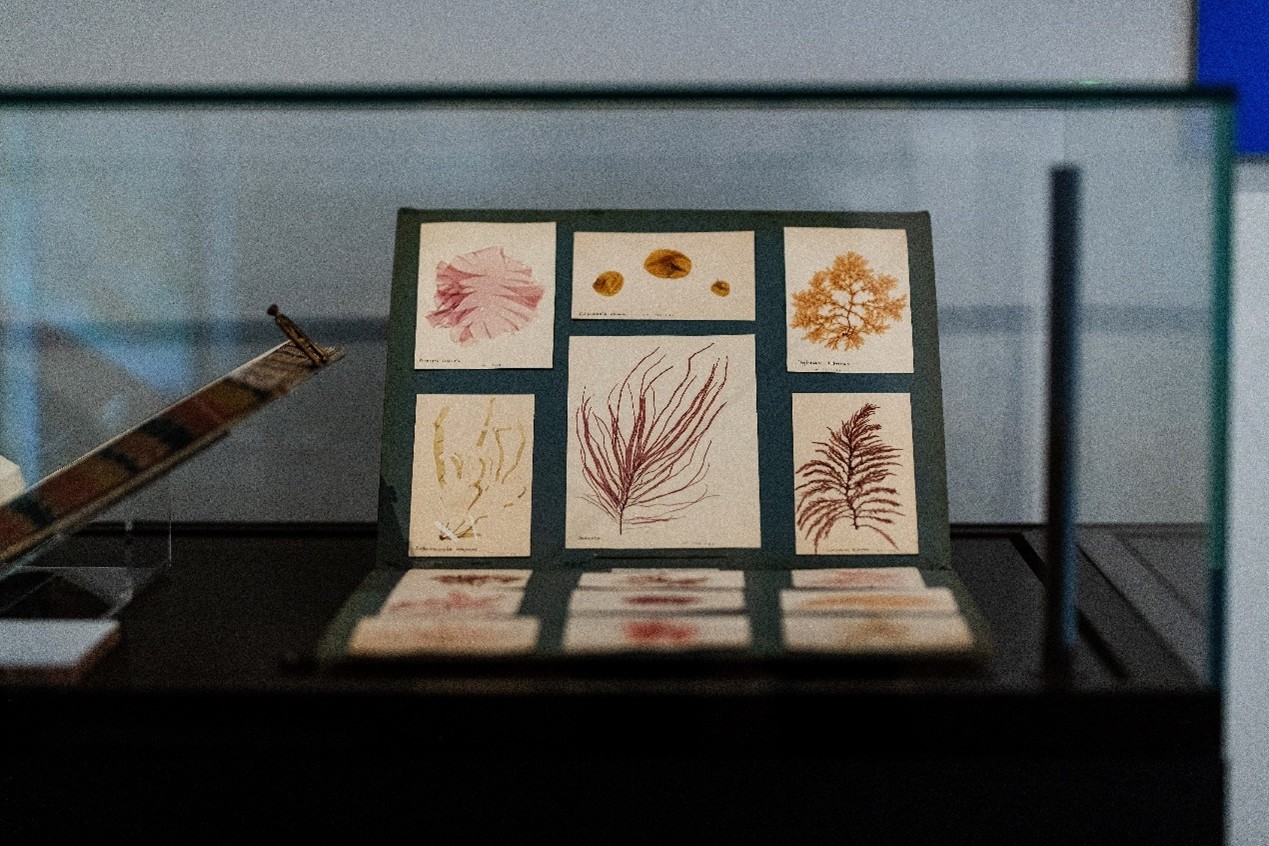
From March 2024 to April 2025, a new exhibition at The Box called Planet Ocean explored Plymouth’s marine heritage and contemporary identity as “Britain’s Ocean City”. Specimens from our natural history collections, including spirit-preserved marine invertebrates, molluscs, corals, mounted sea birds and seaweed folios were displayed alongside art, world cultures collections, image and film and loan material from local partners.

Flowers of the Sea folio by Emily Johns, © Dom Moore

Taking inspiration from science fiction writer and undersea explorer Arthur C Clarke who said “how inappropriate to call this planet Earth when it is clearly ocean”, we explored why the ocean is so important- the fact that we literally couldn’t survive without it as it gives us around half the oxygen we breathe, but also that it sustains and supports us locally with food, jobs, leisure, health and wellbeing. Alongside this quote, the entrance wall of the exhibition featured a moving graphic created collaboratively with Plymouth Marine Laboratory. It used one of the oldest datasets in existence of changing ocean temperatures recorded in Plymouth Sound. This data was input into a globe representing our ocean planet that changed and distorted according to the human impact of climate change over time. This was the first example of science meeting art and partnerships that we developed throughout the exhibition.

Continue reading

Top NatSCA Blogs of 2024

Compiled by Jen Gallichan, NatSCA Blog Editor.

2024 was a great year for the NatSCA blog and we have seen increases in both the number of readers and number of articles submitted. We are now reaching well over 2000 views per month. I want to take this opportunity to thank everyone who contributed an article. The NatSCA blog is driven solely by your contributions, and it is stands as a testament to all the hard work you are doing. I am pleased to say that the 2025 blog calendar is open for business, so drop me a line if you would like to contribute!

To celebrate all your wonderfulness, I am taking this opportunity to highlight the top 10 most read posts from 2024. This year’s line-up feels more diverse that ever, featuring a coelacanth, live dissections, radiocarbon dating, and fluid collections!

In descending order…

Continue reading

Unicorns and Baby Dolls: Narwhal Specimens in the Cole Museum.

Written by Amanda Callaghan, Curator/Director of the Cole Museum of Zoology at the University of Reading.

The narwhal Monodon monoceros is one of the rarest and oddest-looking whales. Cousin to the white Beluga whale, narwhal means “corpse whale” in Icelandic, (nar corpse and hvalr whale) a reference to its blotchy grey pallor1. Male narwhals (and a small number of females) have a canine tooth on the left-hand side of the upper jaw that grows through the upper lip into a long spiral “tusk.” The function of this strange tooth is unclear, but the horns are used for duelling or ‘tusking’ when the males compete for females.

From medieval times through to the 17th century, the legend of the mythical horned horse, or unicorn, was reinforced by the spectacular spiralling horns brought to Europe. Those observed live in the seas around Greenland and Iceland were known as “sea unicorns”2. Today, although we know they are not unicorn horns, there remains a fascination and high price for these rare and beautiful teeth.

Continue reading

Designated Status for Ipswich Museums’ Post-Cretaceous Geology Collection.

Written by Dr Simon Jackson, Collections and Learning Curator (Natural Sciences), Colchester + Ipswich Museums.

Ipswich Museums’ Post-Cretaceous Geology Collection, which includes our outstanding ice age collection, has been awarded Designated status by Arts Council England. The team here are delighted!

“OK, what exactly is Designation?” some of you may be thinking… Well, the scheme is administered by Arts Council England and identifies the pre-eminent collections of national importance held in England’s non-national museums, libraries and archives, based on their quality and significance. So, this award is a mark of distinction which is useful, for instance, in securing funding. If this has piqued your interest, and, for instance, you may be thinking “perhaps my collection is eligible for the scheme?” you can read more about Designation here: Designation Scheme | Arts Council England or my 2020 paper about the Tullie House bid I led on then, here https://www.natsca.org/article/2578 .

So, what’s been Designated at Ipswich? The Ipswich Post-Cretaceous Geology Collection includes c.30,000 specimens. The greatest strength of the collection includes Suffolk Plio-Pleistocene fossils, the remains of animals which lived during the Pleistocene ice age, and the warmer Pliocene before it. Suffolk has an outstanding Plio-Pleistocene record, with the only exposures of the Coralline Crag (Middle Pliocene) and extensive exposures of the Red Crag (the only exposed British deposit to document the transition into the ice age). The county’s deposits also document the dramatically changing environments of the ice age between warmer, wetter episodes (interglacials) and colder, drier episodes (glacials).  With pre-eminent collections covering this period, the collection now attracts international research, which, for instance, includes searching for the oldest mammoth DNA from Europe in c. 200,000 year old teeth from Suffolk – research led by the Centre for Palaeogenetics, at the Stockholm University and the Swedish Museum of Natural History, and the NHM). You can read more about the project here: https://cimuseums.org.uk/mammothdna/

Continue reading

‘Tom’ The Burlingham Bird

Written by Anthony Roach FLS (He/Him), Archives Assistant, Worcestershire Archive and Archaeology Service.

Whilst we do have some objects held at Worcestershire Archives, a mummified bird filed in a plastic pocket was a hugely surprising find all the same! The bird was ‘filed’ – its place as important as other key events in the history of Burlingham & Co., Evesham, a business, which from the late 19th century onwards was managed by Henry Burlingham.  

Image of the Burlingham bird when first discovered Ref 705.1373 BA12963.6.63 © WAAS

Either side of the mummified bird contains photographs of the Evesham premises charting its changing fortunes, a catalogue of products sold, adverts and circulars sent out to clients. Whilst Burlingham & Co. began as merchants and agents of a wide range of goods, including coal, their interests narrowed as sellers of construction materials, garden machinery, and fertiliser.

Close up of the Burlingham Bird Ref 705.1373 BA12963.63 © WAAS

I was excited by ‘The Burlingham Bird’ find and set about the challenge of learning more about it and also how best to conserve and safely store the specimen in our archives.

The Mummy Bird

Close up of image with text ‘Mummified seabird found in bag of Arabian Guano’ c.1957-8 Ref 705.1373 BA12963.6.63 © WAAS

As you can see it was described as ‘Mummified sea bird found in bag of Arabian Guano c.1957/8’  When I first examined it, I thought it most resembled either a cormorant or a shag having been used to seeing both around the coasts and estuaries in Devon. Having reviewed the different species found in Arabia using the image supplied with the bird and the morphology of the mummified bird itself, it most closely resembles the Socotra cormorant (Phalacrocorax nigrogularis) – endemic to the Persian Gulf and the south-east coast of the Arabian Peninsula.

Socotra cormorant – Phalacrocorax nigrogularis – Cornell Lab of Ornithology Macauley Library © Oscar Campbell
Continue reading