How ‘The Beetles’ Changed my Life

Beetles are one of the most successful groups of organisms on the planet. In the UK there are over 4000 species, compared to fewer than 600 wild bird species and around 90 mammal species. Beetles are critical to the health of many habitats, through their roles as feeders on plants and fungi, recyclers of animal and plant debris, and as predators.

When I first began volunteering with natural science collections at Plymouth City Museum, I occasionally assisted local entomologist Peter Smithers of Plymouth University, who regularly ran ‘Bug Hunts’ with schools around the Devon and Cornwall area. It was here that I came across some of my first beetles. In 2010, whilst walking along the South West Coast Path near the chalk cliffs at Beer, I found a black beetle with a vinyl-like sheen. It was beautiful, but unlike anything I had seen before. I later discovered that it was from a distinctive group called Oil Beetles (Meloidae), which possess one of the most extraordinary life cycles of any UK insect: they are nest parasites of solitary mining bees such as Andrena, Anthopora, and Lasioglossum.

After a female Oil Beetle lays her eggs in a nest hole, the larvae (known as triangulins) wait on a plant until they can attach themselves to a passing bee, using hooks on their feet. The larvae then eat the stored pollen and nectar in the bee’s nest. The strategy means minimal effort from the adult female in raising her young, and the larvae have all the food they need.

Black Oil Beetle (Meloe proscarabaeus)

Black Oil Beetle (Meloe proscarabaeus)

At the time of my discovery, Buglife was leading the way in trying to understand the state of Oil Beetle populations in the UK, which had suffered severe declines over the past 100 years. With four species believed to be extinct already, there was an urgent need to understand the distribution of the remaining Black, Violet, Rugged and Short-necked Oil Beetles. Buglife launched an Oil Beetle Recording Scheme to map their distribution and engage people of all ages through citizen science.

The survey results have enabled Buglife to learn more about the habitat preferences and hosts of the remaining species, and gain a better understanding of the health of the UK landscape, as Oil Beetles are restricted to wildflower-rich habitats, unimproved coastal grasslands, and woodland edges. Two species of Oil Beetle that were believed to be extinct in the UK have been re-discovered. The Short-necked Oil Beetle was found in South Devon in 2006, before a much larger second population was found on the Isle of Coll in Scotland in 2010. The rare Mediterranean Oil Beetle was found on the same Devon site in 2012, having been last recorded in Kent in 1906.

The efforts of Buglife, local recorders and naturalists have produced valid records to create time series of biodiversity data. Museum collections can also provide useful time series data for conservation efforts, based on specimen label data in terms of location and distribution in a given year. Where a species has been recorded in a particular place and time, we can perhaps find relic populations or sites for reintroduction.

Interior of the Angela Marmont Centre, NHM

Angela Marmont Centre, NHM

It was my interest in Buglife’s Oil Beetle recording scheme that led me to recently join the Natural History Museum’s Angela Marmont Centre for UK Biodiversity (AMC) as an Identification Trainee. The AMC provides world-class facilities in the museum’s Darwin Centre for citizen scientists, as well as expert and amateur naturalists, to enable them to identify UK species using the AMC’s extensive reference collections. Working here is brilliant, and I hope to be trained to identify the key UK biodiversity groups, gain more practical experience of surveying UK wildlife, assist the AMC team in developing citizen science projects based around museum collections, and continue to develop collections management experience through curatorial projects.


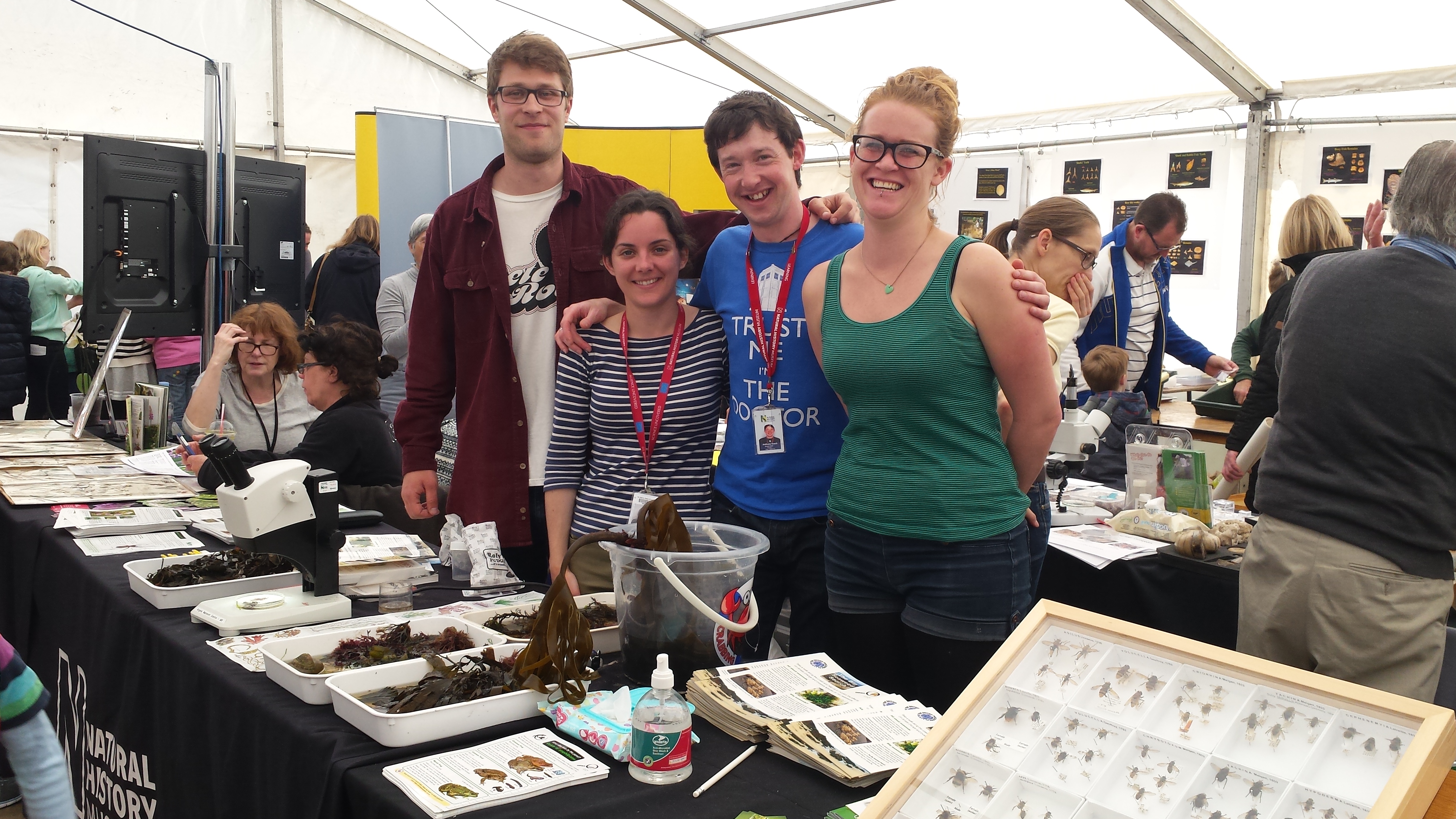
Anthony Roach
Skills for the Future Trainee & Science Educator
NHM


NatSCA Digital Digest

mothdigest

In the blogosphere

For those of us that missed the Progressive Palaeontology conference, Elsa Pancroft, aka Giant Science Lady, has done a great write-up of it. I urge you to take a look.

Delicious news for the GCG: The Geological Society are running their annual bake-off again this year. No lawyers were harmed in the making of these cakes, unless they forgot their oven mitts.


In the news

The appreciation of skeletal form is spreading: first Trafalgar Square’s Gift Horse, now the City of London Academy has unveiled a 13 metre chicken. If anything will stop a person eating meat it’s being killed by a giant chicken.


Conferences and Workshops

Today marks the first day of the Linnaean Society’s two-day Digitisation Seminar. I’m looking forward to hearing from people attending, as it fits quite nicely into this year’s NatSCA Conference theme. Also really looking forward to seeing you all there.


Content assembled by Samuel Barnett

Understanding Museum Taxidermy: Construction, Care and Commissioning

Taxidermy, the art and science of preserving an animal by placing the skin around an artificial body, has always been an important part of natural history collections. During the Victorian era, explorers would bring large and exotic animals back from their long voyages: the mounted skins would be displayed, enthralling the Victorian public, who had never seen creatures such as gorillas and giraffes before. While we thankfully no longer hunt and kill animals for display in museums, taxidermy is still as important as ever for teaching about the natural world – probably more so now as more and more species are threatened with extinction. While there has been a resurgence in the popularity of taxidermy, it is still the case that the number of experts capable of producing and preserving taxidermy is dwindling (in the UK, at least). With this in mind NatSCA, in association with Lancashire Conservation Studios, ran a day of talks and hands-on sessions, entitled ‘Understanding Museum Taxidermy: Construction, Care and Commissioning’, on the 1st April.

The day was led by Lucie Graham, Natural History Conservator at Lancashire Museums. Lucie began by demonstrating how taxidermy can be prepared using a wide variety of different methods, with internal moulds being formed from wood wool, balsam carvings, plaster and more. Taxidermy is an art, and each artist has their own methods. Lucie then went on to discuss how taxidermy can fall into disrepair if not properly cared for or prepared in the first place. We were able to get a close look an assortment of suffering taxidermy from Lancashire Museums, and discuss how we might treat each one to allow it to be better used and conserved. We had an adorable fox cub on our table, which had suffered from some fading, surface dirt and some loose digits on one paw. A bit of a clean and some adhesive to fix the paws, and this little cub could be looking much better!

taxidermy day3

Next we went through to the conservation lab for some cleaning demonstrations, where many of us were amazed to find out that simple cosmetic sponges get thick dirt off taxidermy effortlessly! We were also shown how to preen and straighten the feathers of a taxidermy bird, using steam to ease the process.

taxidermy day2

Finally were talks from a couple of the country’s leading taxidermists. James Dickinson discussed how museums can go about commissioning taxidermy. The Guild of Taxidermists can offer lists of accredited practitioners, ensuring that museums are able to make informed decisions and seek the services of the best person for the job. Jack Fishwick, judge at international taxidermy competitions, showed us a sample of his vast collection of bird photographs, which he uses for inspiration and feel for a bird’s shape and movement in life – vital for producing realistic taxidermy. The day finished with passionate discussion about the shrinking pool of skilled taxidermists – Jack and James warn that we may have no dedicated taxidermists left within the next two decades, which could be a disaster for museums wishing to expand and preserve their collections.

Glenn Roadley
Natural Science Curatorial Trainee

A Tale of Two Playing Cards

The Museum Ethnographers Group conference is being held on Monday and Tuesday at the excellent Powell-Cotton Museum in Kent. The theme is ‘Nature and Culture in Museums’, and the relationship between the two.

I am a zoologist by background, but for the last three years I have been immersed in a different world, working on a review of the Anthropology collections at the Horniman Museum and Gardens. I have learned an enormous amount about material culture from all over the world, seen some incredibly stunning objects, and been surprised by how relevant my Natural History knowledge has been. Many of our objects are made of animal materials, and it’s been a great opportunity to learn new skills in identifying ivories, bone, and antler. Only a few weeks ago I was very excited to be able to identify an Inuit flint-sharpening tool as being made of mammoth ivory!

I have also been asked to add taxonomic data to some Anthropology object records in our Collections Management System, so that we can record the species that are represented by objects. This provides richer contextual data, and links between objects that can be navigated on our website.

Victorian playing cards featuring exotic species (Horniman Museum & Gardens)

Victorian playing cards featuring exotic species (Horniman Museum & Gardens)

One such group of objects is this set of Victorian playing cards. They are cute: on one side is a cryptic clue to the identity of an animal, and on the other is an illustration of that animal. I didn’t anticipate how much the taxonomic information would add to our understanding of the objects, or that it would enable them to tell a story about discovery and extinction…

Two cards in the pack, together, tell this tale. The first is the ‘Black-diver’:

Black-diver playing card (Horniman Museum & Gardens)

Black-diver playing card (Horniman Museum & Gardens)

Mounted Great Auk specimen (Horniman Museum & Gardens)

Mounted Great Auk specimen (Horniman Museum & Gardens)

Which is actually a Great Auk (Pinguinus impennis). I have never heard ‘black diver’ used as a common name for this bird, but the likeness is unmistakable. The last recorded sighting of this species is from 1852, following the death of the last individuals to be shot, in 1844. I was intrigued to see this species represented in the pack, and was left wondering whether any of the Victorian children who played with the cards had ever actually seen a live Auk.

A second card could potentially hold the clue to this:


Reverse of animal playing card (Horniman Museum & Gardens)

Reverse of animal playing card (Horniman Museum &Gardens)

Gorilla playing card (Horniman Museum & Gardens)

Gorilla playing card (Horniman Museum & Gardens)

The Eastern Lowland Gorilla (Gorilla beringei) was not described until 1903, so it seems much more likely that this card represents the Western Gorilla (Gorilla gorilla), described in 1847.

The date of the discovery of the Western Gorilla, combined with that of the extinction of the Great Auk, could potentially narrow down the date at which these cards were made enormously: there is only a five-year period in which both species were known to exist together, between 1847 and 1852. However, the actual date of manufacture could be much later: following their discovery, gorillas were incredibly popular with the public for many years, particularly in the 1860s after the publication of Darwin’s Origin of Species in 1859, and the first live specimen reached a European zoo in 1876. ‘The Auk’ was taken as the title of the American Ornithologists’ Union’s journal, founded in 1884. So the Great Auk was clearly still in the public consciousness long after its extinction. Given this information, it seems quite possible that the original owners of the playing cards may never have seen either species in the flesh!

But that is as far as my research has taken me for now. This is a story that I hadn’t expected to find in these objects. As museum professionals, we are custodians of more than just collections: we are the keepers of specialist knowledge that we use to interpret our collections, to tell stories that will engage our audiences. Sometimes, to find their stories, you need to look at objects from more than one perspective. By working across disciplines and sharing our expertise, we can find new tales and new ways to tell them.


Rachel Jennings
Documentation Assistant, Horniman Museum and Gardens

NatSCA Digital Digest

Hectors swallowtail butterfly extracting nectar from a flower. © Cláudio TimmWelcome to the weekly digest of interesting things from around the web with relevance to natural science. We hope you find this useful and if you have any articles of interest, please contact us at blog@natsca.org

1. Blog: Crime scene micropalaeontology

Natural History Museum, London

Synopsis

‘Micropalaeontological evidence is increasingly being used to solve major crimes. Read on to find out about [curator of micropalaeontology] Steve’s involvement in Crime Scene Live, how our collections could help forensic studies and how our co-worker Haydon Bailey gathered some of the evidence that was key to convicting Soham murderer Ian Huntley’- Giles Miller

Click here to read the whole blog.

2. Museum altruism: Trip Advisor

Anyone, anytime!

Synopsis

Now that the sunshine is here (I hope I don’t jinx it by writing that) potential museum visitors will be looking ahead at inspiration for how to spend their weekends, days off, school holidays, etc. In this day and age it seems the way to find such inspiration is on websites such as Trip Advisor, on which you can read other people’s reviews of places they have visited. Obviously popping on a review of your own collection, if you work in one, would be a bit naughty, but if you have been anywhere else lately, why not help their visitor numbers out by inspiring people to visit too?

Click here to find out more.

3. Now open: Sensational butterflies at the NHM

2nd April to 13th September

Synopsis

It’s back for another summer of beautiful live insects, screaming kids and irritated academics in the offices above. Sensational butterflies in the garden of the Natural History Museum London is now open, complete with exhibition trail, and is well worth a look.

Click here for more details


Compiled by Emma-Louise Nicholls, NatSCA Blog Editor