NatSCA Digital Digest – February

Compiled by Glenn Roadley, NatSCA Committee Member, Curator of Natural Science at The Potteries Museum & Art Gallery.

Welcome to the February edition of NatSCA Digital Digest.

A monthly blog series featuring the latest on where to go, what to see and do in the natural history sector including jobs, exhibitions, conferences and training opportunities. We are really keen to hear more about museum re-openings, exhibition launches, virtual conferences, webinars, and new and interesting online content. If you have any top tips and recommendations for our next Digest please drop an email to blog@natsca.org.

Where to Visit

There are plenty of things to see and do online this February. Throughout 2021, the Science Museum is running a series of Climate Talks, with three taking place this month on the 13th, 15th and 12st and previous talks available to watch via the Science Museum website.

National Museum Cardiff is hosting an online Dino Nights sleep-over event for children, including fort-building and a torch-lit tour with a dinosaur expert.

For those wanting to use the time at home to brush up on some natural history ID skills, the Tanyptera Trust are continuing their series of webinars, with events in February focussing on nocturnal ichneumonoid wasps and centipedes.

And just missing February, but pre-dating our next Digest, the Museums Association will be hosting a Climate Crisis event for members on March 3rd, part of their Coronavirus Conversations series.

The last of our NatSCA blogs covering the NatSCA Decolonisation Conference have now been published, completing the series. The whole conference is now available to watch any time for free via YouTube, so be sure to catch up with these powerful talks if you’ve not yet had the chance.

Register now for this ONLINE DAY MEETING 10.00–14.00 FRIDAY, 12 MARCH 2021.
This meeting will bring together researchers from different disciplines (natural sciences, evolutionary biology, philosophy, history of science and gender studies) to discuss ‘race’ and ‘sex’ in Linnaeus’ work and beyond.
This event will take place online using Zoom webinar.
  • Ticket price is £5 for Fellows, Associates and Student Members / £10 for the general admission
  • Registration is essential, and will close 24 hours before the event is set to begin

Continue reading

Chill Out: A Cautionary Note On The Use Of Aqueous Treatments On Taxidermy

Written by Lu Allington-Jones, Senior Conservator at the Natural History Museum, London.

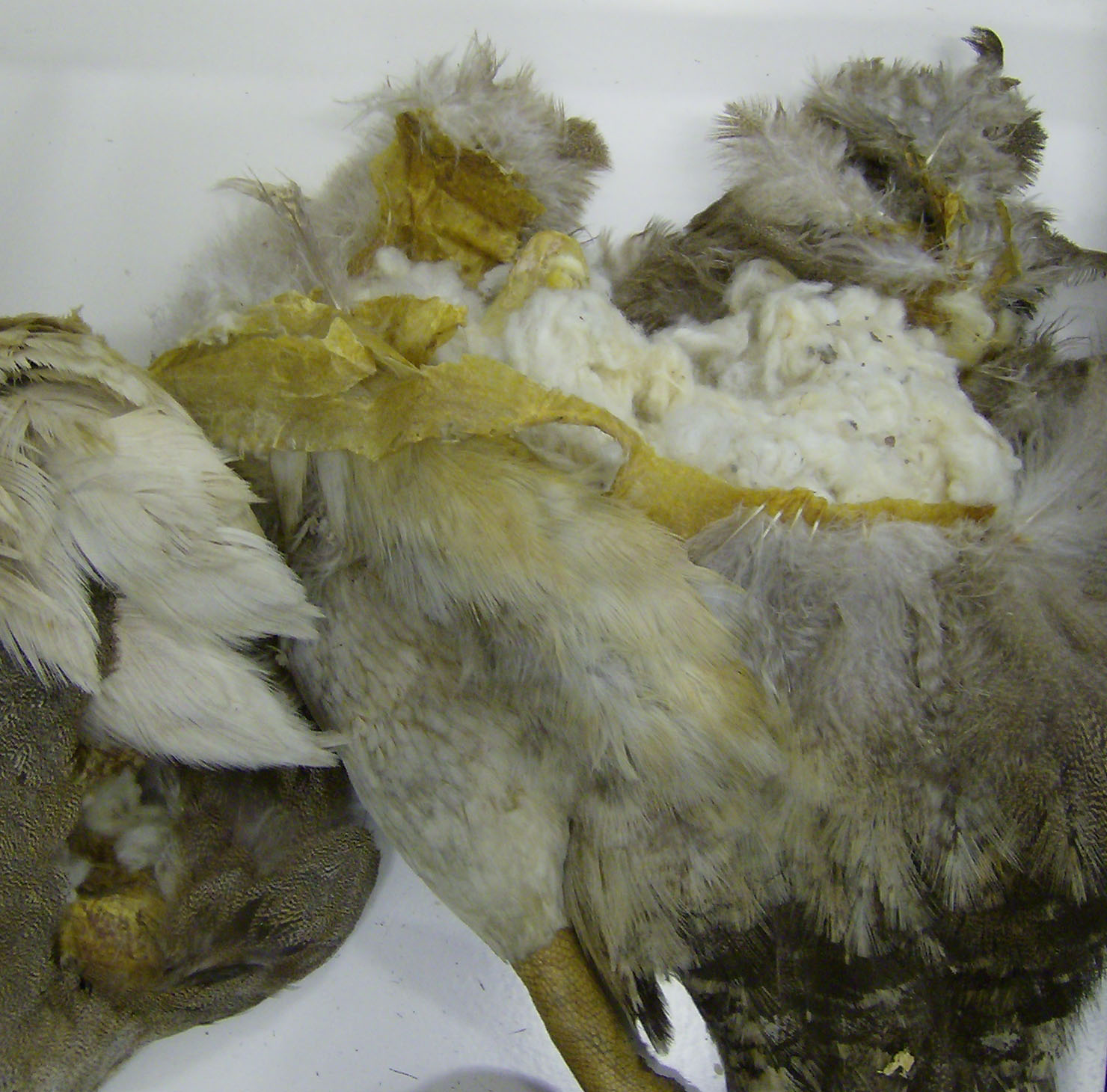
Whilst trying (not very successfully) to find a “cure” for fat burn (Figure 1), I made an unwelcome discovery: sometimes the shrinkage temperature of deteriorated skin is actually lower than room temperature. This means that the skin will irreversibly shrink as soon as any water-based treatments are applied.

Figure 1. Fat burn can cause skin to rip and specimens fall apart

Shrinkage temperature (Ts) is commonly used in leather conservation to determine the level of deterioration, and the effectiveness of treatments. Ts is the temperature at which 2 corian fibres immersed in water show simultaneous and continuous shrinkage activity. It shows the level of deterioration because it indicates destabilisation of collagen fibres. Ts of fresh skin is 65oC and in deteriorated leather this can be reduced to 30oC (Florian, 2006). Ts is measured by immersing samples of leather (or skin) in water and gradually increasing temperature until shrinkage activity is observed under a microscope (Larsen et al. 1996; Vest & Larsen, 1999). Continue reading

Ally Skills 101: Why Allies?

Presented by Hao Ye, University of Florida & Molly Phillips, Florida Museum of Natural History, iDigBio.

Abstract

Natural science collections are, by their nature, collaborative and cumulative, and benefit from the inclusion of diverse people with diverse experiences and backgrounds. Yet many of us recognize that our workplaces, and STEM at large, are not welcoming to all, even after decades of efforts. It is increasingly clear that one of the challenges is that we lack training in turning our shared values into action. In this talk, I will introduce ally skills as a path to change. An ally is a member of a social group that enjoys some privilege that is working to end oppression and understand their own privilege (Frame Shift Consulting). We introduce ally skills via workshops offered by the Gainesville Ally Skills Network. In these workshops we teach people how to recognize when they have power and influence to act as an ally and take effective action to make their workplace more inclusive.

Continue reading

Bill Pettit Memorial Award 2021

Written by David Gelsthorpe, Manchester Museum.

Do you have a great project in mind that supports the conservation, access and use of natural science collections? Well, NatSCA’s Bill Pettit memorial grant for up to £3000 is here to help!

We are looking for applications for exciting new projects for 2021. Terms and conditions and contact details to discuss your project can be found on our Awards and Bursaries page.

To apply please fill out the application form.

Projects previously supported:

2020/2021:

The Last Passenger: Conservation of the SS Great Britain Cormorant Skeleton (Awarded £1424)

Curating, Digitising and Displaying a Unique Historic Odontological Collection (Awarded £2100)

2019/2020:

University of Liverpool Zoology Redisplay Project (Awarded £1840)

Leo Conservation Project (Awarded £1105)

Continue reading

#NatSCAConservation Twitter Conference

Written by Lucie Mascord, NatSCA committee conservation representative.

During the week of the 18th January 2021 NatSCA will be hosting their first ever Twitter conference all on the subject of conservation.

Following on from the success of our inaugural conservation conference “Caring for Natural Science Collections” held at Oxford University Museum of Natural History back in October 2018, the NatSCA conservation working group had hopes of another conference this year. However, it was not to be, so we are changing the format and coming to you in 2021!

The attendees of the “Caring for Natural Science Collections” one-day conference at Oxford University Museum of Natural History in 2018. ©Bethany Palumbo @bethany_bug

Given how strange this year has been we are keeping it simple. Just follow us on the week of 18th January (programme with exact dates and times to follow) on the hashtag #NatSCAConservation and we will bring the unique world of natural science conservation to you for free! Join us for this great opportunity to explore conservation work relating to the range of natural materials including bone, taxidermy, fluid preserved collections, geology, botany and entomology.

Continue reading