The ‘Social History of Natural History: People and Plants’ Workshop One

March 11th 2022, Powell-Cotton Museum

Written by Alexandra Slucky (Assistant Heritage Consultant & Environmental Archaeologist, Atkins, York Office) and Fiona Roberts (Collaborative ESRC PhD student, Cardiff University & Amgueddfa Cymru-National Museum Wales).

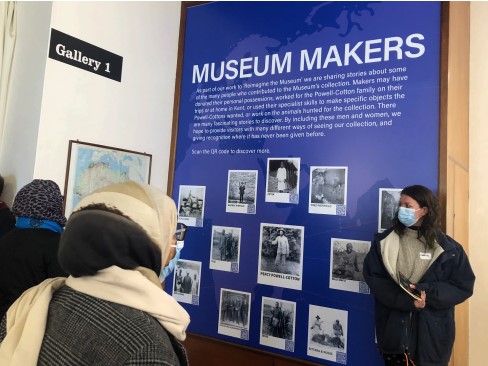
Decolonizing collections has been at the forefront of museums for quite some time. Thinking beyond the Western museum structure, many institutions have taken new opportunities to view indigenous knowledge from indigenous perspectives by revisiting old collections of anthropological material intermixed with botanical specimens. Four years in the making, Workshop One is part of a one-year project called People and Plants: reactivating ethnobotanical collections as material archives of indigenous ecological knowledge, beginning in January 2022. It is led by National Museums Scotland, Royal Botanic Gardens, Kew, and the Powell-Cotton Museum, and funded by the Arts and Humanities Research Council (AHRC).

Entrance to Powell Cotton Museum, Birchington-on-Sea, England, Photo by Alexandra Slucky

The main aim of the project is to engage with three unique indigenous collections located in UK institutions; Somalian, Amazonian, and Aboriginal Australian. The project examines the value and relevance of ethnobotanical collections, both in the present and the future, aiming to bring academics, researchers, museum professionals, botanists and indigenous knowledge holders together in conversation. To focus on sharing authority, it gives a museum voice to women of colour through a process of reactivation, recovery, and relationships, with the result creating more inclusive conditions for future collections.

Continue reading

Digital Digest – April 2022

Compiled by Milo Phillips, Assistant Curator of Entomology for Leeds Museums and Galleries.
Welcome to the April edition of NatSCA Digital Digest.

A monthly blog series featuring the latest on where to go, what to see and do in the natural history sector including jobs, exhibitions, conferences and training opportunities. If you have any top tips and recommendations for our next Digest please drop an email to blog@natsca.org.

Sector News

SPNHC / BHL / NatSCA Conference 2022

This summer will see the return of the physical NatSCA Conference – a partnership with the Society for the Preservation of Natural History Collections and the Biodiversity Heritage Library. Early Rate registration has now closed but a Late Rate registration fee is still available, with NatSCA members eligible for the Standard Member rate. The programme of events is now available to view.

NatSCA Lunchtime Chats

The new lunchtime chats are for members only and run on the last Thursday of every month. In our last session we heard from Mike Rutherford, Curator of Zoology and Anatomy at the Hunterian in Glasgow all about their investigation of a sperm whale that washed up in Thailand.

In this month’s talk we’ll be having a discussion about upcoming openings on the board of trustees for NatSCA (i.e. the committee), so please join us if you’d like to learn more about what we all do. There will be specific roles opening up so departing trustees will be explaining in more detail what those involve, but there will also be general positions available. Any NatSCA member is eligible to become a trustee; no previous experience or length of time as a member is a requirement, just an enthusiasm for supporting the work of the association. We welcome and encourage all applicants and we are particularly keen to receive nominations that help us represent the diversity of our membership, at trustee level.

Continue reading

NatSCA Digital Digest – March 2022

Compiled by Olivia Beavers, Assistant Curator of Natural Science at The Potteries Museum & Art Gallery.

Welcome to the March edition of NatSCA Digital Digest.

A monthly blog series featuring the latest on where to go, what to see and do in the natural history sector including jobs, exhibitions, conferences and training opportunities. We are really keen to hear more about what you are getting up to, exhibition launches, virtual conferences, training, webinars, and new and interesting online content. If you have any top tips and recommendations for our next Digest please drop an email to blog@natsca.org.

Sector News

SPNHC / BHL / NatSCA Conference 2022

This summer will see the return of the physical NatSCA Conference – a partnership with the Society for the Preservation of Natural History Collections and the Biodiversity Heritage Library. Early Rate registration is now open until April 8th (after which the Late Rate fee will apply), with NatSCA members eligible for the Standard Member rate.

The programme of events is now available to view.

NatSCA Lunchtime Chats

The new lunchtime chats are for members only and run on the last Thursday of every month. Paolo Viscardi’s talk: Decanting the Dead Zoo, gave us an amazing and informative insight into how the team at the National Museum of Ireland Natural History moved thousands of specimens (from whales and Giant Deer to fragile Blaschka models) to enable work for the conservation of their roof to begin. The next talk: ‘Investigation of a Sperm Whale that washed up in Trinidad’, will be hosted by Mike Rutherford, Curator of Zoology and Anatomy at The Hunterian in Glasgow on Thursday March 31st 2022, 12:30-13:30.

Continue reading

NatSCA Digital Digest – January 2022

Compiled by Claire Dean, Preventive Conservation student, Northumbria University & placement student at Tullie House Museum and Art Gallery, Carlisle.

Welcome to the January edition of NatSCA Digital Digest.

A monthly blog series featuring the latest on where to go, what to see and do in the natural history sector including jobs, exhibitions, conferences and training opportunities. We are really keen to hear more about what you are getting up to, exhibition launches, virtual conferences, training opportunities, webinars, and new and interesting online content. If you have any top tips and recommendations for our next Digest please drop an email to blog@natsca.org.

Sector News

There’s still time to submit to SPNCC 2022. ‘Through the door and through the web: releasing the power of natural history collections onsite and online’ will take place from 5th to 10th June in Edinburgh and the deadline for abstracts is 28th January. You can submit your abstract to the open symposia or under the general theme. Full details here.

Continue reading

Creating the River Otter Beaver

Written by Jazmine Miles Long, Ethical Taxidermist, Artist, Educator and Natural History Restorer, https://www.jazminemileslong.com, Twitter: @TaxidermyLondon; Instagram: @Jazmine_miles_long

Jazmine with the River Otter Beaver in process

In April 2019 Holly Morgenroth (Collections Officer at The Royal Albert Memorial Museum) gave me a call to say she had acquired a dead beaver that was in good condition for taxidermy. This was significant because this beaver was part of the River Otter Beaver Trial. All deceased beavers should now be sent to the Zoological Society of London for medical autopsies, which means they are usually not in good enough condition for taxidermy after the procedure. This particular beaver, originally from a population of beavers in Scotland, had been introduced to the River Otter in April 2019 to expand the gene pool of the population. Sadly she was found dead – it is possible she drowned in salt water as there were no visible injuries from conflict or a road traffic accident. Devon Wildlife Trust decided she did not need a post mortem and very kindly handed her over to Holly at the museum. Holly jumped at the opportunity and expertly packed her into a large plastic tub and placed her in the museum’s chest freezer and got to work obtaining funding to have her processed into taxidermy and a full skeleton.

Continue reading