Addressing Biodiversity Loss and Climate Change Together: A Great Opportunity for Museums with Natural History Collections

Written by Henry McGhie, Curating Tomorrow, henrymcghie@curatingtomorrow.co.uk

This year has seen not one but two ‘COPs’ (Conference of the Parties), the big meetings where governments monitor their progress towards international agreements. In early November, COP16 for biodiversity was held in Cali, Colombia. In the second half of November, COP29 was held in Baku, Azerbaijan. These big meetings get a lot of press attention, but they are rather poorly understood and are not always reported that well. If you think the COPs are where the leaders of the world get together to hammer out the world’s future, the reality is much more humdrum. By the time countries gather together, they have usually made up their minds on their negotiating positions and not much will change from there on. COP has also become too big and has many ‘layers’ to it. For the climate COPs, there is the Blue Zone, which you need to get a special accreditation to enter (referred to as a ‘badge’), and within that there will be really big plenary events and smaller side events that everyone with a badge can attend. There are also lots of negotiations taking place, inside rooms, that you often can’t access as well as a mass of pavilions, mostly from countries and in some years, businesses. Outside the Blue Zone, there is a public-facing Green Zone that the public can access (sometimes it is in a museum, as it was in 2021 when it was in Glasgow Science Centre). When the climate COP is on there is also a lot of activity going on outside of COP itself, mostly organized by civil society groups, and also by businesses. So, when people say they’ve ‘been to COP’ it can mean a few different things.

Continue reading

NatSCA Digital Digest – August

Compiled by Ellie Clark, Collections Move Team Leader at the Natural History Museum

Welcome to the August edition of NatSCA Digital Digest.

A monthly blog series featuring the latest on where to go, what to see and do in the natural history sector including jobs, exhibitions, conferences, and training opportunities. We are keen to hear from you if you have any top tips and recommendations for our next Digest, please drop an email to blog@natsca.org.

Sector News

Registration is now open for the 13th European Bird Curators Meeting, October 2024, in Liverpool.

The European Bird Curators Meetings aim to promote cooperation, dissemination of best practices and new techniques in the curation, management, and use of bird collections. Presenters in the scientific programme often include curators, collection managers, museum historians and ornithological researchers. These are friendly meetings and anyone with an interest is welcome to join us.

The meeting will include plenary and submitted presentations, discussion sessions, collections tour, conference dinner (optional – Tuesday 29th October) and field excursion (optional – Thursday 31st October). 

Please follow the ‘Tickets available here’ link from the event webpage to register. They have single day registration options and have kept costs as low as possible to encourage attendance by local natural history curators. 

If you have any questions, please email vertebratezoology@liverpoolmuseums.org.uk.

Continue reading

NatSCA Digital Digest – June 2024

Compiled by Olivia Beavers, Assistant Curator of Vertebrate Zoology at World Museum, National Museums Liverpool.

Welcome to the June edition of NatSCA Digital Digest.

A monthly blog series featuring the latest on where to go, what to see and do in the natural history sector including jobs, exhibitions, conferences, and training opportunities. We are keen to hear from you if you have any top tips and recommendations for our next Digest, please drop an email to blog@natsca.org.

Sector News

From Collections to Connections, May – November 2024

This Changing Chalk commission/ Natural Trust funded project is a collaborative archival art and environment initiative. Artist Pauline Rutter invites Black and minoritised young people, their families and communities to explore the rich history of flora and fauna across several locations of the Changing Chalk area within the South Downs National Park.

‘From Collections to Connections’ offers opportunities for learning and sharing about collections held at the Booth Museum which relate to the Sussex locations of Mill Hill, Truleigh Hill and Devils Dyke. Through walks, talks and creative interventions, opportunities are provided for exploring the museum collections and their related histories. Individuals will be invited to find their own connections between these elements and their experiences within the natural and museum environments. To find out more, follow this link to the summary outline: https://drive.google.com/file/d/1cJQh4UYMTeRB_HqsM7EydOmNBLGKYQpb/view

Continue reading

Feeling Older than Your Age? The Importance of Museum Collections for Radiocarbon Dating, and a Request for Collections containing Bivalves Collected Before 1950 from the UK

Written by Rachel Wood, Associate Professor, Oxford Radiocarbon Accelerator Unit, School of Archaeology, University of Oxford.

Radiocarbon dating is routinely used to work out the age of archaeological and palaeontological sites, and often pops up in news articles and TV dramas. But some substantial problems remain. One of these is the calibration process, which allows us to convert the ratio of 14C (“radiocarbon”) and 12C (the common stable form of carbon) to an age estimate. This is particularly challenging when we are trying to date marine shells or any animal that has eaten food from the marine system. This means that it can be difficult for us to get an accurate age for a sample that should be straightforward – for example, the skeleton of Medieval person or a Mesolithic dog.

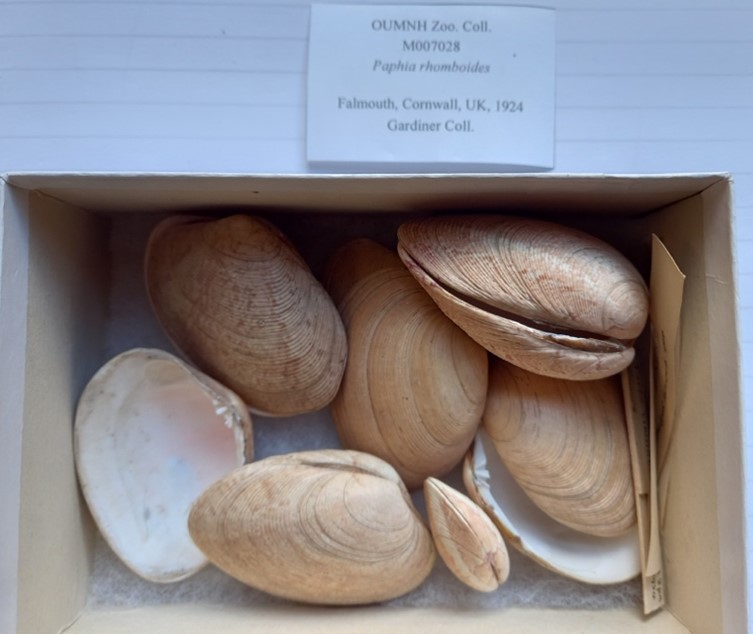
The Oxford Radiocarbon Accelerator Unit is starting a project looking for samples of marine shells to help resolve this problem (Fig. 1). Natural history collections in museums are key to its success, and we would be very grateful to hear if anyone has a collection of pre-1950 marine bivalve shells.

Figure 1. Marine bivalves, suitable for helping us to calibrate radiocarbon dates. Please let us know if you have similar material that can be analysed by sampling a small strip from the edge. (Photo Peter Ditchfield, Courtesy Oxford University Museum of Natural History)

The Problem

At school, we are taught that radiocarbon dating works because radiocarbon decays radioactively at a known rate. By comparing the amount of 14C to a stable form of carbon called 12C, we can work out the age of a sample (Fig. 2). This is true, but only partially so because the starting 14C:12C varies. To get around this problem, we need to calibrate radiocarbon dates. Most 14C is produced in the upper atmosphere, and is incorporated into plants by photosynthesis and then passed through the food chain. This means, that if someone is eating terrestrial food – they will have a similar 14C:12C ratio in their bodies as in the atmosphere.

Continue reading

Taxidermy and the Country House: Where Natural History Meets Social History – a review 

Written by Jack Ashby, Assistant Director of the University Museum of Zoology, Cambridge.

Pat Morris is the authority on the history of British taxidermy, and there is arguably no-one better to write an exploration of the specific context of taxidermy collected for and displayed in private country houses. Although their materiality is identical, by their nature, these collections are often conceptually very different – the antithesis, even – to those in public museum. These differences are not the focus of the book, nonetheless this perspective offers great potential to help us consider more roundly the story of taxidermy and those that made and collected it.

The similarities museum and country house collections do share include their origin-stories, and of course the practicalities of preserving specimens. Like museums, these private collections trace their histories back to cabinets of curiosities. Preservability was fundamental to what could be kept, and Morris begins by explaining that early cabinets of curiosities in country houses were mainly items that required no preservation – dry materials like shells and bone. The only skins that were widely kept were those that could be simply dried without being prone to insect attack, which is why durable specimens like taxidermy crocodiles, hollowed-out armadillos and inflated pufferfish were commonplace in these early collections, rather than the birds and mammals which later became the norm.

Continue reading