Reflecting on a Collections Move During the Pandemic, the Royal Horticultural Society Herbarium one year on.

Written by Clare Booth-Downs, Herbarium Curator, Royal Horticultural Society Herbarium.

Moving On Up, To Move On Out

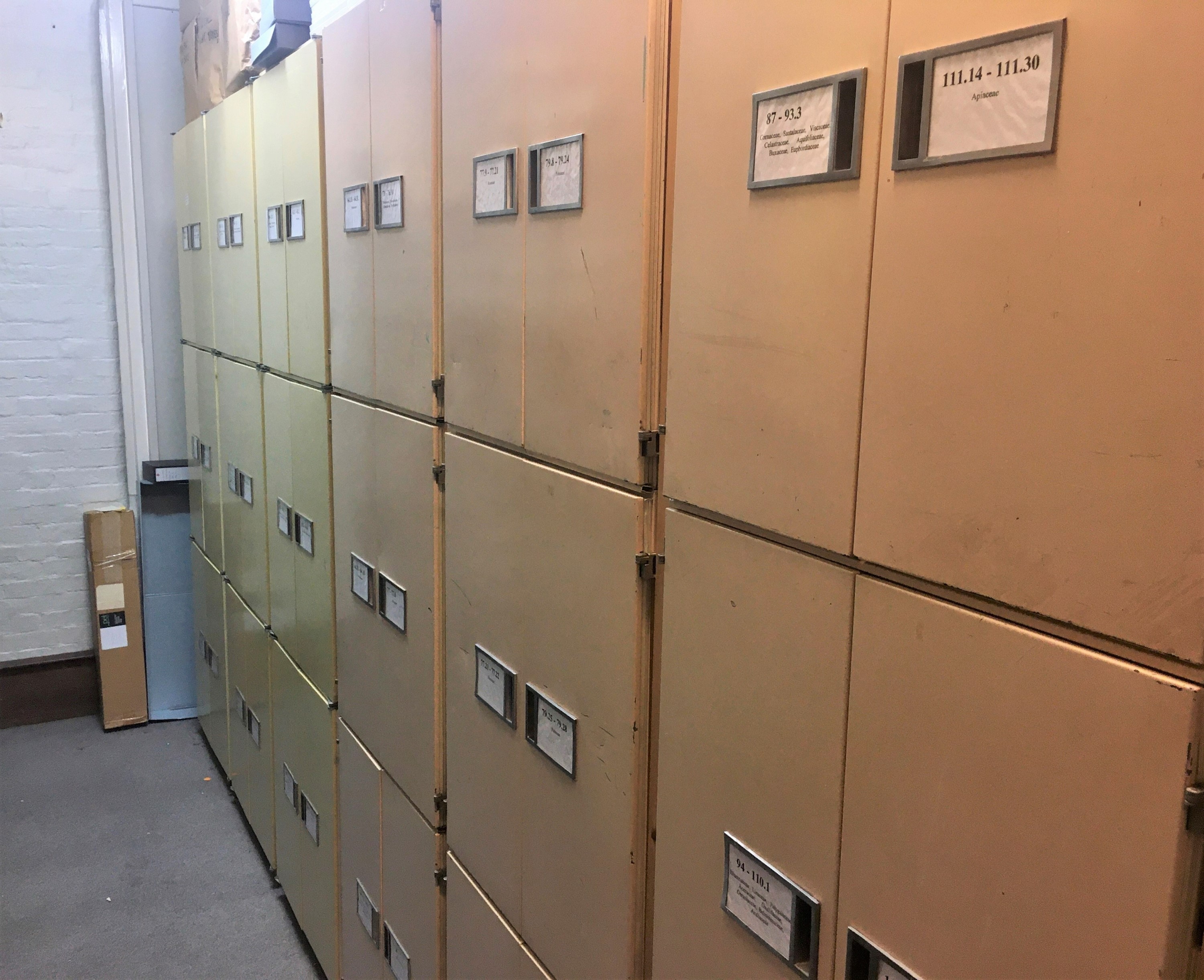
The Royal Horticultural Society Herbarium (RHS), which holds approximately 150,000 specimens and associated ancillary collections, had outgrown its original storage space.  The building of a new dedicated science and collections centre, RHS Hilltop, which opened in late June 2021, provided a solution to this. Hilltop, the home of gardening science, includes a larger, purpose built facility, the 1851 Royal Commission Herbarium.

The Laboratory, RHS Wisley, Surrey. Image by Clare Booth-Downs. © Royal Horticultural Society.
Interior of the original RHS Herbarium showing the overspill on top of the cabinets. Image: Yvette Harvey.

Increasing the capacity of the herbarium was vital as the collection is expected to expand at a fast pace over the next few years.  With a full time plant collector now in place, the RHS’ ultimate aim is to hold a specimen of every species and cultivar of garden plant growing in the U.K. It is estimated this will be a collection numbering 400,000 specimens by 2050.

This repository will act as a reference point for gardeners, breeders, students and researchers as well as for ‘non-traditional’ herbarium visitors, for example, artists and designers looking for inspiration for fabrics and jewellery.  This is alongside one of the Society’s own research foci, as described by Professor Alistair Griffiths, RHS Director of Science & Collections, “In the UK, we’ve got a massive diversity of cultivated plants, originating from around the world, and all have potential for nature-based solutions.  We’re going to work towards a database of the garden plants and their uses from an environmental, and health and wellbeing perspective”.

Continue reading

‘Tom’ The Burlingham Bird

Written by Anthony Roach FLS (He/Him), Archives Assistant, Worcestershire Archive and Archaeology Service.

Whilst we do have some objects held at Worcestershire Archives, a mummified bird filed in a plastic pocket was a hugely surprising find all the same! The bird was ‘filed’ – its place as important as other key events in the history of Burlingham & Co., Evesham, a business, which from the late 19th century onwards was managed by Henry Burlingham.  

Image of the Burlingham bird when first discovered Ref 705.1373 BA12963.6.63 © WAAS

Either side of the mummified bird contains photographs of the Evesham premises charting its changing fortunes, a catalogue of products sold, adverts and circulars sent out to clients. Whilst Burlingham & Co. began as merchants and agents of a wide range of goods, including coal, their interests narrowed as sellers of construction materials, garden machinery, and fertiliser.

Close up of the Burlingham Bird Ref 705.1373 BA12963.63 © WAAS

I was excited by ‘The Burlingham Bird’ find and set about the challenge of learning more about it and also how best to conserve and safely store the specimen in our archives.

The Mummy Bird

Close up of image with text ‘Mummified seabird found in bag of Arabian Guano’ c.1957-8 Ref 705.1373 BA12963.6.63 © WAAS

As you can see it was described as ‘Mummified sea bird found in bag of Arabian Guano c.1957/8’  When I first examined it, I thought it most resembled either a cormorant or a shag having been used to seeing both around the coasts and estuaries in Devon. Having reviewed the different species found in Arabia using the image supplied with the bird and the morphology of the mummified bird itself, it most closely resembles the Socotra cormorant (Phalacrocorax nigrogularis) – endemic to the Persian Gulf and the south-east coast of the Arabian Peninsula.

Socotra cormorant – Phalacrocorax nigrogularis – Cornell Lab of Ornithology Macauley Library © Oscar Campbell
Continue reading

The ‘Social History of Natural History: People and Plants’ Workshop One

March 11th 2022, Powell-Cotton Museum

Written by Alexandra Slucky (Assistant Heritage Consultant & Environmental Archaeologist, Atkins, York Office) and Fiona Roberts (Collaborative ESRC PhD student, Cardiff University & Amgueddfa Cymru-National Museum Wales).

Decolonizing collections has been at the forefront of museums for quite some time. Thinking beyond the Western museum structure, many institutions have taken new opportunities to view indigenous knowledge from indigenous perspectives by revisiting old collections of anthropological material intermixed with botanical specimens. Four years in the making, Workshop One is part of a one-year project called People and Plants: reactivating ethnobotanical collections as material archives of indigenous ecological knowledge, beginning in January 2022. It is led by National Museums Scotland, Royal Botanic Gardens, Kew, and the Powell-Cotton Museum, and funded by the Arts and Humanities Research Council (AHRC).

Entrance to Powell Cotton Museum, Birchington-on-Sea, England, Photo by Alexandra Slucky

The main aim of the project is to engage with three unique indigenous collections located in UK institutions; Somalian, Amazonian, and Aboriginal Australian. The project examines the value and relevance of ethnobotanical collections, both in the present and the future, aiming to bring academics, researchers, museum professionals, botanists and indigenous knowledge holders together in conversation. To focus on sharing authority, it gives a museum voice to women of colour through a process of reactivation, recovery, and relationships, with the result creating more inclusive conditions for future collections.

Continue reading

Unravelling the Golden Thread: The Silk and Cocoon Collection at the Manchester Museum

Written by Piotr Korpak, Visitor Team Assistant, Manchester Museum, The University of Manchester.

Last August saw the Manchester Museum entering the final phase of its capital project called hello future when it closed to the public for over a year, until February 2023. Major redevelopments like this tend to be quite stressful for most institutions, but also bring a lot of excitement and many valuable opportunities for individuals. Being closed to the public meant no visitors and so I was able to support work in other departments. Always interested in natural history collections, I welcomed the chance to work with the Curatorial Team in the Entomology Department with true delight.

The Museum’s arthropod collections are amongst the top three in the UK, with over 3 million specimens, out of which about 2.5 million are insects (Logunov and Merriman, 2012). As is the case with many museums, the collections are vast, the staff numbers small, and it can be difficult for curators to catch up with the backlog of past acquisitions and historic materials. No doubt one could find boxes, cabinets, and all other imaginable storage units full of specimens still awaiting their official accessioning, cataloguing, research, and digitisation in any museum.

Continue reading

Vertebrate Collections of the Institute of Biology, UNAM, Move to the New Building of the National Biodiversity Pavilion in Mexico City.

Written by Fernando A. Cervantes, Professor and Curator of Mammals, Department of Zoology, Instituto de Biología, UNAM.

Mexico is a megadiverse country and has 10% of the world’s species. The Institute of Biology of the National Autonomous University of Mexico (IBUNAM) houses the National Biological Collections (NBC), which contain the largest and most important representation of museum specimens of Mexican biodiversity in Mexico. These include 10 zoological collections, a herbarium, and a botanical garden (Zambrano and Reynoso, 2003). Among the highlights are the National Insect Collection (CNIN), with more than 3,000,000 specimens, the National Herbarium (MEXU), with more than 1,500,000 specimens, and the living collections of the Botanical Garden. They all collaborate in the elaboration of the national biological inventory and their specimens provide knowledge on the presence, distribution, and evolution of biological diversity (Cervantes et al. 2016).

   The NBC are located at the IBUNAM facilities in the Ciudad Universitaria campus, south of Mexico City, Mexico, where they have been for approximately 22 years now. However, the rapid growth in the number of specimens in each of the collections over the last few decades has meant that the space in which they are currently housed is no longer sufficient. At the same time, the number of academic personnel associated with the NBC, students, equipment, and materials have grown in parallel and demand the need for more space to allow for the proper functioning of the NBC.

Continue reading