Naturalis’ New Hall of Evolution

Written by Becky Desjardins, Senior Preparateur, Naturalis Biodiversity Center.

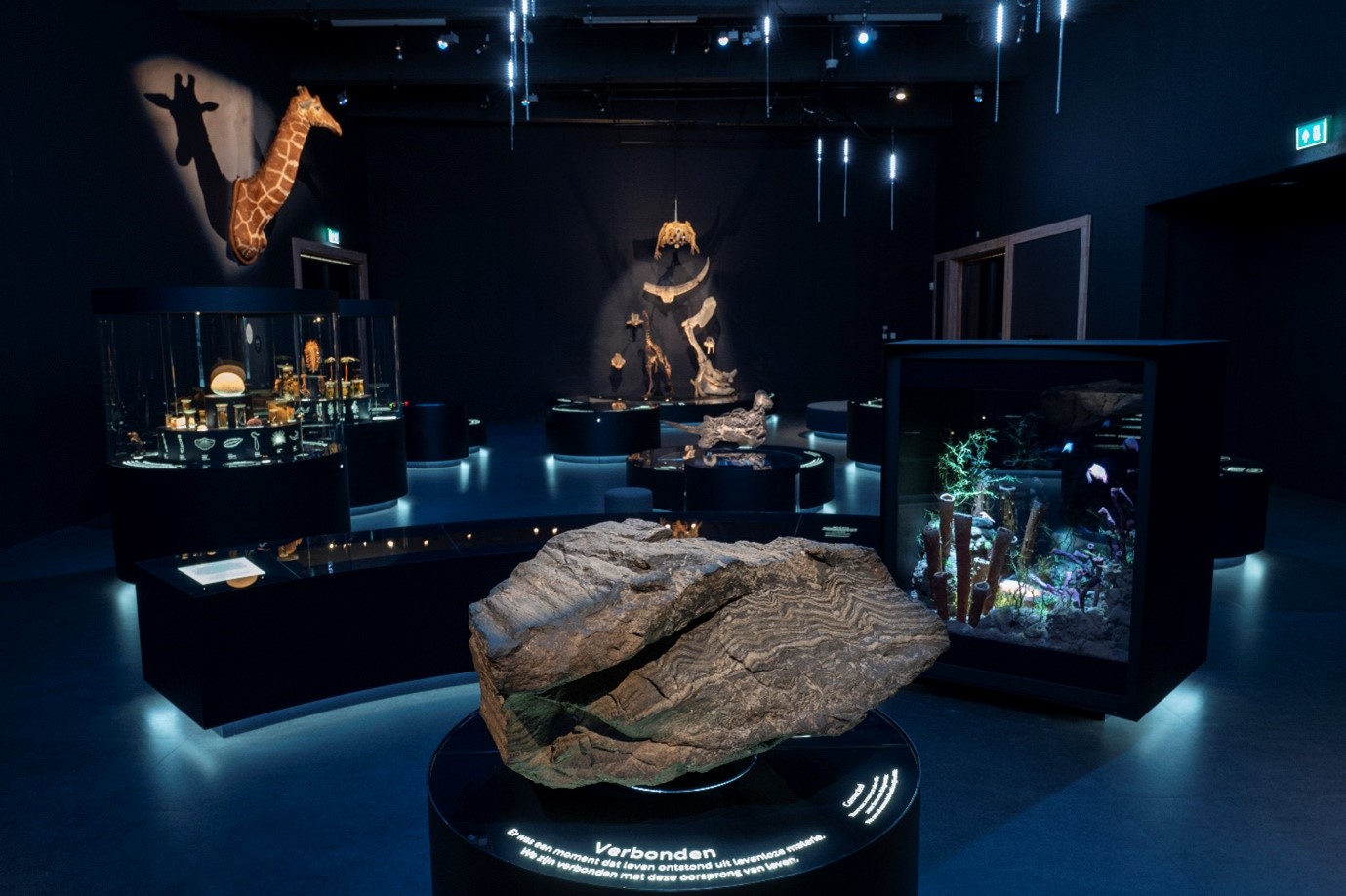
In 2019 Naturalis opened a new building with eight permanent exhibit halls. We are happy to announce that we have opened the ninth hall, Evolution. The exhibit designer, Marijke Besselink, told me that the concept for the hall was developed after she heard how visitors reacted to a stone that was in the former Naturalis prehistory exhibit. This stone came from Greenland and dates to 3.76 billion years ago. In this rock you can see layers that indicate the presence of oxygen that might have been produced by single celled organisms. It is one of the earliest signs of life on earth. One of the museum educators told Marijke how in the old exhibit, visitors were astonished that the rock was so old, and would touch it with awe. Now this centerpiece is in the front centre of the dark blue exhibit, and when a visitor touches the stone, it starts up a light and sound interaction which connects to other vitrines around the exhibit. This gives the visitor a feeling of connection, that everything on Earth is intertwined: we are all related.
© Henk Caspers

Around the stone we can find fossils from the Burgess Shale, a Canadian formation that includes more than 500-million-year-old ancestors of most modern animals. Marijke wanted to make it clear to the public what the animals preserved as fossils looked like as to the casual observer these small fossils sometimes look like a dark grey smudge! Projections help the fossil organisms manifest out of their slate beds and move across the vitrine and into an aquarium filled with creatures from the so-called Cambrian explosion. The aquarium, made with the Pepper’s Ghost technique, is one of the highlights of the hall. Besides being very cool looking, visitors see how these prehistoric animals moved, and see how similar they are to modern animals.

Continue reading

Listening and learning: Reflections on the Second Workshop of the People and Plants Project

Written by Fiona Roberts. Collaborative ESRC PhD student, Cardiff University and Amgueddfa Cymru-National Museum Wales Decolonising biocultural curation of South Asian medicinal plants.

Monday 7th November, National Museums Collections Centre

In early November, a group of academics, researchers, curators, artists and knowledge holders gathered at Edinburgh’s National Museums Collections Centre. The second workshop of the year-long AHRC-funded ‘People and Plants’ project focused on ‘reactivating ethnobotanical collections as material archives of Indigenous ecological knowledge.’

During the object handling session (Photo by Dr Ali Clark, National Museums Scotland)

The People and Plants Project

Led by National Museums Scotland, Royal Botanic Gardens, Kew and the Powell-Cotton Museum, the project investigates current debates on decolonising museum practices, including the interplay between natural history and ethnography collections, creating a conversation about these among varied experts.

The project’s previous workshop, held at the Powell-Cotton Museum in March 2022, brought together Somali knowledge holders from UK diasporic communities and was run in partnership with the University of Kent’s School of Anthropology and Conservation and the NOMAD project, which engages Somali communities in heritage projects. To read more, see this previous blogpost, and view workshop talks on YouTube [People and Plants – YouTube].

Continue reading

Ostracod Odessey – Broadcasting the Brady Collection

Written by Dan Gordon, Keeper of Biology, The Great North Museum: Hancock.

The Great North Museum : Hancock is home to many remarkable collections, but one of the most important is perhaps one of the most unfamiliar to our visitors. The Brady collection of Ostracods.

Ostracods, sometimes called Seed Shrimp, are distinctive Class of crustaceans. A shell of two intricately textured valves almost entirely envelopes their shrimp-like bodies, with just a small opening for a cluster of rapidly moving legs to poke out. As their common name suggests, most species are very small, mostly invisible to human eye, but they’re ubiquitous, busily going about their lives wherever there is permanent or temporary water, from the poles to the tropics. Some swarm the world’s oceans in vast planktonic shoals, while others live in the still, dark pools of caves, in garden ponds or even puddles.

They’re poorly known outside of academic communities, which is a real shame, because despite being fascinating creatures in their own right, they have important roles in many aquatic ecosystems, and significantly, they’re commonly encountered in the fossil record, which means that they are particularly important indicator fossils. In addition, the chemical make-up of their distinctive shells tells us about ocean acidity and temperature, which can tell us about ocean warming and climate change.

The collection was the work of George Stewardson Brady, a local man, born in Gateshead in 1832, and one of the people who pioneered the study of these animals at a time when they were relatively poorly understood.  Housed in a row of cabinets, the Brady collection is made up of nearly 3000 microscope slides with up to 100 Ostracods on each. These specimens were collected all over the world, many of them by well-known expeditions such as the HMS Challenger expeditions in the 1870s. It contains many Types, and provides a valuable resource for the study of these animals today.

Continue reading

A Collection of Sri Lankan Bird Skins.

Written by Eimear Ashe, Documentation Officer, National Museum of Ireland – Natural History.

The Temporary Number

During the course of my work in the Natural History Division of the National Museum of Ireland, (NMI) I came across a couple of boxes of bird skins that were in the wrong place. By deciding to move them to their correct place, I opened a metaphorical can of worms. It turned out that these 200 bird skins had been assigned modern numbers during a volunteer project 16 years ago. In the intervening period, the original accession number had been discovered. Never one to leave a wrong number in place, I took on the challenge to renumber this collection before rehousing them.

The Donor

First, I read the acquisition register and found the donor to be a gentleman named Colonel James Grove White, a career British Army officer. Upon retirement, Grove White came to live in Co. Cork in the south of Ireland, and like many British men in Ireland at that time, he came to hold high office during various periods, and was very active in the local community. It was during his time in Ireland, almost 100 years ago, that he donated his collection of “Ceylonese” bird skins. Presumably these were collected by him while on duty in Sri Lanka, although there is no documentation in the NMI to contribute the field collection details, other than the labels on the birds themselves.

Continue reading

Exploring Materials in Natural History Dioramas

Written by Claire Dean, Curatorial Assistant at Tullie House Museum and Art Gallery, Carlisle, and MA Preventive Conservation student at Northumbria University.

The wildlife dome at Tullie House Museum and Art Gallery
The wildlife dome at Tullie House Museum and Art Gallery Carlisle, C. Dean

In many old dioramas, material mysteries abound. As a Curatorial Assistant at Tullie House, I’ve encountered a tree trunk made from a Robinson’s fruit juice box, a fake roof that contained fibrous signs of asbestos, and a hodgepodge of unidentifiable paints and old plastics. The museum’s new-in-post Biodiversity Curator discovered pests thriving amongst the real vegetation and a 30-year-old slice of bread in a garden scene.

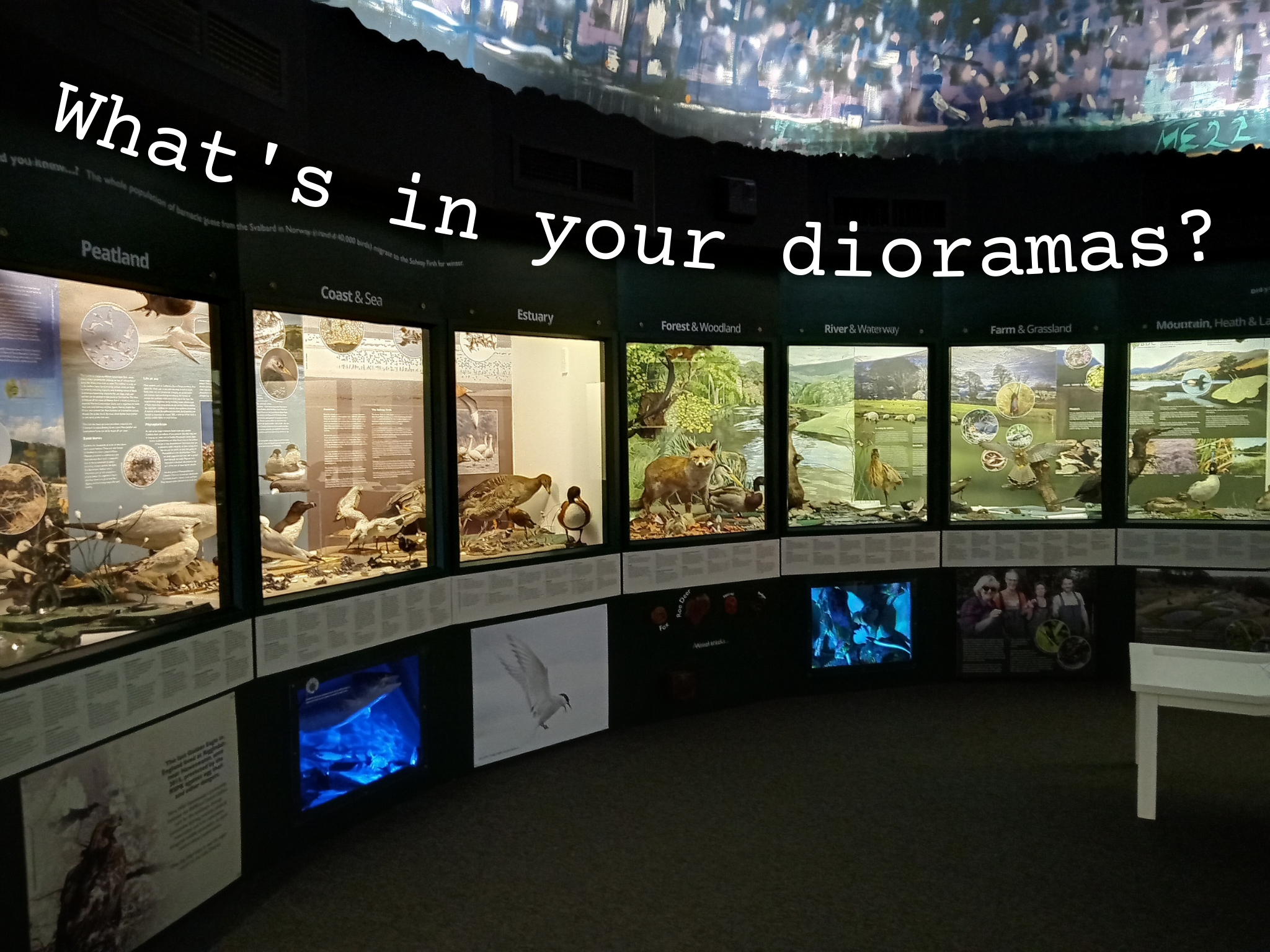
Dioramas aim to create the illusion of real habitats for their taxidermy inhabitants, and they use a huge range of materials to do so. After decades of neglect and destruction there is now wider recognition that habitat dioramas can instil a sense of wonder in visitors that no amount of digital wizardry can replace. Through my dissertation research for an MA in Preventive Conservation at Northumbria University, I wanted to find out more about what materials have been used in dioramas over time, how these might impact the preservation of specimens, and what we can do to better protect the dioramas that remain. I put a call out to ask, ‘What’s in your dioramas?’ through an online survey and received 30 responses from people with experience in a range of different sized institutions and private practice.

Continue reading