Editors note: This is the second of two concurrent blogs about the new diorama at the Booth Museum. Click here to read the first and find out more about how the diorama was created.
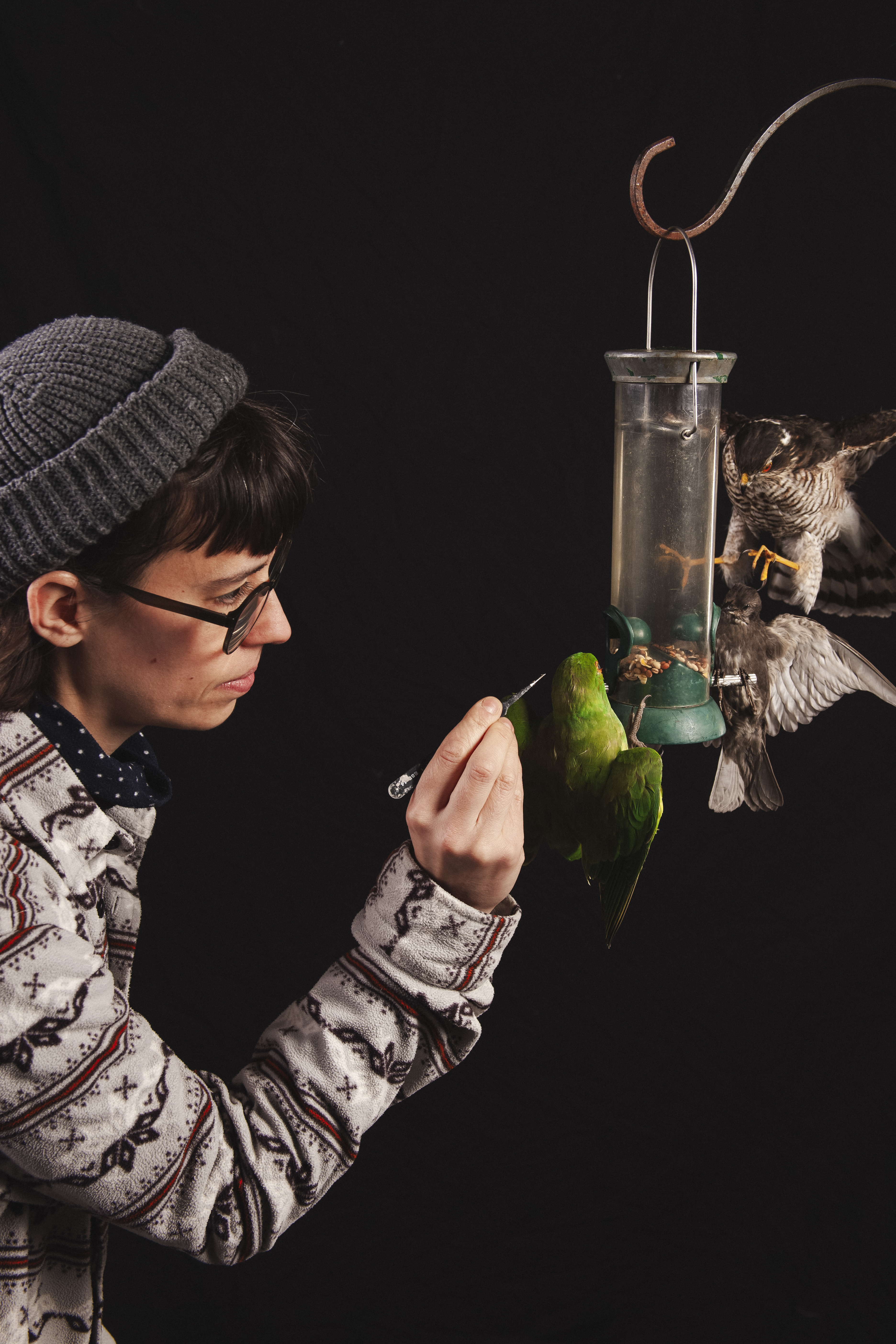
In the autumn of 2022, we started our ‘Discover our Dioramas’ project at the Booth Museum of Natural History, part of Brighton & Hove Museums. Funded by an Esmée Fairbairn Collections Fund of £50,000 we set about building the first natural history diorama at the museum in 92 years. This was a significant project for a museum whose Victorian creator Edward Booth had lined every wall with dioramas of birds. Dioramas are an ideal way of storytelling. They are visual and can get a lot of key information to audiences without the need for words.
Alongside this we were also given £3000 from Rampion Windfarms to research and display more information about people especially women involved in the museum’s history.
These projects gave us the time and space to be playful and to make friends. To impact on our audiences, our staff, our collections, and our future practices. It has brought joy to the museum, visitor and staff alike.
By Sara Merritt, Audience Development Officer at Leeds Museums & Galleries.
Us: We want to retro-fit a permanent gallery! As sustainably as possible! With £40k! In two months! And we want to keep the space open to visitors!
Them: Umm, are you sure that’s a good…
Us: Great! We’ll get cracking.
2022 saw us undertake the retro-fit of our permanent Life on Earth gallery at Leeds City Museum, with the aim of making it as sustainable as possible. The gallery required an overhaul to meet current visitor expectations, with innovative design ideas and production methods to reflect our greater understanding of climate change, the biodiversity crisis, and Britain’s colonial history.
Our objectives were threefold and carefully considered:
To manage and deliver a sustainable retro-fit with the addition of creating a carbon calculator to measure our C02 output
To ensure the interpretation was relevant, and that we had a strong idea of our target audience to attract visitors who were already engaged in making climate-positive changes.
To identify robust materials and production methods which would stand up to visitors pulling, prodding, and everything in between.
We were used to working with greener materials for temporary exhibitions and knew the implications around material availability, longevity of eco materials, and higher associated costs. We therefore needed to keep the project resource light and put our efforts into the interpretation, rather than dramatic object moves. We took the bones of what we had, large cases and great objects, and retold the story with the emphasis on using our objects to inspire our visitors to live more sustainably.
Written by Su Liu, BA English Language and Literature student at the University of Sheffield, formerly summer intern (2023) at Amgueddfa Genedlaethol Caerdydd – National Museum Cardiff.
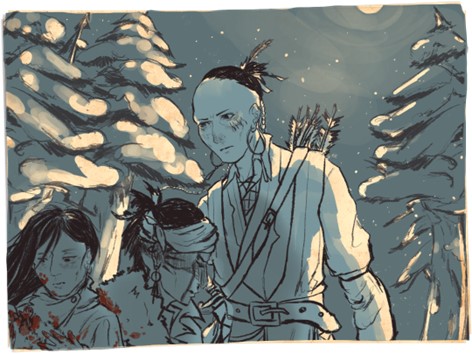
Thomas Drummond, a Scottish naturalist, witnessed the tragedy of his accompanying Native American family – the Iroquois hunters had just lost their beloved and a newborn in the severe winter of Saskatchewan, Canada. Yet their journey had to be continued to collect the 286 specimens in Drummond’s Musci Americani, one of the richest collections of North American mosses.
‘…the whole of the continent of North America has not been known to possess so many Mosses as Mr. Drummond has detected in this single journey.’ – Sir William J. Hooker (1830)
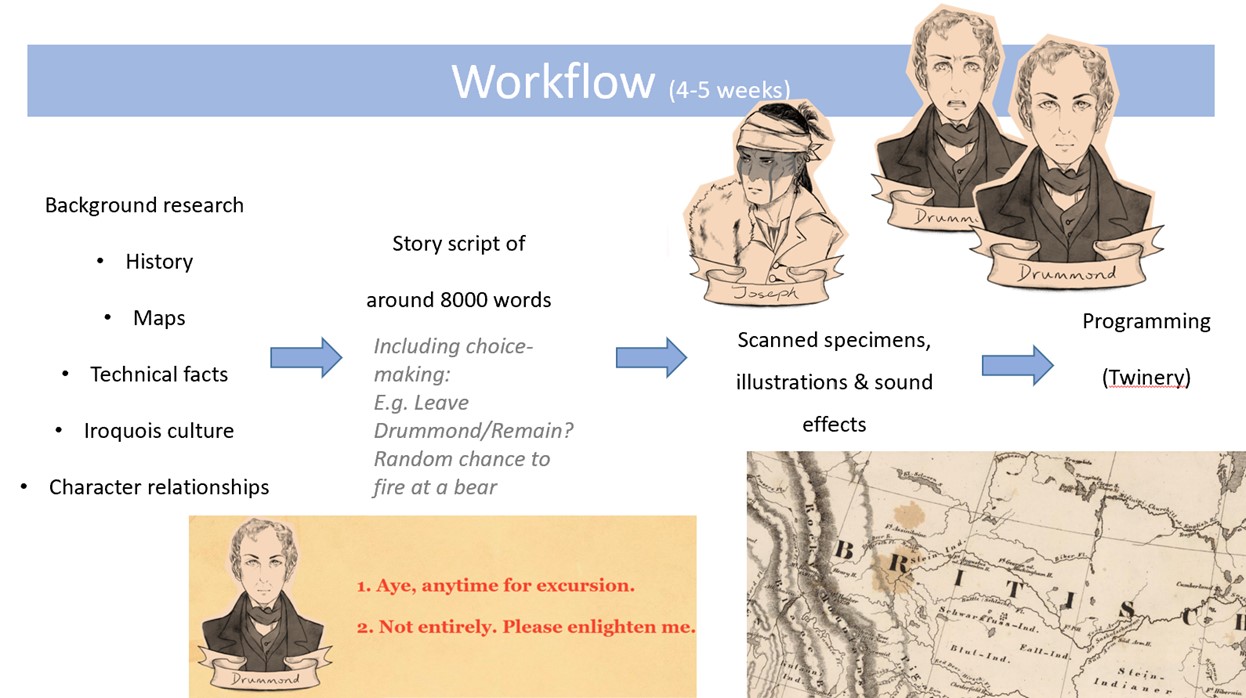
Above is a real event in Drummond’s Sketch of a Journey to the Rocky Mountains and to the Columbia River in North America, which records his excursions during Franklin’s second land expedition. It has been adapted into an interactive digital narrative, Snow, Bonfires and Mosses, in which the reader engages with a combination of novel, visualisations, sound effects and choice-making. Choice-making allows the reader to experience different narratives and explore possibilities amid ambiguities in history.
This browser game is accessible on most devices and comes with an ‘encyclopaedia’ that includes a selection of Drummond’s moss specimens and external links to the biographies of all historical characters.
Lost stories of a distant adventure and forgotten collectors
The story of Drummond’s adventure began in Saskatchewan, 1825, where he parted ways with Franklin’s party and was joined by Iroquois hunters employed by Hudson’s Bay Company, a dominant fur trading company at the time. Their journey near the Rocky Mountains was an underdeveloped version of Man vs. Wild, surrounded by hunger, blizzards, wildlife, and humans – conflict between different tribes continued regardless of the Europeans’ intrusion.
Drummond made excursions whenever he had the opportunity, followed by sleepless nights when he had to treat his specimens before the fur brigade departed. At times, he failed to follow the fur brigade’s pace and consequently much of his work was lost or destroyed. By the time he was brought back to reality from work, he realised that he had been left ‘alone with the Indians’.
In contrast with Drummond’s objectives, the emphasis of the expeditions had been more on the exploitation of new trading routes. The capitalist powers were eager to establish colonial influence in North America and appeared to have taken local labour for granted, so the natives were not having a great time either. Drummond sometimes found the ‘fickleness’ in them hard to deal with but nevertheless depended on their work.
My colleague and BA history student Harry Pointon has pointed out the conventionalised indifference towards local hunters in the early 19th century, whose contributions are acknowledged in Drummond’s Sketch due to the complexity of his journey, as the natives play essential roles in the naturalist’s survival and are experienced guides to the flora in their natural habitat. With that in mind, my digitalisation of the exsiccatae (numbered collections of dried herbarium specimens with a common theme or title) goes in tandem with decolonising the history of the participants, especially the Native Americans.
Behind the scenes of Snow, Bonfires and Mosses
I had a blast writing, drawing and programming to make historical science approachable without being a bore, especially for slightly older children. It was hard to imagine myself working on two-hundred-year-old mosses as an English student, but I was beyond excited to see moss specimens in a great variety of sizes and colours. With the help of the Biodiversity Heritage Library (BHL) and my supervisors, I was able to put together a full timeline of events without much barrier to scientific knowledge.
The historical accounts were quite a fun read. Early modern science writing (approximately from the 17th century onwards) consisting of all sorts of information, from each step of the experiments (even if it results in failure) to personal remarks from the researchers. Unlike contemporary science writing which aims to be brief and impersonal, these accounts are vividly descriptive, and they highlight the presence of all participants: naturalists, hunters and fur traders. Drummond’s Sketch is an excellent resource that conveys his passion for botany and has proven itself practical in helping me construct my storytelling of the specimens. It is also proof of Native American involvement in naturalist excursions.
Apart from the emphasis on Drummond’s excursions and specimens, the narrative also presents parts of Native American culture throughout the characters’ dialogues. Iroquois people, for example, tend to have a strong belief in astrology and female leadership. This will hopefully create a fuller image of the Indigenous collectors, their lives, and the ways they were treated by the Europeans.
As a literature student, my understanding of decolonising history is the liberation of artefacts from hidden archives and unravelling the stories of neglected participants in the most accurate detail as possible. Drummond’s Sketch is perhaps a fortunate case for decolonising the archive, considering the common lack of credit for Native Americans. It is encouraging to see readers entertained and captivated by the story, and hopefully this has been an inspiring attempt at digitalising and decolonising museum archives for educational purposes.
Compiled by Olivia Beavers, Assistant Curator of Vertebrate Zoology at World Museum, National Museums Liverpool.
Welcome to the March edition of NatSCA Digital Digest.
A monthly blog series featuring the latest on where to go, what to see and do in the natural history sector including jobs, exhibitions, conferences, and training opportunities. We are keen to hear from you if you have any top tips and recommendations for our next Digest, please drop an email to blog@natsca.org.
Sector News
NatSCA Annual Conference & AGM 2024
Registration is open for the 2024 Annual Conference & AGM of the Natural Sciences Collections Association. Trials and Triumphs: sharing practice across the museum sector will be held on Thursday 18th and Friday 19th April 2024 in the Oxford University Museum of Natural History. This practical conference aims to celebrate triumphs and amplify successes in museums, but also highlights pitfalls and lessons learned from situations that didn’t go as planned. Members – please remember to contact membership@natsca.org for your promotional code to release discounted tickets.
The event will be physical/digital hybrid, with attendees able to attend in person or online via Zoom. Follow the link for more details and to register.
To celebrate all of your wonderful contributions to the blog in 2023, here is a round up of the top ten most read blogs of the year. I want to take this opportunity to thank everyone who contributed an article. And what a bumper year it has been with articles covering decolonisation work, collections moves, exhibitions, workshops, collections research and management. The NatSCA blog is driven solely by your contributions and it is stands as a testament to the hard work you are all in doing despite challenging times.
I am pleased to say that the 2024 blog calendar is open for business, so drop me a line if you would like to contribute.
9. People and Plants Workshop Three: Sharing Knowledge in the Amazon. Written by Fiona Roberts (Collaborative ESRC PhD student, Cardiff University & Amgueddfa Cymru-National Museum Wales) and Violet Nicholls (Assistant Curator in Herbarium, Portsmouth Museums). The People & Plants workshops were an interesting series of training events focusing on decolonising collections. This article reviews the last of these events which addressed the question of how ethnobotanical collections in museums can best be used to support Indigenous communities.





 NatSCA