Playing with Time

Cave palaeontology collections as vessels of truth and creativity…
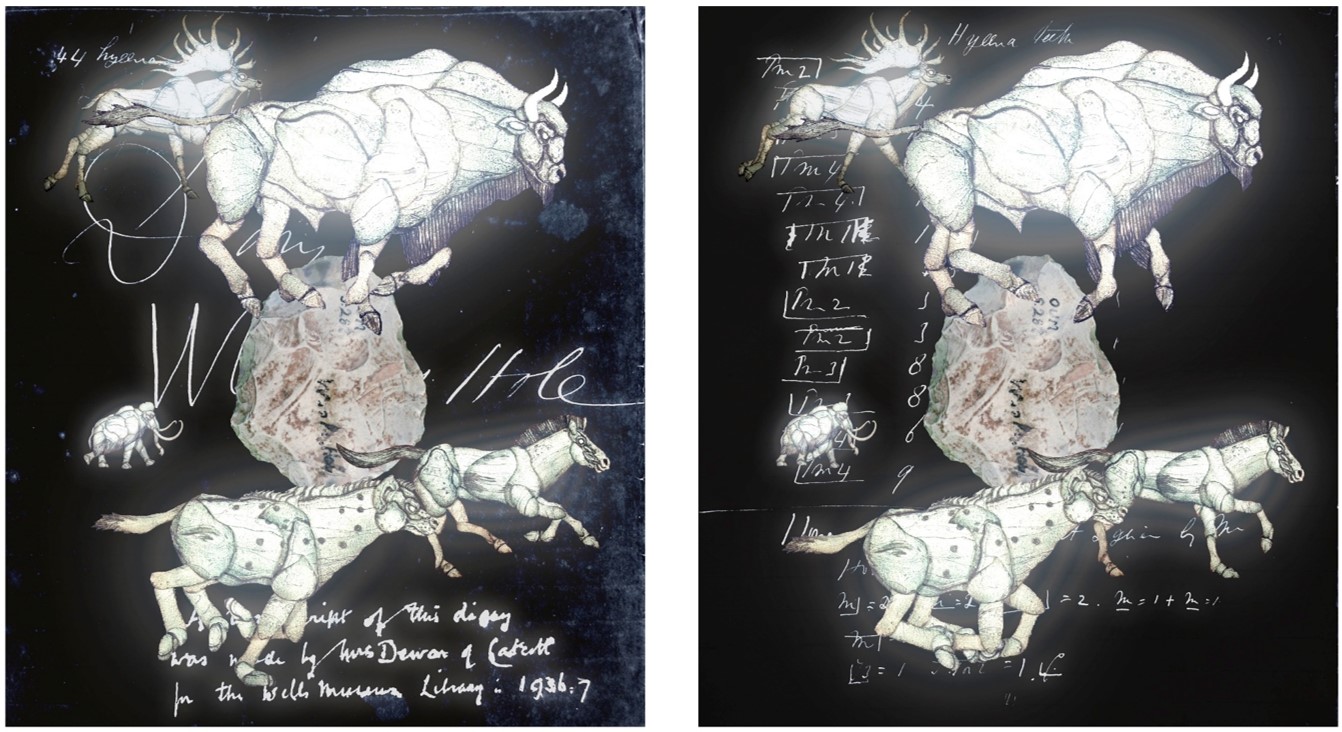
Big Beasts Stalk The Mind of Sir William Boyd Dawkins. Two pages from a flip-book showing animated giant deer, steppe bison, spotted hyaena, horse, pages from Sir William’s notebook relating to the excavation of the Hyaena Den at Wookey Hole and a Palaeolithic hand axe unearthed there. (C) Sean Harris.

Beasts of tooth and claw have always stalked the darker corners of my mind. But we could probably all say that couldn’t we? However, a recent creative collaboration – for which Wells and Mendip Museum’s seminal collection of Pleistocene mammal bone provided the focus – presented a new slant on the mind/ cave analogy.

My grandparents, who exerted such a powerful influence on my formation, did their very best to nurture a natural scientist of some shape or form. They would, I think, have been proud of a geologist, ornithologist, zoologist – also perhaps an archaeologist; maybe even an anthropologist. Someone of great standing and integrity, qualities probably manifest in a really solid moustache.

Consequently, growing up, I spent a lot of time in museums, in hides and ranging across fields with a geologist’s hammer; all activities accompanied with a notebook and pencil. However, to the considerable bafflement (and perhaps frustration) of my well-intentioned elders, a compulsive urge to express the images and narratives that formed themselves in my mind’s eye – ironically borne of hours gazing into cases at the minutiae of taxidermied creatures, patinated bones, geological specimens – won out and instead of a scientist they got an artist and animator.

However, having now, over the course of a career, worked with a diverse array of researchers in museums and conservation organisations, I know that I’m on the same spectrum as a great many of them – albeit perched at a slightly different position along it. Whilst our motivations and the languages we use to communicate our discoveries may be different, we’re all explorers of a type. I wish I could have the opportunity to explain that to my grandmother – though maybe she knew it anyway.

Continue reading

NatSCA Digital Digest – April

Dear Digital Digest-digesters, it has been an extremely busy month but there are just enough hours in the month to put out the April edition. Continue reading for a round up of all the things you need to know…

What Should I Read?

After much to-ing and fro-ing and panicking from various factions, it has been announced that “accredited museums and galleries will be granted an exemption in legislation… that bans the trade of elephant ivory in almost all circumstances”. This is great news for museums. Read the full story on the Museums Association website here.

There has been a lot of coverage of the dinosaur tracks found in Scotland, but if you missed it all, here’s what the BBC had to report. Both sauropod and theropod tracks are present and they’ve gotten everyone all excited.

Wildlife Photographer of the Year is in the news for another year as another photographer falls foul of either not reading, or else ignoring, the rules. The anteater in one of the winning images has been investigated and concluded to be a taxidermy specimen. The image was therefore disqualified and the photographer told to er… get stuffed.

Continue reading

When Art Recreates the Workings of Natural History it can Stimulate Curiosity and Emotion

Natural history is one of the branches of science whose methods and traditions are most often referenced by contemporary artists. A flock of the installations that we find in leading galleries echo, reflect, borrow from and parody the ways that natural history works.

Sometimes these artists pick apart the way that natural history is “done” in museums – Joseph Cornell’s mini display cases; Ruth Marshall’s knitted animal pelts; Tessa Farmer’s “fairies” made from real insect carcasses; Polly Morgan’s modern take on taxidermy and Damien Hirst’s various preserved specimens all invite us to consider the ways that museums represent nature, and the role of museum specimens.

Elsewhere artists point to natural history as a part of our human society, performed in the wild, beyond the walls of museums and universities. For example, Natural Selection by Andy and Peter Holden (currently at The Towner Gallery in Eastbourne until 20th May) tells the story of the people obsessed by the illegal practice of collecting bird eggs.

Work in the museum and in the wild are two central pillars of natural history. One artist who shadows the practices of both is the American artist Mark Dion. His exhibition, Theatre of the Natural World, is showing now at the Whitechapel Gallery in London until 13th May. As a natural historian who works in museums and undertakes fieldwork, I am always interested in art that encourages me to step back and reflect on how my profession actually operates.

Sometimes what it shows me is funny, sometimes it’s sad, and sometimes it’s disturbing. Such art can be a highly effective means of communicating just how absurd some aspects of natural history are. Much of Dion’s work highlights the subjective, peculiar and inconsistent ways that taxonomy operates: it is an entirely human construct intended to place order on the impossibly disordered living world.

Mark Dion
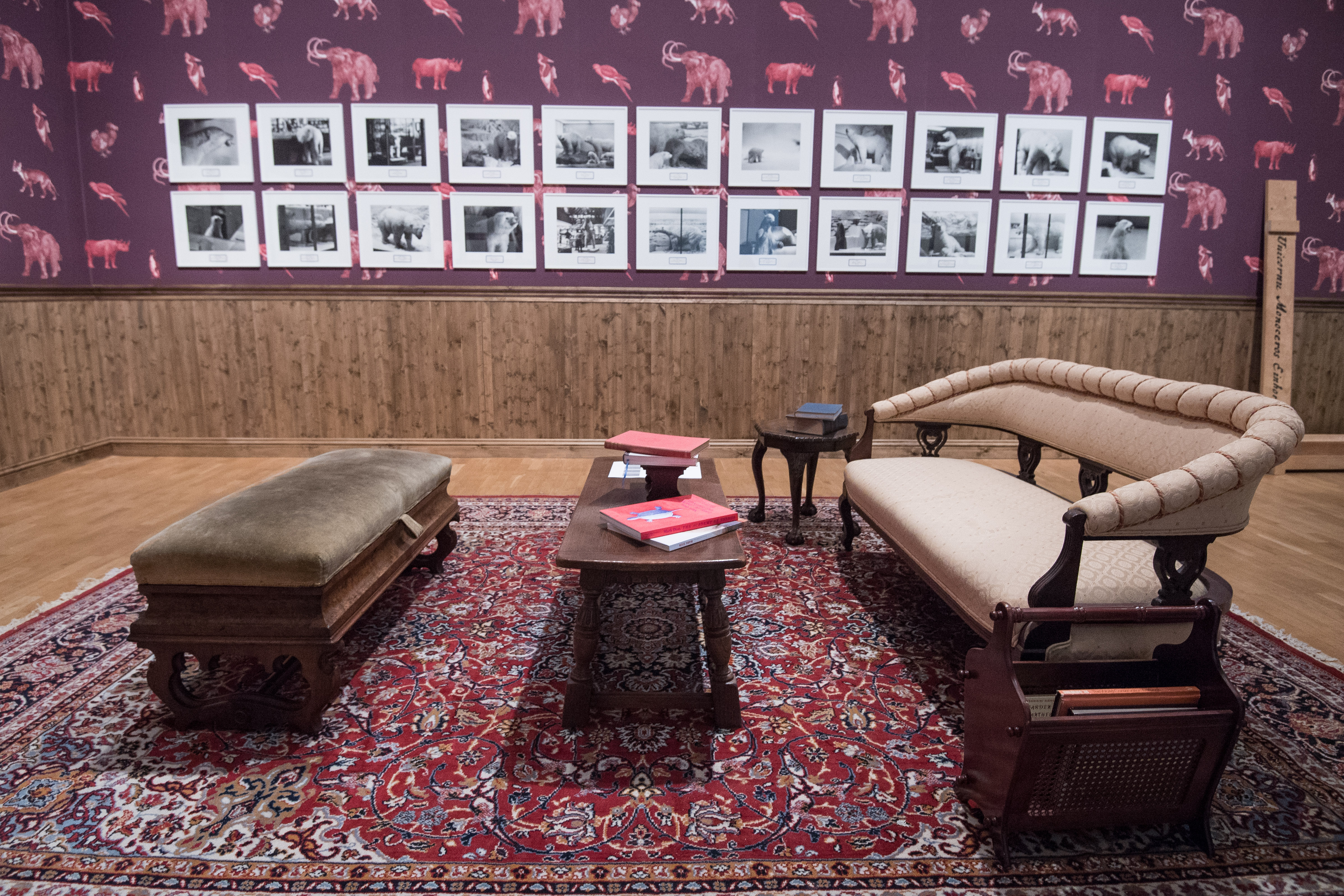
The Naturalist’s Study, 2018
Installation view of Mark Dion: Theatre of the Natural World at Whitechapel Gallery, London, 2018
Photo: Jeff Spicer/PA Wire

Continue reading

Paradise, Problems, Perpetrators, and Positives

Written by Dr Emma Nicholls, Deputy Keeper of Natural History at the Horniman Museums and Gardens, and NatSCA Committee Member

The Paradise

Far away in a tropical land, where few of us will ever visit, there lives a plethora of exotic and enigmatic animals that would be at home in a book on Victorian expeditions and grand discoveries. Scaly pangolins, pygmy elephants, and a species of small rhinoceros that is covered in brown fur represent a drop in the ocean of the immense biodiversity living in the beautiful natural habitats of Indonesia and Malaysia. I hope you are conjuring a heart-warming image in your mind of lush green rainforests; perhaps a huge orange cat with black stripes disappearing into the undergrowth as birds and monkeys join forces to belt out a warning chorus, letting everything nearby know of the tiger’s presence.

Now raze the trees, set fire to everything, destroy the animals, and in the ensuing barren wasteland grow acres and acres of plantations. All for an ingredient called palm oil.

The Problems

What is this magical substance that is worth wiping out entire species of plants and animals for? It’s an edible vegetable oil that is in everything from soap and toothpaste, to cookies and chocolate bars. Pick up a consumable in any supermarket and you’ll probably be holding palm oil. The substance is this omnipresent in the western world and yet 85% of the entire world’s supply of palm oil comes from plantations in Indonesia and Malaysia alone. That should give you an idea of how much of these two Southeast Asian countries has been, and continues to be, burnt to the ground in order to produce palm oil. That biodiversity we spoke of before is hanging on by its finger tips in smaller and smaller… and smaller… pockets of forest.

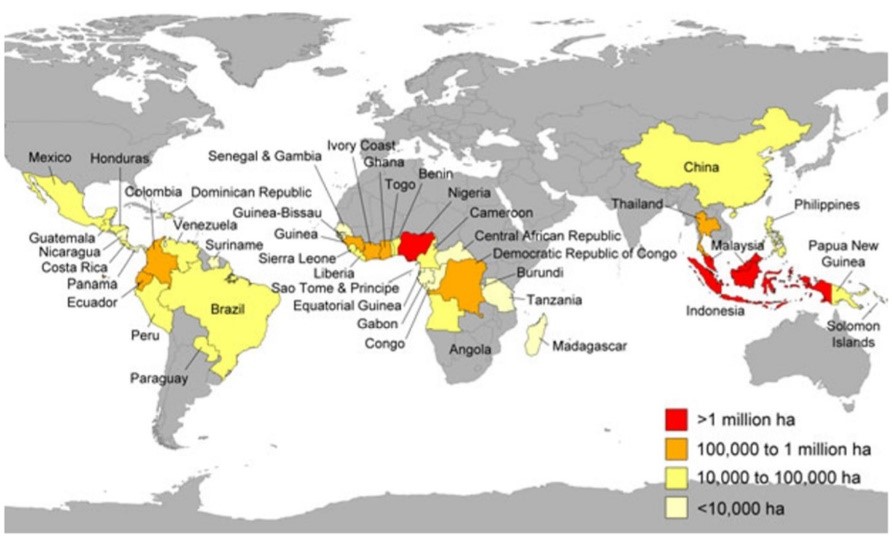
World map showing countries affected by large-scale clearance of natural habitat for producing palm oil as of 2006 (FAO 20076, via Koh and Wilcove, 20087).

Further to the suffering of the natural world, in many areas, indigenous peoples are forced to abandon their forest homes and their traditional ways of life, in order for the land to be purposefully destroyed. Indonesia has one of the highest deforestation rates in the world. What happens to these displaced people? Many of them are forced into working on the plantations as slaves. This includes child slavery. I am sure you have heard of Conflict Diamonds? Conflict Palm Oil is just as inhumane.

If you need further persuasion that palm oil is bad news, the carbon pollution produced by palm oil plantations is a MAJOR player in the line-up of human induced villains that are hurtling our climate out of control. Climate change is a normal, natural phenomenon. What isn’t normal is the speed at which it is occurring due to human activity. It is changing so fast that animals and plants can’t keep up, they can’t evolve or adapt fast enough. So they’re choosing option B and going extinct instead.

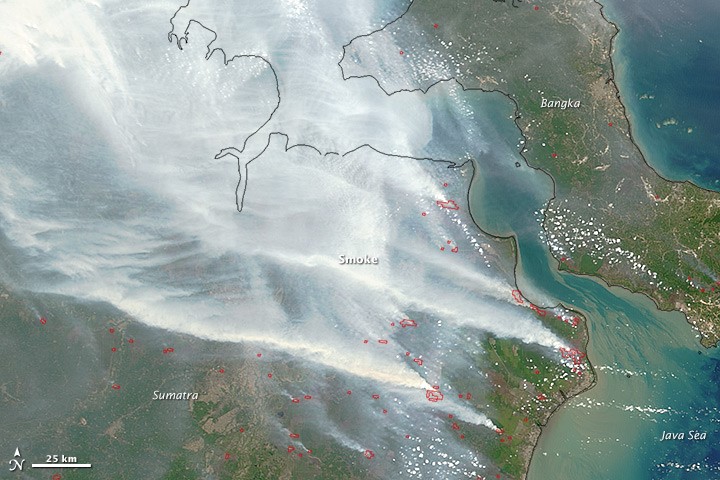
In 2015, smog produced as a direct result of fires used in palm oil production was so thick in Sumatra, Indonesia, that it caused air pollution levels to spike in neighbouring Malaysia and Singapore. (NASA, 2015).

Continue reading

Borderless Collections – Starting a Collections Community (R)evolution

by Deborah Paul (iDigBio) and Isla Gladstone (Senior Curator of Natural Sciences, Bristol Culture)

The heroes. Our natural sciences collections, collections staff, the planet and all the players worldwide (thanks Shakespeare).

Some of the heroes’ dilemmas. Need for online access to collection specimen data for research, dwindling habitat, damaged planet resources, one-of-a-kind objects, minimal staff, need for financial support and expertise, and an urgent need to reach and engage a broader audience if we are to succeed in addressing these dilemmas. Some actors know their roles, others don’t even know they are part of the story.

With support from the John Ellerman Foundation for the South West Area Natural Sciences collections (SWANS) project, Bristol City Council’s Culture Team (based at Bristol Museum & Art Gallery), the Natural History Museum (UK), and iDigBio, jointly created two workshops. Both of these events serve as part of a coordinated effort to envision and create a robust UK regional digital natural sciences collections program that supports research, engagement and skills, and connects directly to local, national, and international programs now and in the future. The vision includes plans to repeat the second workshop across the UK.

Materials. All materials and talks can be found on the respective workshop wikis: UK Strategy and SWANS Practical Digitisation.

Continue reading