NatSCA Digital Digest – June 2022

Compiled by Glenn Roadley, NatSCA Committee Member, Curator of Natural Science at The Potteries Museum & Art Gallery.

Welcome to the June edition of NatSCA Digital Digest.

A monthly blog series featuring the latest on where to go, what to see and do in the natural history sector including jobs, exhibitions, conferences and training opportunities. If you have any top tips and recommendations for our next Digest please drop an email to blog@natsca.org.
Sector News

NatSCA Lunchtime Chats

The new lunchtime chats are for members only and run on the last Thursday of every month. In our last session we heard from Hannah Clarke at the University of Aberdeen, presenting ‘The Marvellous Molluscs Project – Lessons Learnt So Far’.

This series is supposed to be informal, no fancy equipment is needed, it will be put out over the NatSCA Zoom platform and there is no fixed format. There will be shaky walks through stores by mobile, demos, plain pieces to camera or traditional PowerPoints if that’s the best way to share images and info. For those who want to take part please email training@natsca.org to put forward your idea; if a stable internet connection for what you want to achieve is tricky we can put up a pre-recorded video and then speakers can jump in at the end for the discussion.

Continue reading

Unravelling the Golden Thread: The Silk and Cocoon Collection at the Manchester Museum

Written by Piotr Korpak, Visitor Team Assistant, Manchester Museum, The University of Manchester.

Last August saw the Manchester Museum entering the final phase of its capital project called hello future when it closed to the public for over a year, until February 2023. Major redevelopments like this tend to be quite stressful for most institutions, but also bring a lot of excitement and many valuable opportunities for individuals. Being closed to the public meant no visitors and so I was able to support work in other departments. Always interested in natural history collections, I welcomed the chance to work with the Curatorial Team in the Entomology Department with true delight.

The Museum’s arthropod collections are amongst the top three in the UK, with over 3 million specimens, out of which about 2.5 million are insects (Logunov and Merriman, 2012). As is the case with many museums, the collections are vast, the staff numbers small, and it can be difficult for curators to catch up with the backlog of past acquisitions and historic materials. No doubt one could find boxes, cabinets, and all other imaginable storage units full of specimens still awaiting their official accessioning, cataloguing, research, and digitisation in any museum.

Continue reading

Vertebrate Collections of the Institute of Biology, UNAM, Move to the New Building of the National Biodiversity Pavilion in Mexico City.

Written by Fernando A. Cervantes, Professor and Curator of Mammals, Department of Zoology, Instituto de Biología, UNAM.

Mexico is a megadiverse country and has 10% of the world’s species. The Institute of Biology of the National Autonomous University of Mexico (IBUNAM) houses the National Biological Collections (NBC), which contain the largest and most important representation of museum specimens of Mexican biodiversity in Mexico. These include 10 zoological collections, a herbarium, and a botanical garden (Zambrano and Reynoso, 2003). Among the highlights are the National Insect Collection (CNIN), with more than 3,000,000 specimens, the National Herbarium (MEXU), with more than 1,500,000 specimens, and the living collections of the Botanical Garden. They all collaborate in the elaboration of the national biological inventory and their specimens provide knowledge on the presence, distribution, and evolution of biological diversity (Cervantes et al. 2016).

   The NBC are located at the IBUNAM facilities in the Ciudad Universitaria campus, south of Mexico City, Mexico, where they have been for approximately 22 years now. However, the rapid growth in the number of specimens in each of the collections over the last few decades has meant that the space in which they are currently housed is no longer sufficient. At the same time, the number of academic personnel associated with the NBC, students, equipment, and materials have grown in parallel and demand the need for more space to allow for the proper functioning of the NBC.

Continue reading

NatSCA Digital Digest – May 2022

Compiled by Claire Dean, Curatorial Assistant at Tullie House Museum and Art Gallery, Carlisle, and MA Preventive Conservation student at Northumbria University.

Welcome to the May edition of NatSCA Digital Digest.

A monthly blog series featuring the latest on where to go, what to see and do in the natural history sector including jobs, exhibitions, conferences and training opportunities. If you have any top tips and recommendations for our next Digest please drop an email to blog@natsca.org.

Sector News

The countdown is on to the SPNCH/NatSCA/BHL Conference 2022, which is being held in Edinburgh and online. Early Rate registration has now closed but a Late Rate registration fee is still available, with NatSCA members eligible for the Standard Member rate. The programme runs from Sunday 5th to Friday 10th June and is available to view here.

If your work involves (or if you are considering) citizen science, community science, or other forms of research collaborations with the public, you may be interested in joining the virtual C*Sci2022 conference, May 23-26th.  Registration is now open and the full programme is available here.

Brighton’s Booth Museum has received funding from the Esmée Fairbairn Collections Fund for an exciting new project to create a modern diorama to reflect changes in UK wildlife since E.T. Booth’s death in 1890. The project will also involve improving their educational offers and increase audience participation. Due to run from 2022-2024, you can find out more about the project here.

Continue reading

‘Marvellous Molluscs’ – Increasing Accessibility, Improving Storage & Unlocking Research Potential At The University Of Aberdeen

Written by Hannah Clarke, Assistant Curator (Collections Access), University of Aberdeen.

In April 2021, The University of Aberdeen’s Zoology Museum, with support from NatSCA’s Bill Pettit Memorial Award, undertook a year-long project to rehouse and improve the accessibility of the University’s mollusc collection.

The collection comprises approximately 2550, mostly British specimens, collected from the 1840s to the 1970s. The specimens were gifted to the museum by former students, academic staff, and amateur shell collectors, they also include several specimens from as far afield as the Pacific, Africa, China, Madagascar, America, and Canada.

The molluscs form part of the University’s extensive Zoology Collections, which are recognised as being of National Significance. As such, we are constantly striving to improve access to these collections, and the ‘Marvellous Molluscs’ Project aimed to do just that.

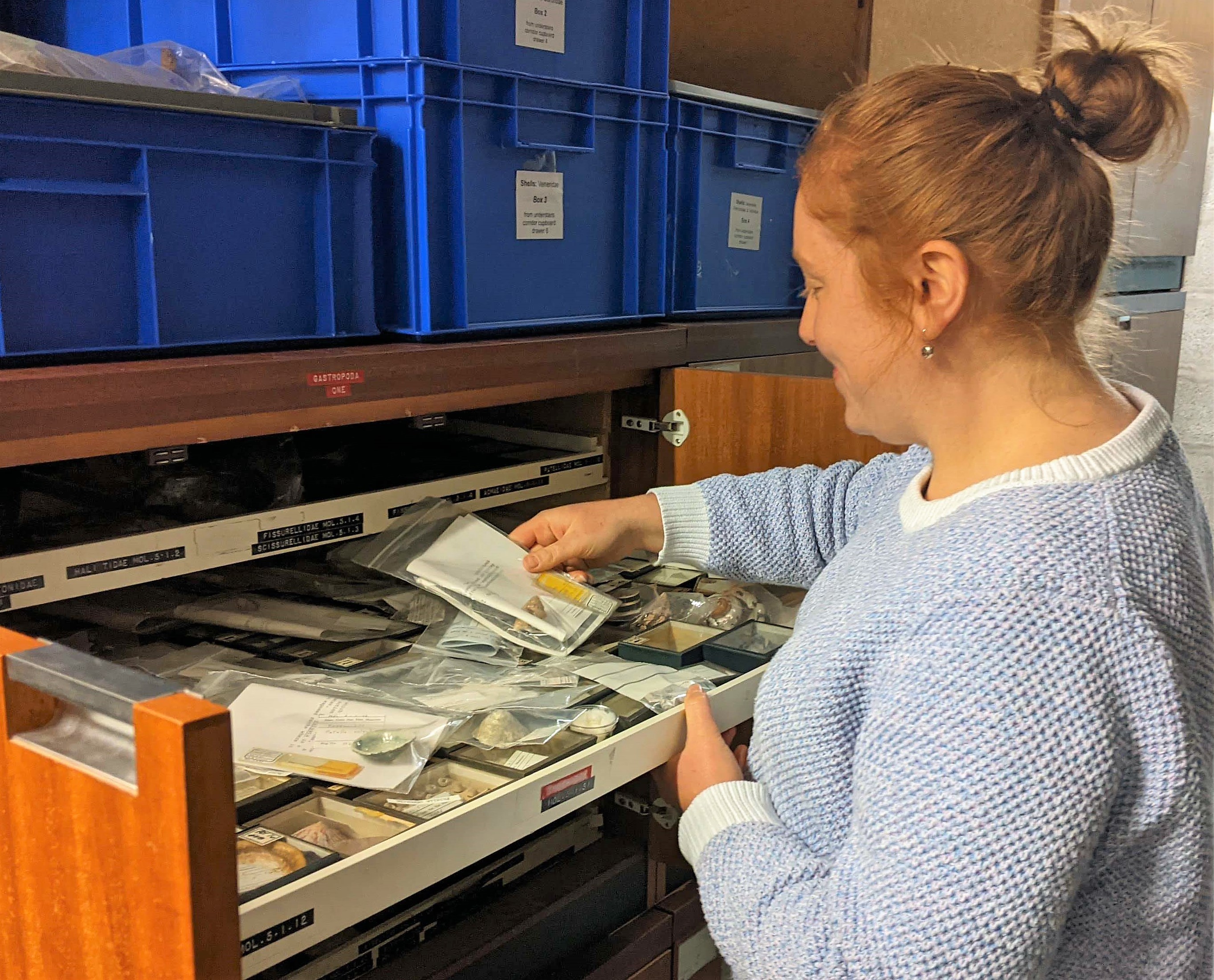
Assistant Curator, Hannah Clarke, identifying storage issues in specimen cupboards.

Having identified the collections both in storage and on display, a project plan was created that would tackle not only the rehousing, but also the documentation of the specimens on the museum database. The majority of specimens were poorly stored several layers deep in drawers, had outdated taxonomy, and lacked any database records or collections data.

Continue reading