
Written by Maria Dragoi, PhD Candidate, UCL Institute of Archaeology & NHM Science.
Insects are very numerous, and very small. Their ubiquity and importance has meant that they need to be addressed in natural history galleries, but their minute size and fragile nature can make this a challenge. Various techniques have been developed to represent insects in galleries, including projection, illustration, and sculpture. This blog looks at model making as a technique used to enlarge insects for public displays at the Natural History Museum in London in the 20th century. It reflects on what magnification as a representation and display tactic does to how we construct a relationship with an insect.
I think something that’s important to remember about when we interact with insect models is that we know and recognise them as such. We are aware that they are not the thing in itself, but a representation of it. What we don’t often realise is that there needs to be a cultural schema around us for us to know and understand these things as representations. There’s some really interesting research by Pauline Kusiak on the use of projections to teach West African communities about the dangers of malaria in the early twentieth century. French Christian missionaries used new projection technology in order to show enlarged images of mosquitoes and their larvae to create awareness within these communities about the transmission of disease. At first it didn’t go very well, because the people that were shown the projections didn’t understand them as such. They told the French missionaries they clearly had no idea what was going on, because what they had shown was huge, a monster, whereas the insects that were known by communities to cause a problem were very small. Before using the model, or projection, as an educational tactic, the missionaries realised they first had to build up an understanding of what their representation technology was.
I think within museums there is a really interesting space between our relationship to nature and truth, which is often greyer than might first appear. The implication is that you go to a natural history museum to see real things, to see real skeletons, real taxidermy, real dead old things pickled in jars – and sometimes that’s true, but sometimes it isn’t. A lot of the dinosaurs on display are casts, sometimes they’re made up of the bones of more than one species. Taxidermy of extinct creatures, like the dodo, is necessarily false but tries to present as real. Insect models are interesting because they don’t try to hide the fact that they are facsimiles taking liberties of scale and material. In that way, they are more honest about the fact that they aren’t the real thing – this makes them quite different from the other things which are trying to obfuscate their falseness. This must do something different to our perception of the things which they represent also.
The earliest mention of insect models in the NHM comes from the 1908 ‘Guide to the Exhibited Series of Insects’. Printed and issued when the museum’s insect collections numbered 1,115,000 specimens, it describes a gallery intended to educate visitors on the life cycles, evolutionary relationships, and environmental contexts of all known insect groups. The gallery, even in its ‘in-progress’ state at the time of the guide being printed, featured 27 table cases and 85 models. ‘Where possible species likely to be of interest from agricultural or horticultural points of view have been chosen.’ (NHM, 1908:1). Eight years later, in 1916 the museum opened a new display, this time putting insects centre stage in the Hintze Hall. This exhibition featured enlarged models of insects and ticks important to the spread of disease. It coincided with a public information campaign launched by the museum to spread awareness about fleas, ticks, lice, and houseflies, offering the general public the knowledge with which to take control of their sanitary conditions. The large models shown in the Hall, and the educational posters which many readers will be familiar with, were created by Mrs. E. D. Blackman and Miss Grace Edwards.
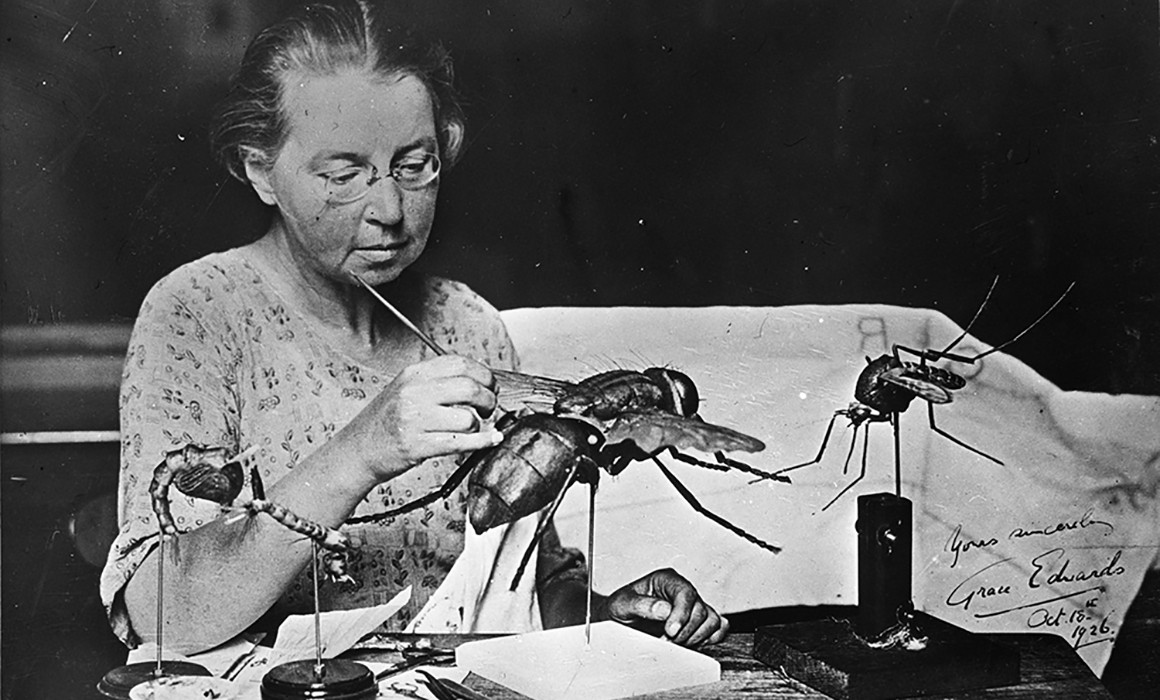
Grace Edwards with insect models in 1926. Natural History Museum, London, UK, Public domain, via Wikimedia Commons.
Although magnified models of insects might seem innocuous, simply a way to visualise creatures which are very small to the naked eye, Charlotte Sleigh has discussed how in science fiction writing, ’the enlargement of the insect was…[a] way…to bring out its menace’ (Sleigh, 2001, 50). Anyone who has had the chance to look at a fly, or any other insect, under a good microscope will know the shock which arises at first glimpse of ‘their strange physiology, normally impossible to see’ (ibid., 51). Sleigh is talking about enlargement in science fiction stories, and argues that the unfamiliarity of the image allows it to be expropriated to produce feelings of horror and revolt. This ‘others’ the insect and reduces its often multifaceted ecological role into one of peril and threat. Creating these feelings of revulsion was probably one of the goals of the 1916 exhibition, as it was only concerned with insects that spread disease.
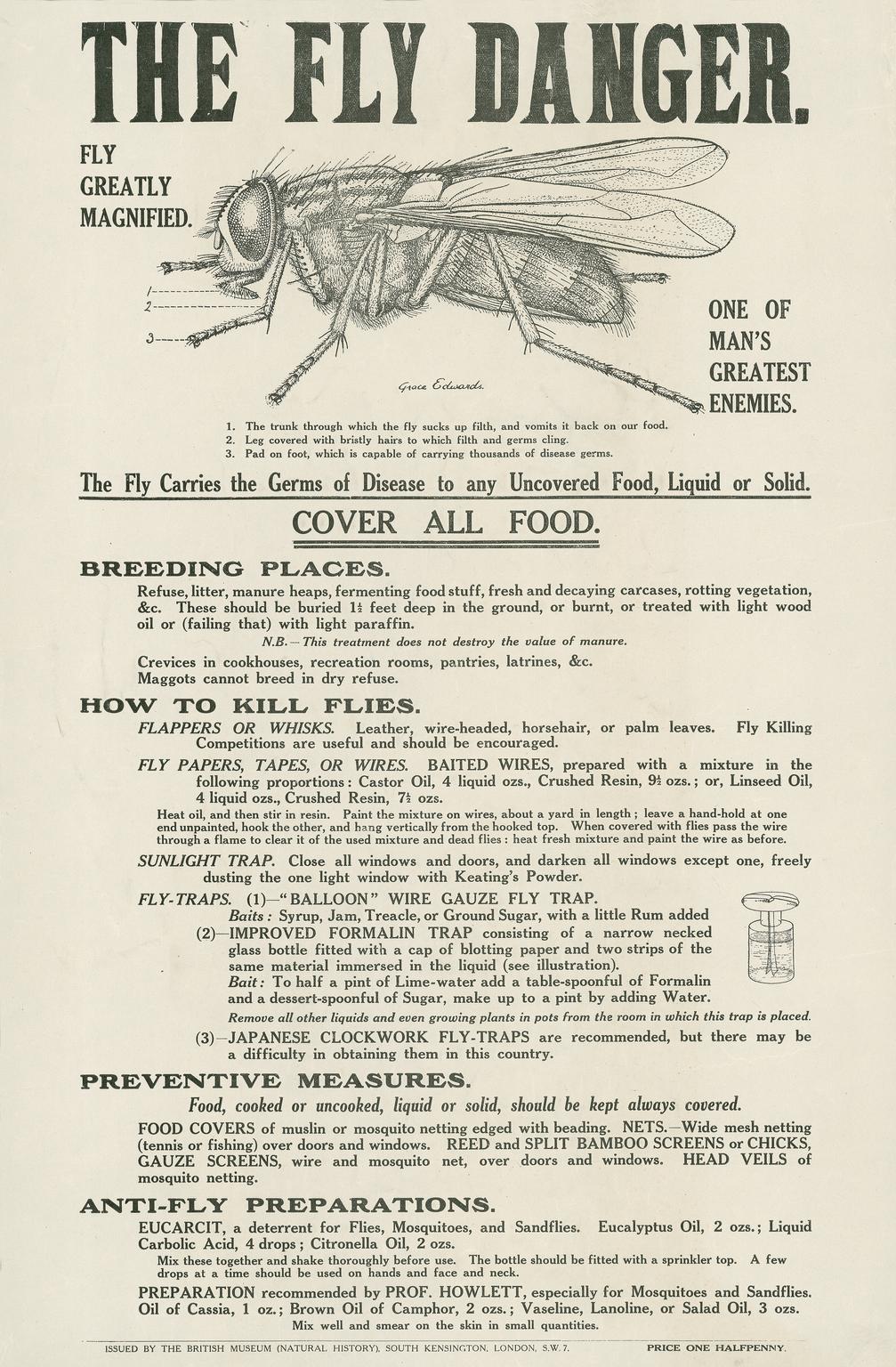
‘The Fly Danger’, with illustrations by Grace Edwards, published by British Museum (Natural History), London, 1918.
By then, the other insect displays had been split into two separate groups – the arthropod gallery featured the ‘general’ collection of insects and ticks, and the north hall had an exhibition specifically on insects which were injurious to crops. Later in the 1960s the insect galleries were consolidated into one room, and then in 1989 Creepy Crawlies opened. For better or worse, Creepy Crawlies closed in January of this year. The way we thought about insects in 1908 is very different than the way we think about them today. Or is it? What would an insect gallery designed in 2026 say about our contemporary relationship to insects?
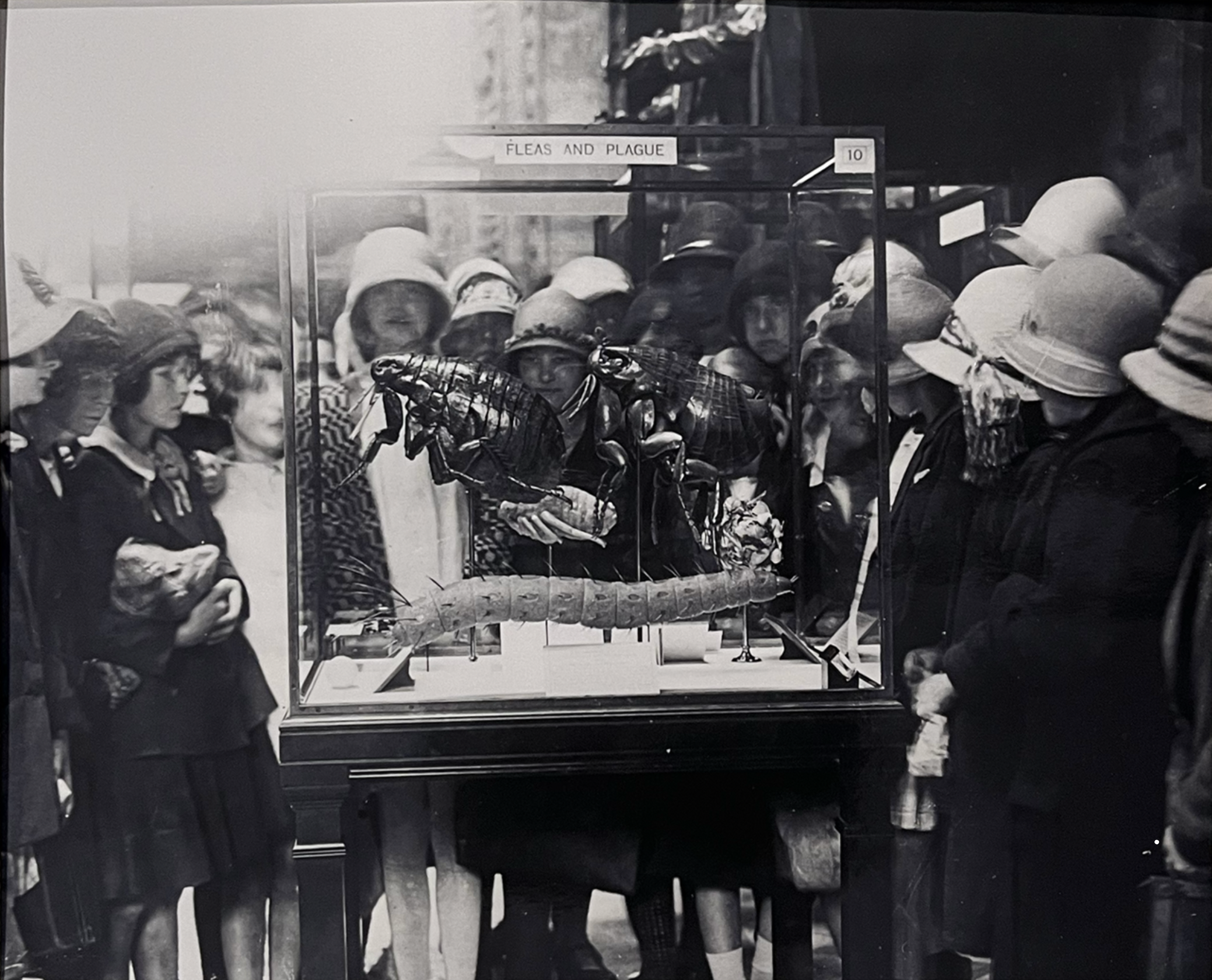
Visitors to the museum viewing a display titled ‘Fleas and Plague’ in 1927. This photograph is on display in the public galleries of the NHM
today. (NHM Library & Archives, 1927)
Today, the NHM has 36.5 million insect specimens – the biggest collection in the world, but this collection is no longer represented in its public facing galleries. Insects are crucial for our understandings of changing biodiversity in a climate crisis, and whether friend or foe, are animals we share our lives with more than any other. How can insect models help us understand how museum exhibitions have shaped public relationships with nature, and how might we use them again to tell new stories about our present and future?
References
Kusiak, P. (2010). Instrumentalized rationality, cross-cultural mediators, and civil epistemologies of late colonialism. Social Studies of Science, 40(6), 871–902. http://www.jstor.org/stable/40997775
Sleigh, C. (2001) ‘Empire Of The Ants: H.G. Wells and Tropical Entomology’, Science as Culture, 10(1), pp. 33–71. Available at: https://doi.org/10.1080/09505430020025492.


