NatSCA Digital Digest


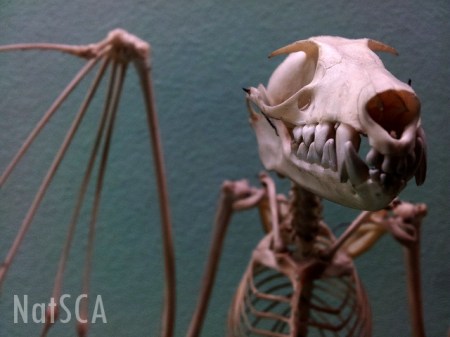
A mounted skeleton of a fruitbat leers at the camera

Welcome to the March edition of the Digital Digest! Without further ado…

News

Booking is open for the 2016 NatSCA Conference and AGM, ‘The Nature of Collections – How museums inspire our connection to the natural world‘, which will be held at the Derby Museum & Art Gallery and The Silk Mill on 21 – 22 April.

We have invited papers and posters looking at how museums have inspired and shaped the relationship of visitors and users of the collections to the natural world:

  • Projects between wildlife/environmental organisations/parks and museums.
  • The training & developing of naturalist skills using collections.
  • Artists projects connecting collections/gallery to outside spaces.
  • Looking at the relationship between natural history societies, their collections & museums.
  • Exhibition examples linking preserved specimens and our environment.

The Early Bird deadline is TODAY (Thursday 10 March), so get booking and save money!

If you’re not yet a NatSCA member, now is a great time to join – you can purchase membership and get the member’s conference rate for the same cost as a non-member ticket! See our membership page to join.

If you are a member, email the NatSCA Membership Secretary (membership@natsca.org) for your booking discount code.

Jobs

Geologist, Scarborough Museums Trust. A great opportunity for any rock and fossil enthusiasts! Application deadline: Friday 8 April.

Research and Data Coordinator in Science Policy (CITES), Kew. One of a selection of interesting posts currently on offer at Kew, the application deadline for this post is Wednesday 16 March.

Around the Web

A taxidermy warehouse in London was broken into on Tuesday this week, and 18 specimens were stolen. The Met police are appealing for information: http://news.met.police.uk/news/help-needed-to-trace-stolen-stuffed-animals-154850

DNA from museum specimens confirms a new species of forest thrush.

Why was the pink-headed duck’s head pink? Museum specimens reveal the secrets of this extinct species.

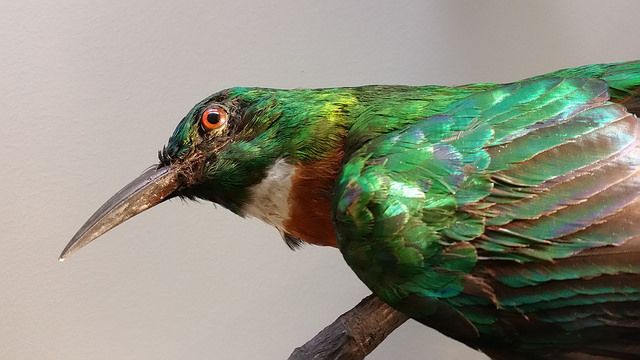
Taxidermy and the Country House: Information Needed!

birdpic

Today we would like to share a research request from historic taxidermy expert Pat Morris. Pat says:

I have been commissioned by the National Trust (NT) and English Heritage (EH) to write a book about ‘Taxidermy and the Country House’. I know about collections in houses managed by NT and EH, but finding out what’s where in privately owned mansions is proving difficult. I have been checking 19th century literature (county avifaunas particularly) for references to past collections, and I am trying to find out how many are still extant. I have also been asking around, which is what I’m doing now. If you know of any old collections of birds or hunting trophies in major country houses, I would be glad to know where, please. Many of the big houses, especially in East Anglia and in Shropshire, had substantial taxidermy collections that ended up in local museums, having been donated when no longer wanted at the Big House. If you know of any of these collections, who collected them and the house in which they were previously displayed, I would be grateful for your assistance.

If you have any information that could help in this matter, please contact Pat Morris at: pat.morris5@outlook.com

Understanding Museum Taxidermy: Construction, Care and Commissioning

Taxidermy, the art and science of preserving an animal by placing the skin around an artificial body, has always been an important part of natural history collections. During the Victorian era, explorers would bring large and exotic animals back from their long voyages: the mounted skins would be displayed, enthralling the Victorian public, who had never seen creatures such as gorillas and giraffes before. While we thankfully no longer hunt and kill animals for display in museums, taxidermy is still as important as ever for teaching about the natural world – probably more so now as more and more species are threatened with extinction. While there has been a resurgence in the popularity of taxidermy, it is still the case that the number of experts capable of producing and preserving taxidermy is dwindling (in the UK, at least). With this in mind NatSCA, in association with Lancashire Conservation Studios, ran a day of talks and hands-on sessions, entitled ‘Understanding Museum Taxidermy: Construction, Care and Commissioning’, on the 1st April.

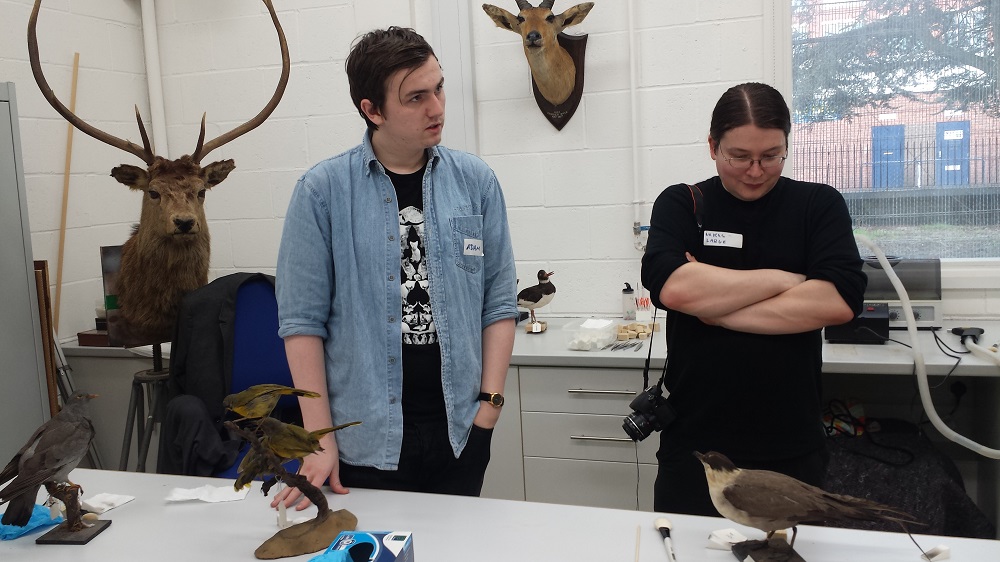
The day was led by Lucie Graham, Natural History Conservator at Lancashire Museums. Lucie began by demonstrating how taxidermy can be prepared using a wide variety of different methods, with internal moulds being formed from wood wool, balsam carvings, plaster and more. Taxidermy is an art, and each artist has their own methods. Lucie then went on to discuss how taxidermy can fall into disrepair if not properly cared for or prepared in the first place. We were able to get a close look an assortment of suffering taxidermy from Lancashire Museums, and discuss how we might treat each one to allow it to be better used and conserved. We had an adorable fox cub on our table, which had suffered from some fading, surface dirt and some loose digits on one paw. A bit of a clean and some adhesive to fix the paws, and this little cub could be looking much better!

taxidermy day3

Next we went through to the conservation lab for some cleaning demonstrations, where many of us were amazed to find out that simple cosmetic sponges get thick dirt off taxidermy effortlessly! We were also shown how to preen and straighten the feathers of a taxidermy bird, using steam to ease the process.

taxidermy day2

Finally were talks from a couple of the country’s leading taxidermists. James Dickinson discussed how museums can go about commissioning taxidermy. The Guild of Taxidermists can offer lists of accredited practitioners, ensuring that museums are able to make informed decisions and seek the services of the best person for the job. Jack Fishwick, judge at international taxidermy competitions, showed us a sample of his vast collection of bird photographs, which he uses for inspiration and feel for a bird’s shape and movement in life – vital for producing realistic taxidermy. The day finished with passionate discussion about the shrinking pool of skilled taxidermists – Jack and James warn that we may have no dedicated taxidermists left within the next two decades, which could be a disaster for museums wishing to expand and preserve their collections.

Glenn Roadley
Natural Science Curatorial Trainee

100 Years Aboard the Ark…

By Dr. Ebony Andrews
Calderdale Museums

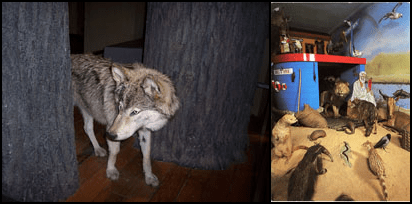
Left: An 'escapee' taxidermied grey wolf on the fringe of the 'Living Planet' gallery, Great North Museum: Hancock (2010). © Image by the author; Right: 'Abel's Ark', Hancock Museum (c.2004). © Archives of the Natural History Society of Northumbria, Great North Museum: Hancock.

Left: An ‘escapee’ taxidermied grey wolf on the fringe of the ‘Living Planet’ gallery, Great North Museum: Hancock (2010). © Image by the author; Right: ‘Abel’s Ark’, Hancock Museum (c.2004). © Archives of the Natural History Society of Northumbria, Great North Museum: Hancock.

For the past four years I have been researching changes in the use, display and interpretation of taxidermy in three regional museums in the North of England. These museums are: Leeds City Museum, Museums Sheffield: Weston Park (more commonly known as ‘Weston Park Museum’), and the Great North Museum: Hancock, Newcastle, (previously the Hancock Museum). The culmination of this research is the completion of my PhD thesis, entitled: Interpreting Nature: Shifts in the Presentation and Display of Taxidermy in Contemporary Museums in Northern England (2013).

In the study, I mapped out some of the wider trends in changes to the display and interpretation of museum taxidermy spanning roughly the last century across all three of the case study museums, but with a particular emphasis on the more recent display histories (from 1950-2013).One of the primary aims of my research was to challenge the idea that the unpopularity of museum taxidermy displays at different points in history, but particularly following the rise of the conservation movement in the UK, was exclusively related to the ‘controversial’ materials of taxidermy’s construction (ie. the use of animal derivatives). Rather, I proposed that much of the perceived ‘problem’ with taxidermy, both public and institutional in the latter part of the twentieth century, could be attributed not only to what was being presented, but also to a significant degree, to how it was being presented. In other words, how and through what mechanisms, public museums were interpreting their taxidermy collections for their public audiences.

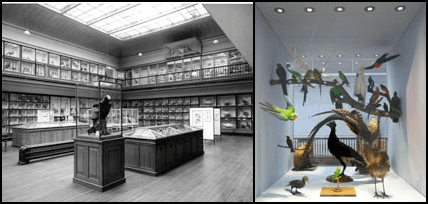
Left: The 'Bird Room', Hancock Museum (c.1966) © Archives of the Natural History Society of Northumbria, Great North Museum: Hancock; Right: 'Bio-Wall' display (detail) featuring 'Sparkie' the budgerigar (centre bottom), from 'Living Planet', Great North Museum: Hancock (2011). © Image by the author.

Left: The ‘Bird Room’, Hancock Museum (c.1966) © Archives of the Natural History Society of Northumbria, Great North Museum: Hancock; Right: ‘Bio-Wall’ display (detail) featuring ‘Sparkie’ the budgerigar (centre bottom), from ‘Living Planet’, Great North Museum: Hancock (2011). © Image by the author.

In a period where museum taxidermy is once again being afforded a considerable amount of attention, my research investigates some of questions that are now being asked about recent shifts in the use of taxidermy in museums along with some of the issues now facing museums in regard to the presentation of historical collections. My thesis is available through White Rose eTheses Online, see: http://etheses.whiterose.ac.uk/6637/ or simply go to http://etheses.whiterose.ac.uk/ and search the database by author or publication title to gain access to the complete document. Access to this resource is free, and you are not required to register your details to use it. With full colour illustrations and an extensive bibliography, I hope my thesis may be of use to those interested in the history of the display and interpretation of taxidermy, the impact of shifting cultural and ethical positions on the popularity of taxidermy, and the fascinating politics of both past and present approaches to the display of taxidermy in regional museums.

NatSCA Digital Digest

Welcome to the fortnightly digest of posts from around the web with relevance to natural science collections. We hope you find this useful and if you have any articles that you feel would be of interest, please contact us at blog@natsca.org

1. Blog: Night at the Museum, Uni Week

Synopsis

The next wave of young scientists have been on their feet this week showing us all their exciting research. Yours truly went down to the Natural History Museum, London to see how collections are being used right now.

Night at the Museum, Uni Week

2. Conference: NatSCA / SPNHC / GCG Conference, Cardiff 2014

22-28 June 2014

Synopsis

Time is running out to book your place for the Cardiff conference. If your team can spare you for that long it’s going to be a great week. You can book your place here.

3. Training: Taxidermy Seminar

18 July 2014
UCL Room G10, Chandler House, 2 Wakefield Street, London, WC1N 1PF

Synopsis

For folks that can get into London next month we have a great seminar lined up for you with seven speakers spanning a number of taxidermy-related disciplines. Book fast, spaces are limited.

TaxidermySeminar

4. Lecture: Indefatigable Naturalists. Wallace and Darwin on the Evolutionary Trail

30 July 2014
Flett Events Theatre, Natural History Museum, South Kensington, London

Synopsis

Professor of Biology Dr. Jim Costa discusses the life and works of naturalist Alfred Russell Wallace. The annual Wallace lecture is organised by the NHM’s Wallace Correspondence Project.

How to book

Compiled by Samuel Barnett, NatSCA Blog Editor