How to Foster Empathy with Endangered Animals: Developing a Creative Writing and Drawing Workshop Toolkit

Written by Dr Christina Thatcher, Lecturer in Creative Writing & Dr Lisa El Refaie, Reader in Language and Communication, Cardiff University.

With biodiversity declining at an alarming rate, we need to find ways of encouraging people to care about all endangered animal species, not just the ones with the most obvious appeal, such as pandas and polar bears, for example. According to the International Union for Conservation of Nature’s ‘Red List of Threatened Species’, 27% of mammals are threatened with extinction, but so are 44% of reef corals, 41% of amphibians, 37% of sharks and rays, 21% of reptiles, and 12% of birds.

In 2023, we—Dr Christina Thatcher and Dr Lisa El Refaie from Cardiff University—met and discovered our shared interest in the expressive arts, metaphor, empathy and nature. We then designed a project which aimed to use the power of creativity to increase public awareness of, and empathy for, endangered animals, focusing on species that have few or no obvious human-like features. The project was funded by the Arts and Humanities Research Council (AHRC) Impact Acceleration Account and ran from November 2023 until the autumn 2024, in collaboration with Natural History curators at the National Museum Cardiff. Continue reading

Feeling Older than Your Age? The Importance of Museum Collections for Radiocarbon Dating, and a Request for Collections containing Bivalves Collected Before 1950 from the UK

Written by Rachel Wood, Associate Professor, Oxford Radiocarbon Accelerator Unit, School of Archaeology, University of Oxford.

Radiocarbon dating is routinely used to work out the age of archaeological and palaeontological sites, and often pops up in news articles and TV dramas. But some substantial problems remain. One of these is the calibration process, which allows us to convert the ratio of 14C (“radiocarbon”) and 12C (the common stable form of carbon) to an age estimate. This is particularly challenging when we are trying to date marine shells or any animal that has eaten food from the marine system. This means that it can be difficult for us to get an accurate age for a sample that should be straightforward – for example, the skeleton of Medieval person or a Mesolithic dog.

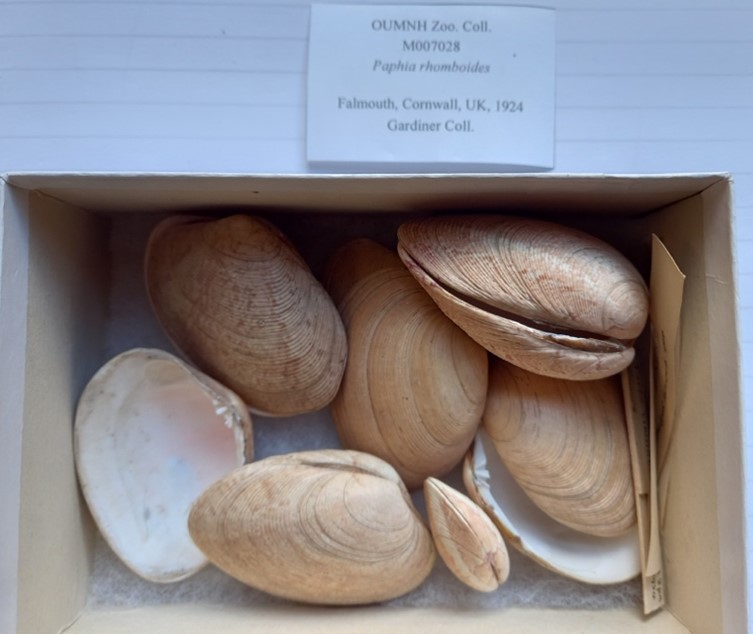
The Oxford Radiocarbon Accelerator Unit is starting a project looking for samples of marine shells to help resolve this problem (Fig. 1). Natural history collections in museums are key to its success, and we would be very grateful to hear if anyone has a collection of pre-1950 marine bivalve shells.

Figure 1. Marine bivalves, suitable for helping us to calibrate radiocarbon dates. Please let us know if you have similar material that can be analysed by sampling a small strip from the edge. (Photo Peter Ditchfield, Courtesy Oxford University Museum of Natural History)

The Problem

At school, we are taught that radiocarbon dating works because radiocarbon decays radioactively at a known rate. By comparing the amount of 14C to a stable form of carbon called 12C, we can work out the age of a sample (Fig. 2). This is true, but only partially so because the starting 14C:12C varies. To get around this problem, we need to calibrate radiocarbon dates. Most 14C is produced in the upper atmosphere, and is incorporated into plants by photosynthesis and then passed through the food chain. This means, that if someone is eating terrestrial food – they will have a similar 14C:12C ratio in their bodies as in the atmosphere.

Continue reading

Behind The Heads: Natural History, Empire and The Abel Chapman Collection. Part 2.

Written by Dan Gordon, Keeper of Biology, The Great North Museum: Hancock.

Abel Chapman’s time in southern Africa was only the first of many visits to the continent. His next trip, in 1904, was to a very different place – British East Africa. This was a colonial protectorate roughly equivalent to today’s Republic of Kenya. It had grown out of land leased by the British East Africa Company but was now firmly under British imperial control.

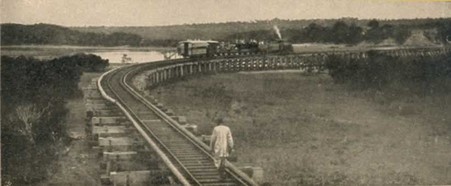
The Uganda railway, a huge feat of engineering, had been completed just three years before Chapman’s visit. This now allowed trains to travel the 800km (500 miles) between Mombasa on the east coast and the African Great Lakes. The British now had the means to extend their influence right across East Africa, disrupting the slave routes and simultaneously opening up the land to the missionaries, settlers, tourists and game hunters that were now pouring in. It was in this rapidly changing environment that Chapman strove to find the longed for wilderness that had eluded him in Transvaal, and test his skills as a sportsman, before that land too vanished under the settler’s plough.

Figure 1. An undated photo of the Uganda Railway near Mombasa (http:/www.jaduland.de, Public domain via Wikimedia Commons)
Continue reading

CryoArks Biobank and COVID-19

Written by Andrew Kitchener, Principal Curator of Vertebrates, National Museums Scotland.

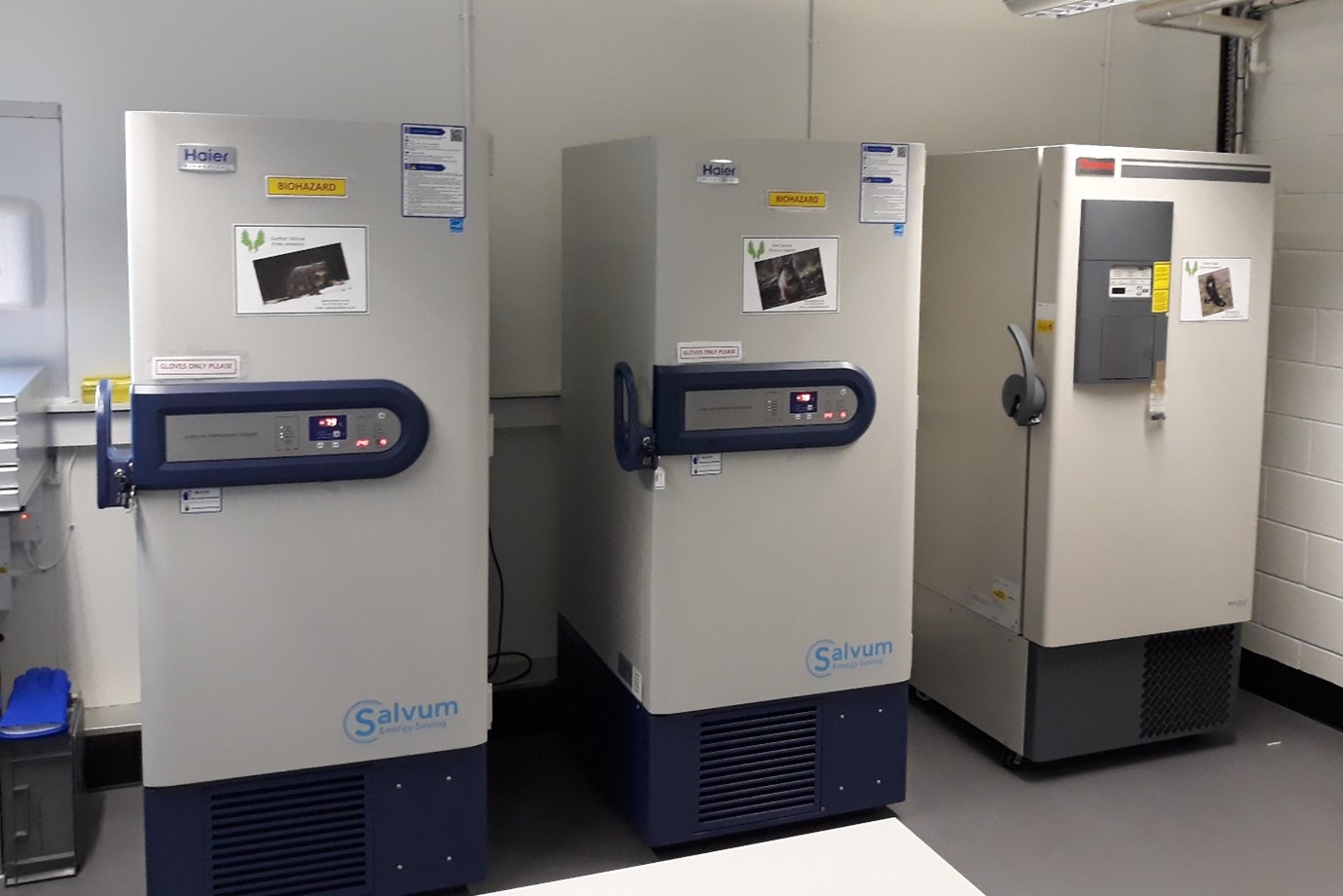
Biobanks may sound a bit dull when compared to shelves teeming with boxes filled with fascinating skeletons, or cabinets stuffed with colourful skins, beautiful eggs or pinned insects. Serried ranks of anonymous freezers, enhanced with the odd fridge magnet, could make your heart sink, but peep inside the biobanks’ databases and you will see an amazing array of biodiversity. 

CryoArks Biobank at National Museums Scotland ©National Museums Scotland

At National Museums Scotland we host one of the main hubs of the CryoArks Biobank initiative alongside our partners at the Royal Zoological Society of Scotland, who also host a hub of the European Association of Zoos and Aquaria Biobank, and the Natural History Museum in London. CryoArks is a project led by Professor Mike Bruford of Cardiff University and funded by the Biotechnology and Biological Sciences Research Council to establish zoological biobanking in the UK. As well as the -80o freezer infrastructure to store the tissue samples long term, CryoArks is developing an online database that will allow researchers to find out what genetic resources are available in the CryoArks Biobank hubs and in member institutions. With the advent of the Nagoya Protocol on Access and Benefits Sharing in 2014, access to genetic samples from species from range countries is more challenging. Therefore, it is vital that we make the best use of the samples already available in the UK and make these freely available to support research, much of which may benefit the conservation of endangered species worldwide. 

Continue reading

Behind The Heads: Natural History, Empire and The Abel Chapman Collection. Part 1.

Written by Dan Gordon, Keeper of Biology, The Great North Museum: Hancock.

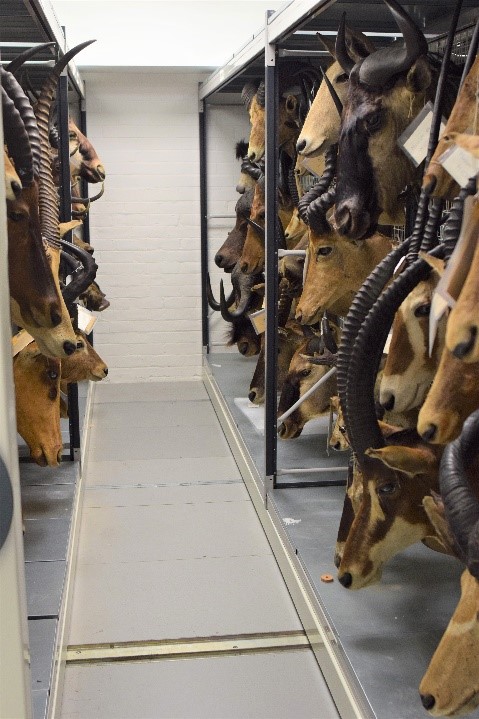
In the museum’s basement is a room filled with heads. Row after row of them stare out from metal racks, glassy eyed and bristling with every kind of horn and antler. Visitors to this room are sometimes awestruck at the breadth of species on display. The Kudu, its head crowned by spiralling horns like giant corkscrews. A tiny Klipspringer with horns like shiny black thorns. The huge Eland, its vast head armed with massive horns like tank shells. A parliament of Africa’s fantastic beasts, all in this small storeroom. These are hunting trophies from the Abel Chapman collection. When he died in 1929 they were taken down from the walls of his Northumberland home, and gifted to the museum.


Figure 1. A rack of game trophies from the Chapman collection in the Great North Museum resource centre (Copyright Tyne and Wear Archives and Museums.

In light of the current conversation about museums and colonialism, and the insightful work of Lowe and Das on the subject of Natural History collections in this context, I thought I’d try to learn more about the history of the great North Museum’s African collections, and my attention was caught on the horns of Chapman’s trophies. The more I’ve learned about their story, the more I’ve come to feel that trophy heads, some of the most recognisable Natural History objects, are great examples of the way that colonialism has both helped to shape naturalism, museum collections and even our ideas about wildlife conservation.

The story of our collection begins in 1851 when Abel Chapman was born into a wealthy Sunderland brewing family. Educated at the elite Rugby School, he joined the family firm as a young man and embarked on a successful business career. Chapman was intelligent and adventurous, making expeditions to places like Canada, Scandinavia and the Arctic. In detailed notebooks filled with deft pencil sketches he documented the things he heard, saw and shot, and used these to write a whole series of books. He built a reputation as a ‘hunter naturalist’ passionate about combining field sports with game preservation, and as well as amassing a horde of trophies, he became an influential figure in the emerging field of wildlife conservation.

Continue reading