How Do You Do Decolonial Research in Natural History Museums?

Written by Jack Ashby, Assistant Director of the University Museum of Zoology, Cambridge.

Subhadra Das and Miranda Lowe’s paper, Nature Read in Black and White: Decolonial Approaches to Natural History Collections (2018) acted as a wake-up call to our sector, effectively founding a discipline in natural history museums. In the five years since, a lot of work has begun to address the colonial legacies underpinning collections of animals, plants, fungi and rocks.[i] The principal aims of this work include telling more honest stories about the different kinds of injustice involved in the acquisition of collections; and addressing the fact that our museums have long been prioritising narratives elevating white individuals over everyone else. In doing so, it is hoped that a greater diversity of people will feel represented by our museums, thereby enhancing the relevance of the collections.

Natural history collections dwarf those of any other museum discipline, and unlike sectors which have been thinking about this for decades, the practices underpinning their creation have not traditionally prioritised recording associated cultural or social histories. Like others who felt inspired by Subhadra and Miranda’s call to action, faced with contemplating how to begin to unpick the stories hidden behind literally millions of ‘scientific’ specimens, it was fundamental to consider the question, where do you start with decolonial research in natural history museums? Obviously, there is no one answer, but I thought it could be helpful to list a few possible approaches. One underlying element is to recognise how colonialism and its framings have shaped the way that events took place – from major historical moments to minute individual acts – and how the stories about these events have been told.

Below is a list of possible starting points for research, with examples of what that could look like in practice (in reality most of these overlap). For me, each has something to say about the entwined human and environmental costs of the colonial project – questions that natural history museums are uniquely placed to address.

Continue reading

What is Taxidermy? An Intimate Relationship between Death and Maker.  

Written by Jazmine Miles Long, Taxidermist. https://www.jazminemileslong.com, Twitter: @TaxidermyLondon; Instagram: @Jazmine_miles_long

For taxidermy to exist an animal must have died. This brutal truth creates unease and leaves the viewer to ponder how the death occurred. And secondly how the death and the body is managed. A fluffy rabbit, cute and cuddly in life, suddenly becomes hideous and untouchable in death. Due to my profession, I am raising a child who has been exposed to dead animals and the concept of death his whole life. This has not made him desensitised to death, I’d say the opposite. He is deeply hurt by the death of any animal; he is a self-proclaimed vegetarian and last week at the age of 4 he asked me if his job when he grows up could be to stop people eating animals. He shouts at cars to slow down in case they hit anything and one of my favourite things he asks me when we meet new people is if they are a vegetarian or a carnivore eyeing them up suspiciously. Does a good understanding of death at a young age give a person greater empathy for animals and take us closer to not seeing them as ‘other’? 

When my son is asked what a taxidermist does, he says they look after animals when they die. I get at least one phone call a week from someone mourning their dead pet, I give advice on what to do next, ideas for memorials and how to store the body in the freezer while they decide what to do. I didn’t expect as a taxidermist to be a councillor, a listening ear, someone who is qualified to talk about death. 

Continue reading

Designated Status for Ipswich Museums’ Post-Cretaceous Geology Collection.

Written by Dr Simon Jackson, Collections and Learning Curator (Natural Sciences), Colchester + Ipswich Museums.

Ipswich Museums’ Post-Cretaceous Geology Collection, which includes our outstanding ice age collection, has been awarded Designated status by Arts Council England. The team here are delighted!

“OK, what exactly is Designation?” some of you may be thinking… Well, the scheme is administered by Arts Council England and identifies the pre-eminent collections of national importance held in England’s non-national museums, libraries and archives, based on their quality and significance. So, this award is a mark of distinction which is useful, for instance, in securing funding. If this has piqued your interest, and, for instance, you may be thinking “perhaps my collection is eligible for the scheme?” you can read more about Designation here: Designation Scheme | Arts Council England or my 2020 paper about the Tullie House bid I led on then, here https://www.natsca.org/article/2578 .

So, what’s been Designated at Ipswich? The Ipswich Post-Cretaceous Geology Collection includes c.30,000 specimens. The greatest strength of the collection includes Suffolk Plio-Pleistocene fossils, the remains of animals which lived during the Pleistocene ice age, and the warmer Pliocene before it. Suffolk has an outstanding Plio-Pleistocene record, with the only exposures of the Coralline Crag (Middle Pliocene) and extensive exposures of the Red Crag (the only exposed British deposit to document the transition into the ice age). The county’s deposits also document the dramatically changing environments of the ice age between warmer, wetter episodes (interglacials) and colder, drier episodes (glacials).  With pre-eminent collections covering this period, the collection now attracts international research, which, for instance, includes searching for the oldest mammoth DNA from Europe in c. 200,000 year old teeth from Suffolk – research led by the Centre for Palaeogenetics, at the Stockholm University and the Swedish Museum of Natural History, and the NHM). You can read more about the project here: https://cimuseums.org.uk/mammothdna/

Continue reading

4th MOBILISE Training School: “Next Step in the Digitisation Process of Natural History collections: Publishing of Biological, Geological, Palaeontological and Mineralogical data”.

Written by Olivia Beavers, Assistant Curator of Vertebrate Zoology at World Museum, National Museums Liverpool.

In December I was selected, along with 17 others, to attend the 4th MOBILISE Action Training School held in Brussels, 6–7th February. This training school gave an opportunity for students and professionals of Natural History Institutions from Europe and Israel to learn more about the publishing of our collections’ data sets. A crucial aim of the training school was to learn how to map data to the Darwin Core Standard, and as a result, create a Darwin Core Archive file to be uploaded to GBIF.

The Training School consisted of two parts: the first was an introduction to the group. This was conducted online and addressed theoretical issues associated with our datasets. Part 2 was the two-day, face to face trip to Brussels to check the cleaning and validation of our data for it to be ready for publishing on GBIF (for Biological Data) or GeoCASe (for Geological, Palaeontological and/or Mineralogical data).

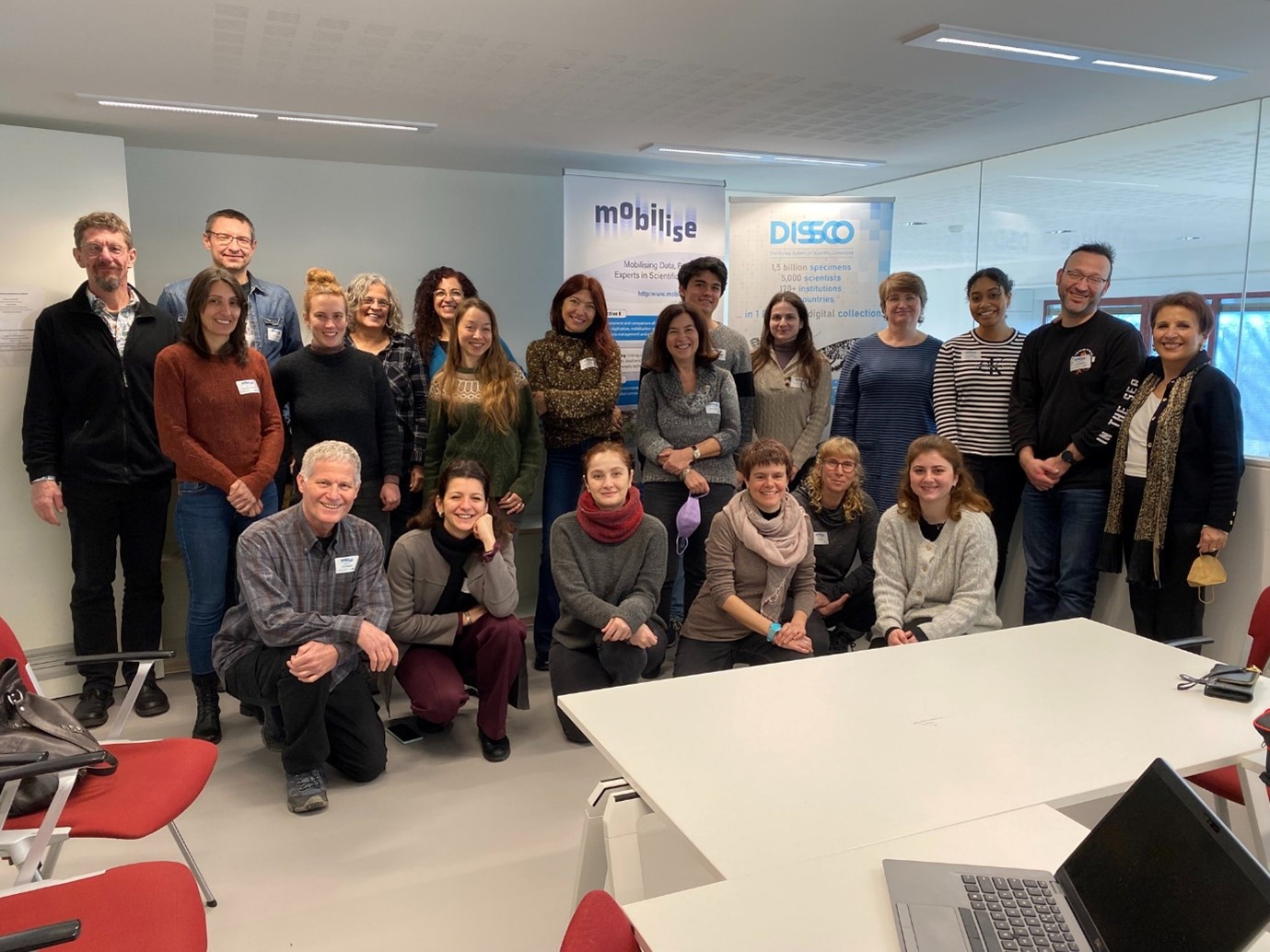
A group photo of the 21 attendees and group leaders at the 4th MOBILISE Action Training School, Brussels
Figure: 1 A group photo of the attendees and group leaders at the 4th MOBILISE Action Training School, Brussels ©Katerina Voreadou
Continue reading

Listening and learning: Reflections on the Second Workshop of the People and Plants Project

Written by Fiona Roberts. Collaborative ESRC PhD student, Cardiff University and Amgueddfa Cymru-National Museum Wales Decolonising biocultural curation of South Asian medicinal plants.

Monday 7th November, National Museums Collections Centre

In early November, a group of academics, researchers, curators, artists and knowledge holders gathered at Edinburgh’s National Museums Collections Centre. The second workshop of the year-long AHRC-funded ‘People and Plants’ project focused on ‘reactivating ethnobotanical collections as material archives of Indigenous ecological knowledge.’

During the object handling session (Photo by Dr Ali Clark, National Museums Scotland)

The People and Plants Project

Led by National Museums Scotland, Royal Botanic Gardens, Kew and the Powell-Cotton Museum, the project investigates current debates on decolonising museum practices, including the interplay between natural history and ethnography collections, creating a conversation about these among varied experts.

The project’s previous workshop, held at the Powell-Cotton Museum in March 2022, brought together Somali knowledge holders from UK diasporic communities and was run in partnership with the University of Kent’s School of Anthropology and Conservation and the NOMAD project, which engages Somali communities in heritage projects. To read more, see this previous blogpost, and view workshop talks on YouTube [People and Plants – YouTube].

Continue reading