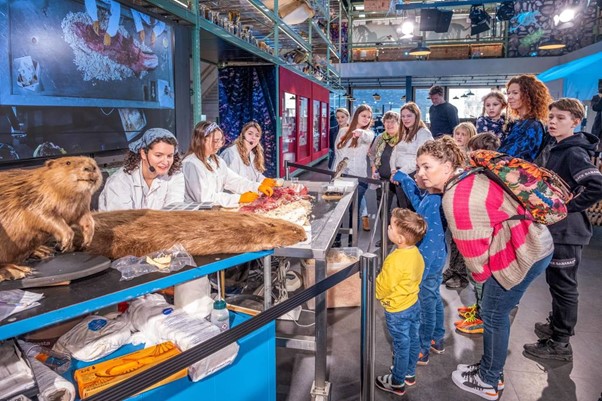
Making a Green Gallery – A Leeds Story

By Sara Merritt, Audience Development Officer at Leeds Museums & Galleries.

Us: We want to retro-fit a permanent gallery! As sustainably as possible! With £40k! In two months! And we want to keep the space open to visitors!

Them: Umm, are you sure that’s a good…

Us: Great! We’ll get cracking.

2022 saw us undertake the retro-fit of our permanent Life on Earth gallery at Leeds City Museum, with the aim of making it as sustainable as possible. The gallery required an overhaul to meet current visitor expectations, with innovative design ideas and production methods to reflect our greater understanding of climate change, the biodiversity crisis, and Britain’s colonial history.

Our objectives were threefold and carefully considered:

  • To manage and deliver a sustainable retro-fit with the addition of creating a carbon calculator to measure our C02 output
  • To ensure the interpretation was relevant, and that we had a strong idea of our target audience to attract visitors who were already engaged in making climate-positive changes.
  • To identify robust materials and production methods which would stand up to visitors pulling, prodding, and everything in between.

We were used to working with greener materials for temporary exhibitions and knew the implications around material availability, longevity of eco materials, and higher associated costs. We therefore needed to keep the project resource light and put our efforts into the interpretation, rather than dramatic object moves. We took the bones of what we had, large cases and great objects, and retold the story with the emphasis on using our objects to inspire our visitors to live more sustainably.

Continue reading

NatSCA Digital Digest – April 2024

Compiled by Milo Phillips, Digitisation Co-ordinator at the Royal Botanic Garden Edinburgh

Welcome to the April edition of NatSCA Digital Digest.

A monthly blog series featuring the latest on where to go, what to see and do in the natural history sector including jobs, exhibitions, conferences, and training opportunities. We are keen to hear from you if you have any top tips and recommendations for our next Digest, please drop an email to blog@natsca.org.

Sector News

NatSCA Annual Conference & AGM 2024

Not long now until the 2024 Annual Conference & AGM of the Natural Sciences Collections Association. Trials and Triumphs: sharing practice across the museum sector will be held next week, Thursday 18th and Friday 19th April 2024, in the Oxford University Museum of Natural History. This practical conference aims to celebrate triumphs and amplify successes in museums, but also highlights pitfalls and lessons learned from situations that didn’t go as planned. 

Find more information, and the programme of talks and events on the event page here.

The Unnatural History Museum

The Unnatural History Museum series of talks brings together museum professionals, creatives and academics across disciplines to platform vital conversations about the museum mediation of the natural world during the sixth mass extinction.

The series unfolds over a series of themed Zoom sessions featuring short presentations, followed by a roundtable discussion. The third session, on “Deep Time”, will feature papers from and discussion with Diana Marsh (University of Maryland), Richard Fallon (Natural History Museum, London), and Shana van Hauwermeiren (Workshop Intangible Heritage).

The talk will be later this month, on Wednesday 24th April at 5pm Irish Standard Time.

Registration is free and more information can be found on the Eventbrite page here.

Continue reading

The Institute of Biology of the National Autonomous University of Mexico Celebrates its 95th Anniversary

Written by Fernando A. Cervantes and Yolanda Hortelano-Moncada, National Mammal Collection, National Biodiversity Pavilion. Institute of Biology, UNAM. Mexico City, Mexico.

The Instituto de Biología (IB) will celebrate its 95th anniversary on November 9, 2024 and is a dependency of the Universidad Nacional Autónoma de México (UNAM) (Fig. 1). This date coincides with the same time that the Mexican government granted “autonomy” to the then National University of Mexico.  

Fig. 1. Central buildings of the Institute of Biology, National Autonomous University of Mexico, Mexico City (Photograph: Institute of Biology, UNAM).

The central buildings of the IB are located in the south of Mexico City, in the area known as Pedregal de San Ángel, which is characterized by a rocky substrate of volcanic origin. Currently, a large part of the IB campus is an ecological reserve that protects the flora, fauna, and fungus of the natural ecosystem of the area, which corresponds to xerophytic scrub (Fig. 2). 

Fig. 2. Xerophytic scrubland growing on volcanic rock in the Ecological Reserve of Pedregal de San Ángel, where the Institute of Biology, UNAM, is located in Ciudad Universitaria, Mexico City (Photograph: Dirección General de Comunicación Social, UNAM).
Continue reading

Mainstreaming Biodiversity in Museums

Written by Henry McGhie, Curating Tomorrow henrymcghie@curatingtomorrow.co.uk.

Link to the guide: https://curatingtomorrow236646048.files.wordpress.com/2023/11/mainstreaming-biodiversity-in-museums_2023.pdf

‘Mainstreaming’ is a policy and planning approach that means that we don’t just create a new programme or strand of work, but that we embed it across all activities. We can embed support for biodiversity and environmental concerns across museum activities. Why is this important? Well, for a few reasons. Firstly, biodiversity is not yet fully mainstreamed into museum thinking – in terms of their goals, actions, or evaluation. Second, museums present a massive potential to support biodiversity in different ways, notably through education, research, public awareness and partnerships. Third, museums make big negative impacts on biodiversity and the environment, through their contributions to climate change (from use of energy, waste, and visitor emissions), and their involvement in environmentally damaging activities (e.g. how their investments are used). Fourth, because biodiversity is in deep crisis: species continue to decline, major challenges are getting worse, and there is no clear prospect of a change for the better. Lastly, fifth, because people and nature are interdependent: if the environment suffers, people and communities suffer.

Continue reading