NatSCA Digital Digest – February 2025

Compiled by Ellie Clark, Collections Moves Team Leader at the Natural History Museum

Welcome to the February edition of NatSCA Digital Digest.

Digital Digest is a monthly blog series featuring the latest on where to go, what to see and do in the natural history sector including jobs, exhibitions, conferences, and training opportunities. We are keen to hear from you if you have any top tips and recommendations for our next Digest, please drop an email to blog@natsca.org.

Sector News

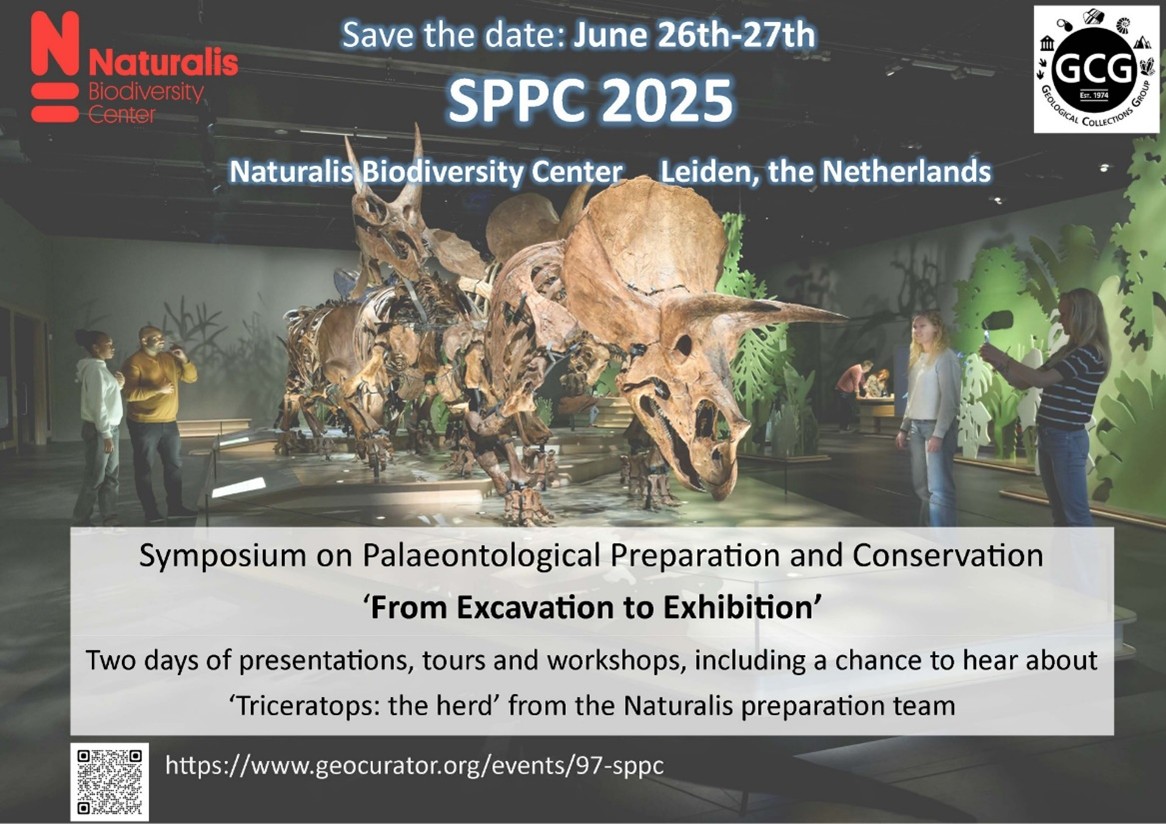
Save the Date: SPPC, June 26th – 27th 2025

The 30th Symposium on Palaeontological Preparation and Conservation will be held in the Netherlands this year on 26-27th June.

The theme will be From Excavation to Exhibition including aspects of the story of how geological collections end up on display in our museums, as well as their conservation and preparation. A call for abstracts and registration is coming soon. For more details visit: https://www.geocurator.org/events/97-sppc

Continue reading

NatSCA Digital Digest – January 2025

Compiled by Milo Phillips, Digitisation Co-ordinator at the Royal Botanic Garden Edinburgh.

Welcome to the January edition of NatSCA Digital Digest.

Happy New Year everyone, and welcome to the first Digital Digest of 2025.

Digital Digest is a monthly blog series featuring the latest on where to go, what to see and do in the natural history sector including jobs, exhibitions, conferences, and training opportunities. We are keen to hear from you if you have any top tips and recommendations for our next Digest, please drop an email to blog@natsca.org.

Sector News

First, we have a few conference deadline reminders for the start of the year:

NatSCA Conference & AGM 2025

The 2025 NatSCA conference Call for Papers is closing soon! The deadline to submit is 5pm GMT Friday 17th January. Get in touch with the committee with any questions (conference@natsca.org). We look forward to reading your submissions!

Making a Difference: Showing the Positive Impact of Natural History Collections

The Annual Conference & AGM of the Natural Sciences Collections Association will be held on Thursday 8th and Friday 9th May 2025 at The University of Manchester, Manchester Museum.

Natural history collections are involved in a huge range of work that has enormous positive impacts on people and the planet – this is a conference to share these stories. The #NatSCA2025 conference invites proposals for presentations looking at impact, how our work is making a difference, how we measure it, how we show success, and how we advocate for collections.

We seek ideas from the natural history collections community, educators, collaborators, and beyond. We are interested in practical lessons, unique solutions, new collaborations, and to show what has and hasn’t worked. We are particularly looking for presentations that share the differences museums are making in:

  • facing global challenges such as the biodiversity and climate crises, and environmental issues
  • improving people’s lives
  • changing laws
  • social justice, restitution, and decolonisation
Continue reading

NatSCA Digital Digest – December 2024

Compiled by Olivia Beavers, Assistant Curator of Vertebrate Zoology at World Museum, National Museums Liverpool.

Welcome to the December edition of NatSCA Digital Digest.

A monthly blog series featuring the latest on where to go, what to see and do in the natural history sector including jobs, exhibitions, conferences, and training opportunities. We are keen to hear from you if you have any top tips and recommendations for our next Digest, please drop an email to blog@natsca.org.

Sector News

NatSCA Conference & AGM 2025

The 2025 NatSCA conference Call for Papers is open! The deadline to submit is 5pm GMT Friday 17th January. In the meantime, don’t hesitate to reach out to the committee with questions. (conference@natsca.org) We look forward to reading your submissions!  

Making a Difference: Showing the Positive Impact of Natural History Collections

The Annual Conference & AGM of the Natural Sciences Collections Association will be held on Thursday 8th and Friday 9th May 2025 at The University of Manchester, Manchester Museum.

Natural history collections are involved in a huge range of work that has enormous positive impacts on people and the planet – this is a conference to share these stories. The #NatSCA2025 conference invites proposals for presentations looking at impact, how our work is making a difference, how we measure it, how we show success, and how we advocate for collections.

We seek ideas from the natural history collections community, educators, collaborators, and beyond. We are interested in practical lessons, unique solutions, new collaborations, and to show what has and hasn’t worked. We are particularly looking for presentations that share the differences museums are making in:

Continue reading

NatSCA Digital Digest – October 2024

Compiled by Milo Phillips, Digitisation Coordinator at the Royal Botanic Garden Edinburgh.

Welcome to the October edition of NatSCA Digital Digest.

A monthly blog series featuring the latest on where to go, what to see and do in the natural history sector including jobs, exhibitions, conferences, and training opportunities. We are keen to hear from you if you have any top tips and recommendations for our next Digest, please drop an email to blog@natsca.org.

Sector News

Forensic Solutions to Pangolin Poaching

Does your collection include pangolins? Museum pangolins requested in an effort to build a stable isotope database.

The plight of the pangolin and intensification of poaching for traditional medicine is well-publicised. There is an urgent need for new forensic solutions to this crisis that transcend disciplines. The Scottish Universities Environmental Research Centre (SUERC) are seeking small scale samples from any and all pangolin species held in UK museums. Of particular interest currently is the Philippine pangolin (Manis culionensis).

The project aims to develop a robust, multi-isotope provenancing map which will make it possible to determine where specific confiscated scales are poached. It will do this using stable isotopes and spatial markers such as trace metals. The team at SUERC are happy to travel for in-house destructive sampling or can provide postage materials if the curators and collection managers would prefer to take samples themselves.

For details, please contact Ruth Lewis-Smith (r.lewis-smith.1@research.gla.ac.uk) at the University of Glasgow.

Continue reading

NatSCA Digital Digest – July 2024

Compiled by Milo Phillips, Digitisation Coordinator at the Royal Botanic Garden Edinburgh.

Welcome to the July edition of the NatSCA Digital Digest.

A monthly blog series featuring the latest on where to go, what to see and do in the natural history sector including jobs, exhibitions, conferences, and training opportunities. We are keen to hear from you if you have any top tips and recommendations for our next Digest, please drop an email to blog@natsca.org.

Sector News

SPPC Registration and Call for Abstracts

Registration for the Symposium on Palaeontological Preparation and Conservation is now open!

The deadline for abstract submission is July 31st and, the symposium will be run in a hybrid format. Afternoon tours of the university archaeological laboratories will also be available.

For more information on SPPC and to see past abstracts and posters, please visit their website.

Call for Papers – Book of Nature, Nature of Books: Practices of Female Botanists

The research centres TIL (Université de Bourgogne) and EMMA (Université Paul-Valéry Montpellier 3) are organizing a bilingual, international, interdisciplinary conference on the role of women in the development of botany as part of visual, manuscript and print cultures, from the Middle Ages to the contemporary period.

Discussions will focus on the history of natural sciences, print culture, book history, illustration studies, gender studies, plant studies and ecocriticism and the organisers welcome papers on a wide range of case studies, from archives and museum collections to the garden itself.

Please send a 300-word abstract and a biobibliography (in English or French) before 31 October 2024 to the following address: bookofnature2025@gmail.com

The full details can be found here.

Continue reading