NatSCA Digital Digest – January 2023

Compiled by Claire Dean, Project Curator, Tullie House Museum & Art Gallery.

Welcome to the January edition of NatSCA Digital Digest.

A monthly blog series featuring the latest on where to go, what to see and do in the natural history sector including jobs, exhibitions, conferences, and training opportunities. We are keen to hear from you if you have any top tips and recommendations for our next Digest, please drop an email to blog@natsca.org.
Sector News

The NatSCA annual conference and AGM will be held at The Potteries Museum & Art Gallery on Thursday 27th and Friday 28th April 2023. The focus this year is So how do we actually do all this? Hopeful futures and turning theory into practice for big issues in natural history collections.

We are looking for 20-minute presentations, 5-minute lightning talks, and posters. Work can be presented in-person or digitally. All the details you need are here. The deadline for submission is 5pm GMT Monday 30th January.

Abstract submissions are also now open for SPNHC 2023. The 38th Annual Meeting of The Society for the Preservation of Natural History Collections is being held in San Francisco, California 28 May – 2 June 2023. Full details here.

Continue reading

NatSCA Digital Digest – May 2022

Compiled by Claire Dean, Curatorial Assistant at Tullie House Museum and Art Gallery, Carlisle, and MA Preventive Conservation student at Northumbria University.

Welcome to the May edition of NatSCA Digital Digest.

A monthly blog series featuring the latest on where to go, what to see and do in the natural history sector including jobs, exhibitions, conferences and training opportunities. If you have any top tips and recommendations for our next Digest please drop an email to blog@natsca.org.

Sector News

The countdown is on to the SPNCH/NatSCA/BHL Conference 2022, which is being held in Edinburgh and online. Early Rate registration has now closed but a Late Rate registration fee is still available, with NatSCA members eligible for the Standard Member rate. The programme runs from Sunday 5th to Friday 10th June and is available to view here.

If your work involves (or if you are considering) citizen science, community science, or other forms of research collaborations with the public, you may be interested in joining the virtual C*Sci2022 conference, May 23-26th.  Registration is now open and the full programme is available here.

Brighton’s Booth Museum has received funding from the Esmée Fairbairn Collections Fund for an exciting new project to create a modern diorama to reflect changes in UK wildlife since E.T. Booth’s death in 1890. The project will also involve improving their educational offers and increase audience participation. Due to run from 2022-2024, you can find out more about the project here.

Continue reading

Digital Digest – April 2022

Compiled by Milo Phillips, Assistant Curator of Entomology for Leeds Museums and Galleries.

Welcome to the April edition of NatSCA Digital Digest.

A monthly blog series featuring the latest on where to go, what to see and do in the natural history sector including jobs, exhibitions, conferences and training opportunities. If you have any top tips and recommendations for our next Digest please drop an email to blog@natsca.org.

Sector News

SPNHC / BHL / NatSCA Conference 2022

This summer will see the return of the physical NatSCA Conference – a partnership with the Society for the Preservation of Natural History Collections and the Biodiversity Heritage Library. Early Rate registration has now closed but a Late Rate registration fee is still available, with NatSCA members eligible for the Standard Member rate. The programme of events is now available to view.

NatSCA Lunchtime Chats

The new lunchtime chats are for members only and run on the last Thursday of every month. In our last session we heard from Mike Rutherford, Curator of Zoology and Anatomy at the Hunterian in Glasgow all about their investigation of a sperm whale that washed up in Thailand.

In this month’s talk we’ll be having a discussion about upcoming openings on the board of trustees for NatSCA (i.e. the committee), so please join us if you’d like to learn more about what we all do. There will be specific roles opening up so departing trustees will be explaining in more detail what those involve, but there will also be general positions available. Any NatSCA member is eligible to become a trustee; no previous experience or length of time as a member is a requirement, just an enthusiasm for supporting the work of the association. We welcome and encourage all applicants and we are particularly keen to receive nominations that help us represent the diversity of our membership, at trustee level.

Continue reading

NatSCA Digital Digest – February

What’s New?

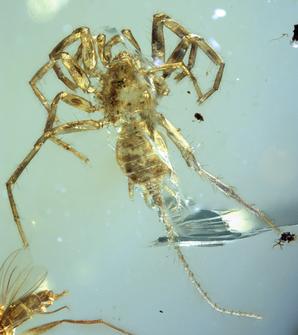
If you haven’t heard about the exciting discovery of a “spider-like” ancient creature from 100 million years ago, now is the time to check it out! Named Chimerarachne yingi, this little beauty has eight legs and a tail, and is exquisitely preserved. I only wish H. R. Giger had been around to see it. You can read more about the discovery here.

Chimerarachne (Image in public domain)

It’s day three of Operation Move Sue the T. rex over at the Field Museum. To follow this story, follow #SueOnTheMove.

What Shall I Attend?

The big item on everyone’s calendar is of course the NatSCA Conference 2018 – this year hosted in Leeds. Keep the dates 26th and 27th April free. I’m hoping people bring their live-tweeting A-game this year because I’m not able to go, so I need to live vicariously through you wonderful people. You can find more information on our website. Paper and poster submissions are now closed but you can still contribute; continue reading to the next section for more information.

Continue reading

NatSCA Digital Digest – January

Happy New Year, and welcome to the first Digital Digest of 2018. We have lots of news, conferences, and jobs to keep you entertained for the rest of the ‘working week’. Read on…

What Should I Read?

Palaeontologists have made public the discovery of a new giant bat found in New Zealand, and the media has gone mad for it. Its scientific name (Vulcanops jennyworthyae) was chosen to commemorate the Roman god of fire (specifically including that of volcanoes, making him rather relevant to New Zealand), as well as the hotel in the village in which it was found (also named after Vulcan – that is the Roman god, not Spock’s home planet), and the scientist who found the first fossils; Jenny Worthy.

If you’d like to know all about the Chair of the Geological Curators’ Group, Matthew Parkes, then a perusal of the new blog Six questions for a geological curator would be a good place to start.

The third blog article I’d like to recommend actually came out mid December but it has a lot of interesting points that are important for those working with natural history collections to consider, and so is worth another mention; Four ways natural history museums skew reality.

Continue reading