Compiled by Ellie Clark, Collections Moves Team Leader at the Natural History Museum.
Welcome to the August edition of NatSCA Digital Digest.
Digital Digest is a monthly blog series featuring the latest on where to go, what to see and do in the natural history sector including jobs, exhibitions, conferences, and training opportunities. We are keen to hear from you if you have any top tips and recommendations for our next Digest, please drop an email to blog@natsca.org.
Sector News
Transmitting Science Upcoming Online Courses
Registration is open for a number of online training courses over at Transmitting Science. Upcoming courses include Naturalistic & Scientific Illustration, An Introduction to R, Finite Element Analysis Applied to Life Sciences and Python Machine Learning in Biology.
For a full list of courses, details on timetables, course structure, pricings, academic credits, and registration can be found on the courses open for registration page here.
Compiled by Ellie Clark, Collections Moves Team Leader at the Natural History Museum
Welcome to the February edition of NatSCA Digital Digest.
Digital Digest is a monthly blog series featuring the latest on where to go, what to see and do in the natural history sector including jobs, exhibitions, conferences, and training opportunities. We are keen to hear from you if you have any top tips and recommendations for our next Digest, please drop an email to blog@natsca.org.
Sector News
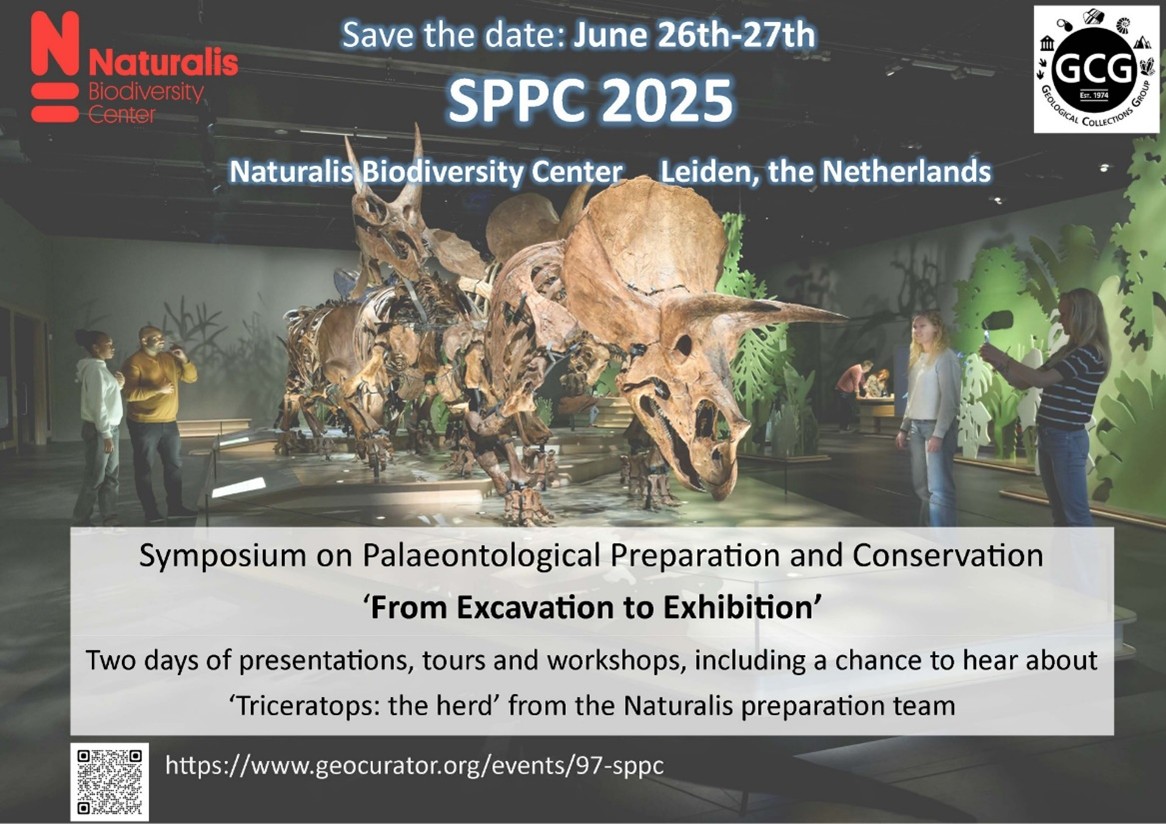
Save the Date: SPPC, June 26th – 27th 2025
The 30th Symposium on Palaeontological Preparation and Conservation will be held in the Netherlands this year on 26-27th June.
The theme will be From Excavation to Exhibition including aspects of the story of how geological collections end up on display in our museums, as well as their conservation and preparation. A call for abstracts and registration is coming soon. For more details visit: https://www.geocurator.org/events/97-sppc
The Displays of Power exhibition explores the zoology collections of the Grant Museum, motivated by the conviction that, “there are stories of empire in any natural history collection – if you know how to look”.
Research found that empire played a key role in the development of the Grant Museum. The map of the British Empire was reflected in where the specimens were collected and empire helped to turn animals into objects for worldwide trade. Teaching specimens were used to promote racism and colonialism. Specimens hunted to extinction by colonists evidenced how empire affected the natural world. Hunting trophies demonstrated imperial attitudes towards animals that persist.
Displays of Power was inspired by a paper co-authored by Subhadra Das, one of our curatorial team, and Miranda Lowe, a Principal Curator at the Natural History Museum, which argues that natural history museums perpetuate racism and alienate BAME visitors by ignoring colonial histories. To remedy this erasure, Displays of Power foregrounds the legacy of empire throughout the museum display.
The exhibition takes the unusual approach of reframing and reinterpreting objects that are already on display. In this way, we turned a lack of temporary exhibition space into an opportunity to show that stories of empire are ubiquitous but untold throughout collections. Displays of Power was created as a means to open up the conversation around empire in as many different ways as possible. This includes a collaboration with poet Yomi Sode, visitor conversations with trained front of house staff and family and school activities and resources. Associated events include a community take over day and evenings exploring privilege through comedy and a giant immersive game of snakes and ladders. Visitor feedback highlights the deep personal impact of the exhibition. Visitors are sending a strong message that we (and other museums) need to continue decolonising our collections and that is what we intend to do.
Compiled by Jennifer Gallichan, NatSCA Blog Editor; Curator at Amgueddfa Genedlaethol Caerdydd – National Museum Cardiff.
Welcome to the December edition of NatSCA Digital Digest.
This month’s Digest dispenses with the usual format and focuses on all things Christmas. Apologies to all those Scrooges out there, but all things considered, this year needs as much sparkle and fairy lights as we can throw at it people!
There are some super virtual advent calendars going on. I am off course recommending my very own institutions @CardiffCurator account. This year our annual #MuseumAdvent calendar meets #NatureOnYourDoorstep. We launched our nature #WinterBingo challenge on the 1st December. Find all 24 things before Christmas, tag them in and they’ll retweet your finds.
Then there is the wonderful Leeds Discovery Centre Video Advent Calendar. Every day, open a door to see what object their curators and staff have found in the Store. Also an excellent opportunity for a virtual nose around their stores.
And this year, Manchester Museum are bringing you a #Caring Christmas advent calendar. Each day their gift to you is a little story of wonder, celebrating how we care for our world and each other.
Compiled by Sam Barnett, NatSCA Volunteer and PubSci Committee Member.
Welcome one and all to the June 2019 edition of the Digest.
What should I read?
New experiments in flight design don’t crop up every day – which is why the discovery of Yi qi, the creature that looked like a bird had tried to imitate a bat and an aye-aye at the same time, was so surprising. The problem was that the remains were so scrappy it left a lot of interpretation as to how that membrane of skin fit around its wing (see image from the paper for a couple of proposals). Thankfully that picture is getting clearer due to the discovery of a second member of the family: named Ambopteryx, this little beauty helps fill the gaps in our understanding. You can read more about Ambopteryx in the Nature paper or over at The Atlantic for the lowdown by Ed Yong.





 NatSCA