Darwin and Marx in the Museum. A review of Joel Wainwright’s ‘The End: Marx, Darwin and the Natural History of the Climate Crisis’.

Written by Joe Rigby, Senior Lecturer, University of Chester: Faculty of Arts, Humanities and Social Sciences.

‘Storehouses for dinosaur bones, mineral samples, and fading dioramas portraying early humans. Do such places have something to tell us about capitalism and the climate crisis?’ (Wainwright 2025, p. 8)
Attached cover image of Joel Wainwright’s The End

As readers of the Natsca blog will appreciate, the discipline of ‘natural history’ encompasses a wide range of what today have become institutionalised as more or less separate fields of knowledge, including geology, biology, geography, anthropology, and history. In The End: Marx, Darwin and the Natural History of the Climate Crisis Joel Wainwright argues that recovering this kind of knowledge of ‘the history of nature and the role of nature in history’ (Wainwright 2025, p. 8) is essential to help address the current climate crisis. Whilst Wainwright is hardly the first person to make such a claim about the importance of natural history today, The End makes a convincing case for the importance of drawing jointly on the ideas of Charles Darwin and Karl Marx in order to do so.

Continue reading

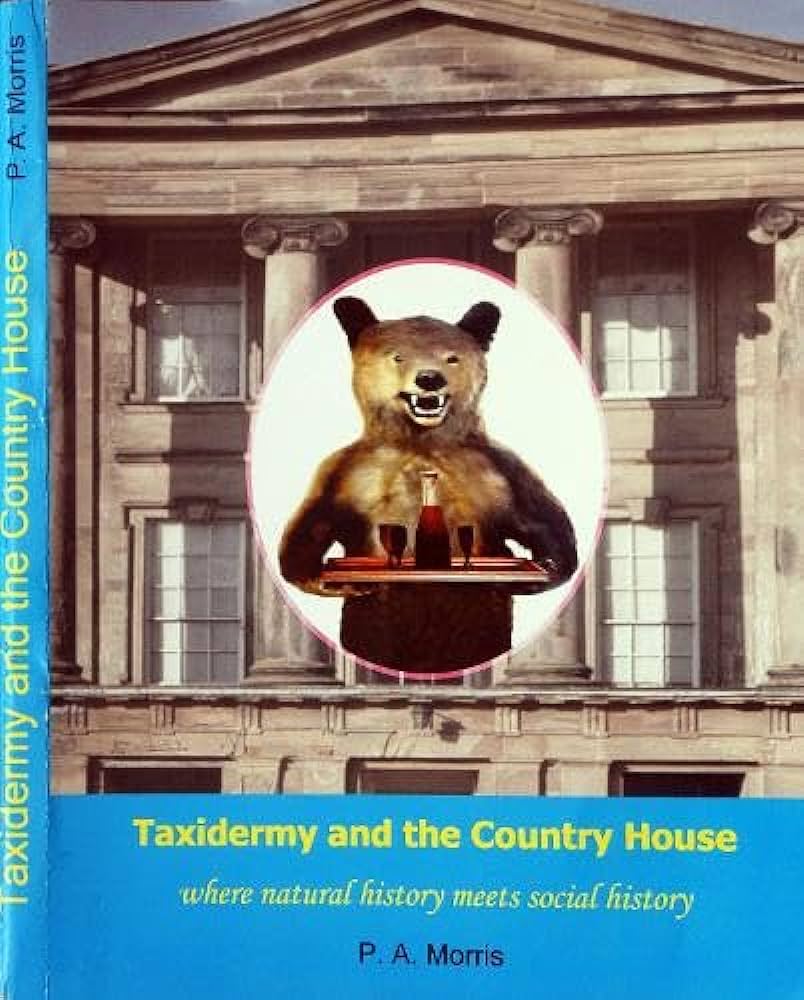
Taxidermy and the Country House: Where Natural History Meets Social History – a review 

Written by Jack Ashby, Assistant Director of the University Museum of Zoology, Cambridge.

Pat Morris is the authority on the history of British taxidermy, and there is arguably no-one better to write an exploration of the specific context of taxidermy collected for and displayed in private country houses. Although their materiality is identical, by their nature, these collections are often conceptually very different – the antithesis, even – to those in public museum. These differences are not the focus of the book, nonetheless this perspective offers great potential to help us consider more roundly the story of taxidermy and those that made and collected it.

The similarities museum and country house collections do share include their origin-stories, and of course the practicalities of preserving specimens. Like museums, these private collections trace their histories back to cabinets of curiosities. Preservability was fundamental to what could be kept, and Morris begins by explaining that early cabinets of curiosities in country houses were mainly items that required no preservation – dry materials like shells and bone. The only skins that were widely kept were those that could be simply dried without being prone to insect attack, which is why durable specimens like taxidermy crocodiles, hollowed-out armadillos and inflated pufferfish were commonplace in these early collections, rather than the birds and mammals which later became the norm.

Continue reading

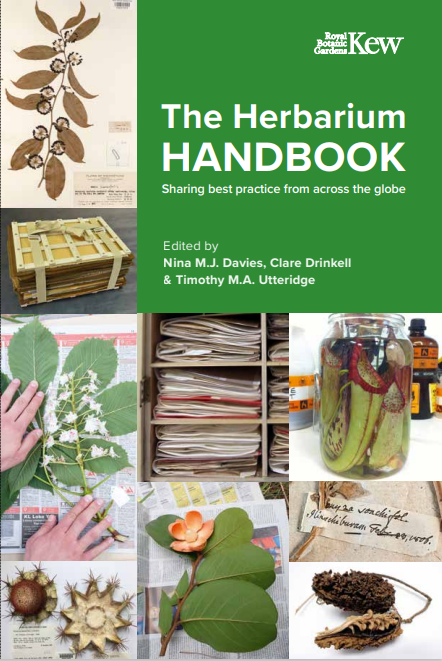
The Herbarium Handbook – Sharing Best Practice from Across the Globe.

Submitted by Clare Drinkell, Senior Curator Botanist at the Royal Botanic Gardens, Kew.

Editors: Nina Davies, Clare Drinkell, Timothy Utteridge. 290 pp, 234 x 156 mm. Over 700 colour photographs. Paperback, ISBN 9781842467695. Kew Publishing, TW9 3AE, UK 2023. £25.00. https://shop.kew.org/kew-herbarium-handbook

Cover page of The Herbarium Handbook

The new Herbarium Handbook is a key new addition to Kew Publishing’s series of handbooks, including The Plant Glossary and The Temperate Plant Families Identification Handbook. Unlike the other books in the series the Herbarium Handbook is a new version of a book first compiled and edited by Kew botanists some thirty-four years ago. The initial Herbarium Handbook came about following an extremely popular International Diploma Course in Herbarium Techniques at Kew. The demand to attend the course was so high that the number of applicants far exceeded places on the course. In view of the interest, the main information imparted during the course was published as a manual, widely recognised as an important reference for fundamental aspects of herbarium care and management.

Continue reading

Book Review: A Historical Directory of Taxidermists.

Reviewed and written by Jazmine Miles Long, Taxidermist. https://www.jazminemileslong.com, Twitter: @TaxidermyLondon; Instagram: @Jazmine_miles_long

A Historical Directory of Taxidermists: Bird and Animal stuffers, Naturalists, Beast and Bird Preservers in Southwest England and Wales. Early 19th C to Mid-20th C.

A directory complied by Kelvin Boot
Published by MPM Publishing
2022
ISBN 978-1-7397161-0-3
Contact – kelvinbootbooks@gmail.com

This book is a must have for any researcher exploring the lives and work of taxidermists from Southwest England and Wales during the 19th and 20th Century. 140 pages in black and white including some images of taxidermists trade labels.

The book is a thorough directory of the taxidermists trading in the area at the time, the introduction cites how the directory was researched, exploring printed documents, not only naturalists publications but newspapers, trade directories and census records where taxidermists may have been mentioned or advertised. Exploring what the life of a taxidermist may have been like and how just like today it was the ‘celebrity’ taxidermists that would have been more likely to be written about.

Continue reading

Book Review: Managing Natural Science Collections

Written by Jan Freedman, Curator of Natural History, The Box, Plymouth.

Working with natural science collections is quite a unique role. The specimens we care for, the stories they tell, the research we carry out or help facilitate, and the engagement with the public, are just a few rewarding jobs that we carry out daily. Sometimes there are barriers between those working with natural science collections and those at a higher management level. This is mainly due to a lack of understanding of the importance of these types of collections. “Why are there so many flies?“, “It’s just taxidermy, bring it out for people to stroke“, “It’s just a rock”. Just a few of things many of us have heard being said about natural science collections.

Whilst we can respond to these kinds of comments, some of us may find it more difficult to respond in a strategic way: in a language that makes sense to high level managers or funders. I have in the past, and I’ve found that frustrating, because I know the importance of the collections I look after. I was very pleased to be asked to review a new book about management of collections, focusing on strategy and development, Managing Natural Science Collections: A guide to strategy, planning and resourcing which was released this year and it couldn’t have come at a better time. A time when the country is recovering from an economic slump after the Covid pandemic. A time when cuts to the museum sector are inevitable.

Continue reading