Curators of the Caribbean

300-year-old plant collection brings Bristol Museum & Art Gallery and the Natural History Museum Jamaica together!
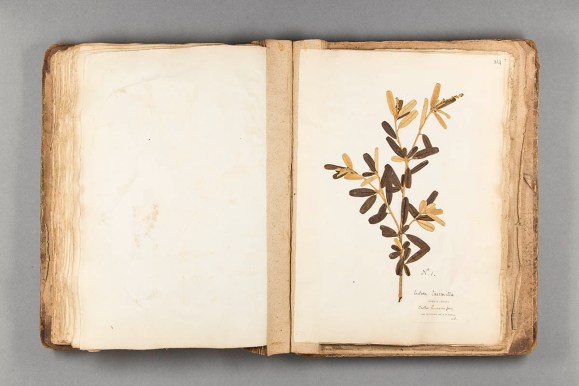
vol_3_jamaican_p324

A digitised page from Volume 4 of the Jamaican herbaria

In the autumn of 2014, I was fortunate to be contracted by Bristol Museum to conserve and digitise 4 bound volumes of plant specimens dating from the 1770s and collected by the prestigious botanist Dr Arthur Broughton. The conservation and digitisation was completed in early 2015, yet two years on I am still working with and fascinated by this fabulous collection.
slide1

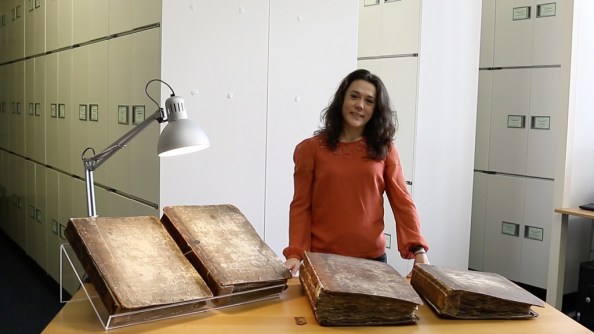
Rhian Rowson and the 4 volumes of 18th century bound herbaria

Dr Arthur Broughton, was a Bristolian who made the mammoth journey to Jamaica, due to ill health, and myself and Rhian Rowson, biology curator at Bristol Museum & Art Gallery, are trying to piece together his years studying botany in Jamaica and the impact this renowned botanist has had on the island and the world of botany. The volumes are large, heavy, leather bound books holding c. 1000 specimens including extremely rare and type material. The books were analysed for biocides, cleaned in preparation for digitisation, digitised and then each specimen was painstakingly removed from the volumes and re-mounted onto archival sheets. This project has mitigated the risk of contamination from handling the treated pages, has increased access and ease of handling but most importantly the images have been shared with other institutions. The ebook highlights some of the star specimens in the collections

The most exciting connection made during the research side of this project was with the Natural history museum of Jamaica (NHMJ). Through this collaboration, the opportunity has arisen for both me and Rhian to travel to Jamaica to collect modern material, research the historic plant specimens and illustrations held in Bristol museum and the collectors behind them. We have been extremely fortunate to gain funding from both WIRP (Working Internationally Regional Project) and the Jonathan Ruffer Curatorial Grant. Both funders were extremely supportive and constructive in helping towards our submitting a successful application.
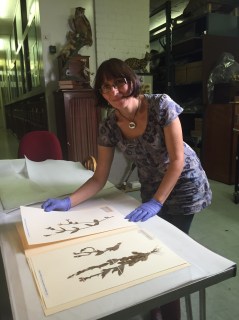
Victoria Purewal viewing Broughton plant specimens

Victoria Purewal viewing remounted specimens from one of the Jamaican volumes.

We fly into Kingston, Jamaica on Tuesday 27th September and will be gathering historical data on Dr Broughton and other prestigious botanists including Robert Long and the Reverend Lindsay, both of whom were collecting and working during this interesting time in history. We will be met by Keron Campbell, the botany curator at the NHMJ and together with the natural history team we will be escorted around the island, helping us to identify and verify plant specimens and localities. Modern day specimens will be collected to help interpret our historic material and provide a contemporary and fresh perspective that we can use to engage with our Bristol and Jamaican communities. We will be keeping active on social media whilst there, and hopefully offer some insight on the specialisms and research being conducted in Jamaica but also on the botany and the habitats on the island of Jamaica.

bmagnhmjcultureicomart


Project Airless

Project Airless’ is a three year venture that began in August 2015 at the Natural History Museum (NHM) in London, with the objective of treating and preventing pyrite decay in the Museum’s historic earth sciences collections.

Pyrite Decay

Pyrite, or ‘fool’s gold’ (iron sulphide), is a common mineral of varying crystal structure (though cubic is common) that can often be found in or around fossils. It can occur in a compact, crystallized and stable form – or as a porous, microcrystalline and unstable form.

Pyrite oxidation, or ‘decay’, can occur when the mineral reacts with atmospheric oxygen in relative humidities (RH) above 60%. The resulting by-products of this oxidation depend on the mineral composition of the fossil and matrix, but often comprise sulphuric acid and hydrated ferrous sulphates, which can be very harmful to specimens, labels, and storage media. Once pyrite has begun to oxidise, mineral hydrates will form at as low as 30% RH. Signs that pyrite oxidation is occurring include expansion cracks, white or yellowish acicular crystal formations, and a sulphurous odour.

Distressing scenes for fossil enthusiasts: a drawer of fossils with pyrite decay

Distressing scenes for fossil enthusiasts

Method

Three conservation technicians have been surveying the collections and recording where pyrite decay is occurring amongst the NHM’s 7 million fossils and 500,000 mineralogical specimens.

Hunting high and low for signs of pyrite oxidation; conservators check drawers for suffering specimens

Hunting high and low for signs of pyrite oxidation

Affected specimens are temporarily removed from the collection, photographed, and a condition report created for the specimen on the Museum’s collections database. Following this, any remedial treatments are undertaken as necessary (ammonia gas treatment, for example). The fossil is then placed in an acid-free tray within a Plastazote inlay for protection. To prevent further oxidation, the specimens are heat-sealed in a NeoEscal barrier film bag with oxygen scavenging sachets, forming an anoxic microenvironment. Once sealed, the technicians complete a process report and return the fossil to the collections. This work is being undertaken in advance of the development of a new Earth and Planetary Science building, which will have a more efficiently controlled environment.

Specimens re-housed in an anoxic microenvironment, sealed in a bag

Specimens re-housed in an anoxic microenvironment

Treatments

Once a specimen has been assessed for pyrite decay, there are some remedial treatments the conservation technicians can undertake, depending on the severity. The first of these is the removal of any white/yellowish crystals by dry brushing, followed by consolidating any cracks in both the fossil and the matrix with Paraloid B72 in Acetone.

If a figured or type specimen is exhibiting signs of severe pyrite oxidation, a cast can be made in order to preserve morphological detail before it deteriorates further. However, moulding and casting carry risks for fragile specimens.

Ammonia gas treatment is a method that successfully neutralizes sulphuric acid produced by pyrite oxidation, and involves exposing specimens to the vapour emitted by a mixture of ammonium hydroxide and PEG 400 (polyethylene glycol) within an enclosed polyethylene or glass container. The vapours from the ammonium hydroxide react with the decay products, turning the affected areas a brick-red colour.

Team Airless to the rescue!

Team Airless to the rescue!

The Future

According to current estimates, 14,000 specimens at the Museum are in urgent need of this protective measure. As the project progresses, the team hopes that they will be able to share knowledge and expertise with other museums and institutions that may be facing the same problems as the NHM. Images generated for each specimen during the project should vastly improve the Museum’s collection database – and may even limit the need to open the bags. While ensuring that these valuable specimens remain intact, and of use for years to come, the project is also increasing digital access and reducing unnecessary handling by using a web based application to associate images with each specimen’s unique barcode.

Kieran Miles, Matthew Porter, and Amy Trafford

NHM, London

NatSCA Digital Digest

natsca

Jobs and Traineeships

If, like many, your world will never be the same again once Dippy the Diplodocus retires from his position adorning the entrance hall to the Natural History Museum in South Kensington, you can at least help secure him a happy future by going for the job of Corporate Partnerships Manager- Dippy the Dinosaur on Tour at the NHM. The deadline is the 25th January so there’s still time to affect the life of this semi-retired much loved icon.

If digital engagement is more your thing then the University of Cambridge Museums (UCM) are currently looking for a Digital Engagement Specialist. The deadline for this post is also the 25th January, with interviews on the 8th February.

Events and Exhibitions

The London Transport Museum is holding an interesting half day symposium on 7th March 2016 called Contemporary Collecting. The symposium is free and includes an evening reception at the Museum. There are six areas of focus listed on the website, ranging from risks of collecting to acquisitions that ‘are inherently, and/or overtly, political’. Sounds exciting!

Around the Web

The project of digitising the Charles Lyell Fossil Collections is well underway at the Oxford University Museum of Natural History. The blog (link above) is a fun and interesting read but more importantly, if you have any Charles Lyell specimens in your collection, Sarah Joomun and Eliza Howlett at the OUMNH would love to hear from you.


NatSCA Digital Digest

natsca

Conference

We will be holding our 2016 annual conference & AGM on 21st and 22nd April, generously hosted by Derby Museums. The venues will be The Silk Mill and Derby Museum & Art Gallery. So, it goes without saying, Save The Date!

Events

On 29th October there is a talk at the Natural History Museum on one of my favourite things: curatorial research!
‘Curatorial research gets a bad name when it serves personal ends, but can it help unlock collections for wider engagement?
This talk is based on a project to understand the life and work of a Victorian ornithologist, Henry Dresser.
Held at the Flett Events Theatre, from 2.30–3.30pm. Click here for details.

Speaking of my favourite things, the Wildlife Photographer of the Year exhibition is open at the Natural History Museum. If, like me, you’ve been avoiding social media so you get to see the images for the first time at the exhibition, you can now do so.

Around the Web

Did you know Manchester Museum has an important collection of almost 17,000 earwigs? A type catalogue of this fantastic resource has been published with a description of the collection and its history and is freely downloadable here.

The Love London Awards hosted by Time Out and voted for by the general public has issued its shortlists. In the Bloomsbury, Fitzrovia and Holborn area ten museums and collections are jostling for position, you can click here to vote. Two of the ten are natural history collections, and could be voted for, by you, if you so desired, just saying…

The Symposium of Vertebrate Palaeontology and Comparative Anatomy is often referred to as the friendly conference. Not just palaeontology, the conference also covers comparative anatomy and thus attracts a natural history audience as well. However the guise under which the conference is going to continue into the future is currently under debate, and those with an interested are being invited to comment.

Derby Museums showcases 200 year old Captain Cook shells

200 years after being collected, a group of sea shells with links to Captain Cook’s voyages have been fully documented and photographed for the first time, and put on display in Derby Museum & Art Gallery, thanks to one of the museum’s Super Nature volunteers, Hannah Maddix. Donated to the museum in 1961, along with original documents dating to 1815, they are key to unlocking the secrets of 18th century shell studies. Fred Woodward, former president of the Conchological Society of Great Britain and Ireland, said: “The collection could be considered an equivalent to the Rosetta Stone since it contains shells with common names and Latin names not only used by Humphrey in his catalogues but also numbered by Humphrey himself, which until now has not been known.”

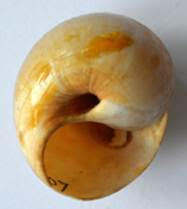
Shell. Image: Derby Museums

Image: Derby Museums

The shells have a fascinating history. They were bought by a Mrs Borough in 1815 from George Humphrey, a London dealer in shells and ‘curiosities’ who in turn had bought shells collected on Captain Cook’s second and third voyages of discovery to Australia and New Zealand in the 1770s. It is almost certain that the Australian and New Zealand shells in the collection came from Captain Cook’s voyages. George Humphrey was one of the world’s first conchologists, and wrote numerous catalogues of important shell collections. The shells in Derby Museum have tiny numbers written on them by George Humphrey, and his original lists survived with the collection. This unique combination of actual specimens related to original lists provides a missing link for modern shell specialists, allowing them to translate long forgotten 18th century shell names into their modern equivalents.

Rachel Atherton, Co-production Curator at Derby Museums said:

“This wonderful collection of shells not only links to Captain Cook and the discovery of a continent, but also give us a glimpse into the early scientific study of shells.”

Shell. Image: Derby Museums

Image: Derby Museums

Hannah Maddix, who catalogued the collection, said:

“It was such a delight to research these shells and discover that we have specimens collected from all over the world. For over two hundred years they have remained desirable and beautiful objects, commonplace and yet still precious.”

The Borough family was once a prominent Derby family, originally called Borrow, living at Castlefields House, before moving to Chetwynd House, Shropshire in 1803. Mrs Borough’s shell collection was passed down in the Borough family until they were donated to Derby Museums in 1961, along with six Joseph Wright oil paintings and a portrait of Isaac Borrow, twice Mayor of Derby in 1730 and 1742.

The shells are on display in Derby Museum’s new nature gallery ‘notice nature feel joy’.