Bark Tanning Skins into Leather for Taxidermy – A Sustainable, Natural and Non-harmful Alternative to Commercial Tanning Products?

Written by Jazmine Miles Long, Taxidermist.

When a taxidermy mount is made, the skin of the mammal (and in some cases reptiles and birds) is usually tanned. Tanning is the process of turning a raw skin into leather using chemistry. By turning the skin into leather, we are changing a fragile perusable material into something durable that can be sculpted into taxidermy and be more resistant to insect attack. Tanning the skin involves removing proteins in the skin and loosening the collagen fibres and then attaching tannins to these structures. Leather can be made with either the hair on or off the skin. When we are making taxidermy, we want the fur to stay attached to the skin and so the process is different to when the fur is to be removed. With hair on tanning, we want the pH to stay low to prevent the fur from falling out. The skin starts by going into a pickle solution of around pH 2 and after it has been through the tanning process it ends up at about pH 4.5 -5.

Continue reading

Planet Ocean: Using Local Collections to Celebrate Global Climate Action

Written by Sarah Marden, Curator of Natural History at The Box, Plymouth.

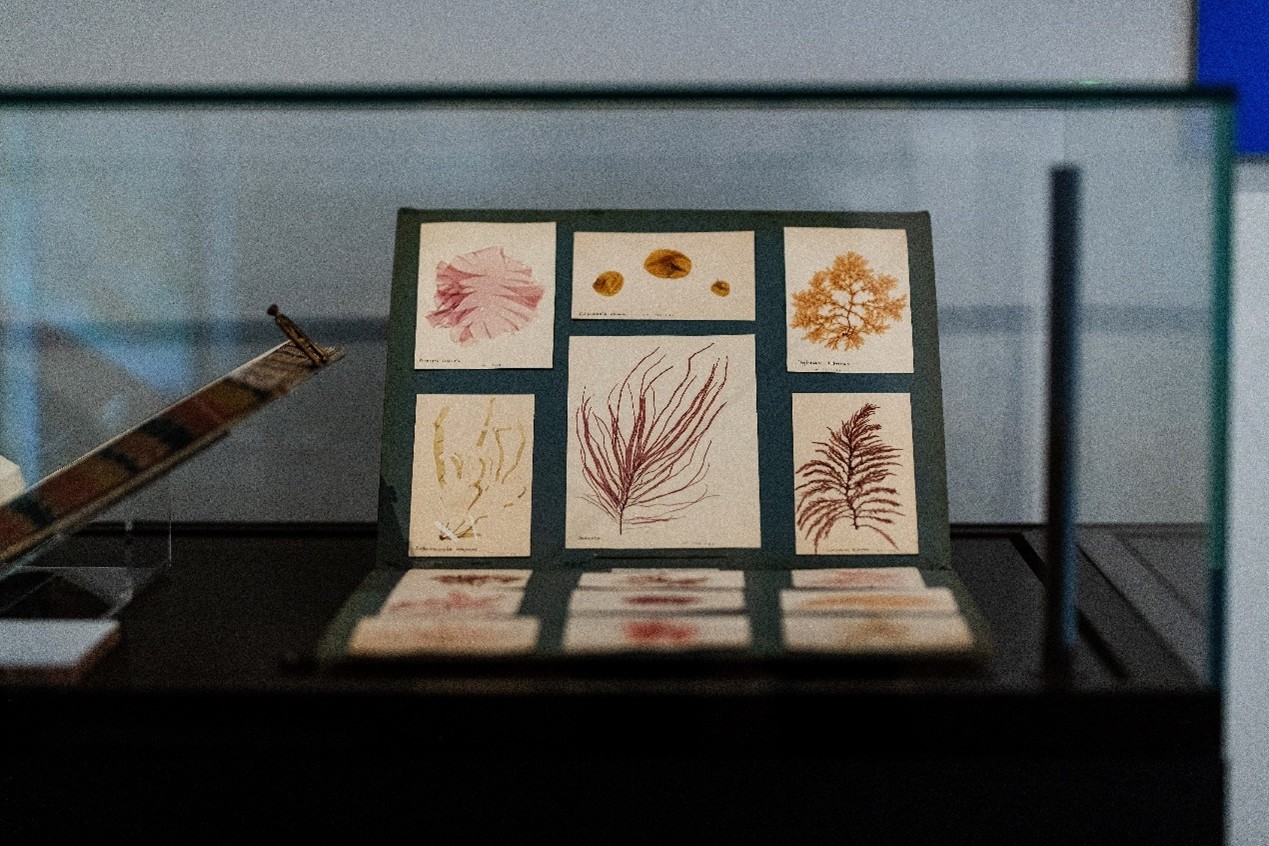
From March 2024 to April 2025, a new exhibition at The Box called Planet Ocean explored Plymouth’s marine heritage and contemporary identity as “Britain’s Ocean City”. Specimens from our natural history collections, including spirit-preserved marine invertebrates, molluscs, corals, mounted sea birds and seaweed folios were displayed alongside art, world cultures collections, image and film and loan material from local partners.

Flowers of the Sea folio by Emily Johns, © Dom Moore

Taking inspiration from science fiction writer and undersea explorer Arthur C Clarke who said “how inappropriate to call this planet Earth when it is clearly ocean”, we explored why the ocean is so important- the fact that we literally couldn’t survive without it as it gives us around half the oxygen we breathe, but also that it sustains and supports us locally with food, jobs, leisure, health and wellbeing. Alongside this quote, the entrance wall of the exhibition featured a moving graphic created collaboratively with Plymouth Marine Laboratory. It used one of the oldest datasets in existence of changing ocean temperatures recorded in Plymouth Sound. This data was input into a globe representing our ocean planet that changed and distorted according to the human impact of climate change over time. This was the first example of science meeting art and partnerships that we developed throughout the exhibition.

Continue reading

5 Top Tips on How to Decant your Museum

By Eimear Ashe, Collections Moves Project Manager, National Museum of Ireland

Having recently completed a major decant of Natural History collections in the National Museum of Ireland, I thought it a perfect opportunity to share my learnings with fellow NatSCA colleagues.

National Museum of Ireland – Natural History

Tip 1. Start with the staff!

  • What skills do you need to recruit in or increase capacity in?
  • Recruit new temporary staff. Training should be provided in the following areas: hazards in collections, manual handling, object handling, photography (if part of the workflow), condition assessment, object packing, transfer documentation procedures, integrated pest management (IPM), and the collections management system.
  • If you cannot recruit new staff, you will have to use existing resources. Agree with management that the permanent staff team will not be able to carry on their regular duties during the period of decant. You should also make the public aware of this reduction in capacity and service provision.
Continue reading

A Stable Future – Research into the Stability of Materials used in Taxidermy Manufacture.

Written by Jazmine Miles Long – Taxidermist & Bethany Palumbo – Head of Conservation, Natural History Museum Denmark.

Taxidermy collections are crucial for our understanding of biodiversity, evolution, population genetics and climate change. They form a large part of natural science collections and their long-term preservation is essential. Historically, taxidermy was created using natural, durable materials such as wood, plant fibres, wax, clay and glass with examples dating back to the 16th century. However, over the past 50 years, taxidermists have increasingly adopted synthetic and plastic-based materials due to their ease of application, lower cost, and effectiveness in creating realistic specimens. One such example is polyurethane, a very widely used material to build the form that goes under the taxidermy skin. Although polyurethane has been extensively tested (albeit not specifically for taxidermy), it has already been shown to be unstable and unsuitable for long-term use. Awareness of stable, durable materials is not widespread within the taxidermy community. As a result, many modern museum taxidermy pieces are made with untested and potentially unstable materials.

Continue reading

A Time Capsule of Extinction: Scotland’s Iconic Wildlife

Written by Caitlin Jamison, Museum Collection Technician, Montrose Museum: ANGUSalive.

Montrose Museum in Angus, northeast Scotland, houses an impressive natural history collection. Everything from taxidermy to fossils to rare minerals are housed in a modest, Greek-revival style museum off the high street. Built in 1842, it is one of the first purpose-built museums in Scotland.

Sadly, due to changing public interest (and the challenging funding situation facing many local authority museums) the collection has been somewhat forgotten since it was catalogued onto neat pink index cards in the late 1970s.

Montrose Museum’s 1970s card catalogue (author’s own photo)
Continue reading