Mainstreaming Biodiversity in Museums

Written by Henry McGhie, Curating Tomorrow henrymcghie@curatingtomorrow.co.uk.

Link to the guide: https://curatingtomorrow236646048.files.wordpress.com/2023/11/mainstreaming-biodiversity-in-museums_2023.pdf

‘Mainstreaming’ is a policy and planning approach that means that we don’t just create a new programme or strand of work, but that we embed it across all activities. We can embed support for biodiversity and environmental concerns across museum activities. Why is this important? Well, for a few reasons. Firstly, biodiversity is not yet fully mainstreamed into museum thinking – in terms of their goals, actions, or evaluation. Second, museums present a massive potential to support biodiversity in different ways, notably through education, research, public awareness and partnerships. Third, museums make big negative impacts on biodiversity and the environment, through their contributions to climate change (from use of energy, waste, and visitor emissions), and their involvement in environmentally damaging activities (e.g. how their investments are used). Fourth, because biodiversity is in deep crisis: species continue to decline, major challenges are getting worse, and there is no clear prospect of a change for the better. Lastly, fifth, because people and nature are interdependent: if the environment suffers, people and communities suffer.

Continue reading

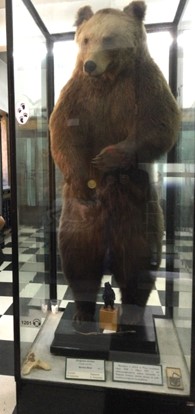
A Prize Winning Brown Bear in Sofia.

Written by Richard Crawford, who has just completed a PhD thesis at the University of the Arts London, entitled ‘Re-presenting taxidermy; Contemporary Art interventions in Natural History Museums’.

I am used to seeing trophy specimens in mainstream natural history museum collections – for example, the crouching tiger shot by King George V in 1911 that is on display in the natural history galleries at the Royal Albert Museum in Exeter – but I was surprised to see a taxidermy specimen of a big Brown Bear at the National Museum of Natural History, Sofia, holding a medal that it had been awarded at the Berlin International Hunting Exhibition in 1937.

The prize winning brown bear in Sofia Natural History Museum

The 1937 Berlin International Hunting Exhibition showcased all manner of hunting trophies including mounted antlers, boar heads, bear skins and various taxidermy animals. It also featured demonstrations with live animals, including hunting eagles and a pack of beagles. The event was given official approval by the then prime minister, Hermann Goering, who opened the exhibition amid fluttering Nazi flags and rows of hunters dressed in smart grey uniforms. In his opening remarks, Goering stated his view, that hunting could promote international peace:

Continue reading

Snagged Setae 2, The Sequel: Packing Materials After 14 Years in Fluid Storage

By Lu Allington-Jones (Senior Conservator), Wren Montgomery (FTIR Specialist) and Emma Sherlock (Senior Curator), The Natural History Museum, London UK

Many years ago, we undertook some research into a suitable replacement for cotton wool as bungs for vials holding small fluid-stored specimens. In 2008 we placed samples of Parafilm MTM, white Plastazote® LD45 and colourless HDPE (high-density polypropylene) lids in 10% formalin, 100% ethanol, and 80% IMS (Industrial Methylated Spirit, aka Industrial Denatured Alcohol) and allowed them to steep for 3 years. We undertook visual inspections, pH tests and FTIR analysis and concluded that Parafilm MTM was an unsuitable replacement, but that the other materials had undergone no change and had caused no contamination of the host fluids.  

We decided to revisit the samples after an additional 11 years on a south-west facing sunny lab windowsill, for a total of over 14 years of storage in the various fluids. 

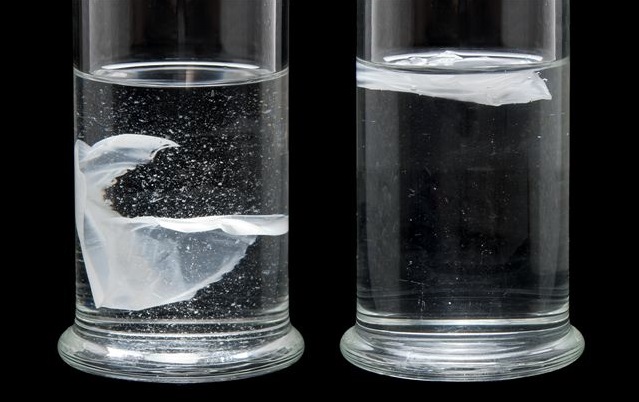
The state of ParafilmTM after only 3 years: particles are visible to the naked eye in the 100% ethanol on the left. The ParafilmTM in the formalin on the right showed a thinning and perforation at its edges. ©The Trustees of the Natural History Museum
Continue reading

The Herbarium Handbook – Sharing Best Practice from Across the Globe.

Submitted by Clare Drinkell, Senior Curator Botanist at the Royal Botanic Gardens, Kew.

Editors: Nina Davies, Clare Drinkell, Timothy Utteridge. 290 pp, 234 x 156 mm. Over 700 colour photographs. Paperback, ISBN 9781842467695. Kew Publishing, TW9 3AE, UK 2023. £25.00. https://shop.kew.org/kew-herbarium-handbook

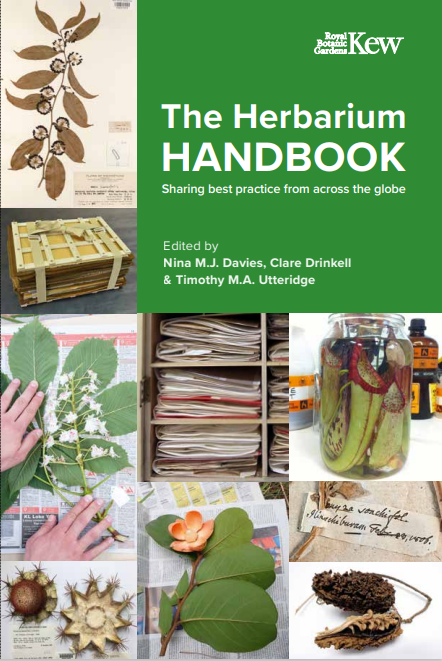
Cover page of The Herbarium Handbook

The new Herbarium Handbook is a key new addition to Kew Publishing’s series of handbooks, including The Plant Glossary and The Temperate Plant Families Identification Handbook. Unlike the other books in the series the Herbarium Handbook is a new version of a book first compiled and edited by Kew botanists some thirty-four years ago. The initial Herbarium Handbook came about following an extremely popular International Diploma Course in Herbarium Techniques at Kew. The demand to attend the course was so high that the number of applicants far exceeded places on the course. In view of the interest, the main information imparted during the course was published as a manual, widely recognised as an important reference for fundamental aspects of herbarium care and management.

Continue reading