The Rediscovery of a Challenger Expedition Specimen in William Herdman’s Zoology Museum Collection at the University of Liverpool (and how digitisation is transformative).

Written by Leonie Sedman, Curator of Heritage & Collections Care, University of Liverpool.

Along with many other NatSCA members, I care for a mixed collection, meaning that one inevitably becomes something of a ‘Jack of all trades’ missing out on the academic satisfaction created by specialisation. As a curator who finds collections research to be the most satisfying part of my job, it can be frustrating when that research is often only possible on a ‘need-to-know’ basis – usually when a new display or exhibition is being planned, or when the specimens are to be used in teaching. Looking on the bright side though – this does provide glimmers of joy when the research produces something exciting!

In 2004 when I was first employed to manage the University of Liverpool’s Heritage Collections (medical & scientific museum collections built up through research or teaching), I retrieved a large proportion of the collections from attics and cellars where they languished because the objects and specimens were no longer actively used in teaching (this is now changing – but that would be a different blog). The Zoology Museum collection was one of these.

Continue reading

Splits and Distortion of a “Hisstoric” Snakeskin: Humidification as Part of Remedial Conservation Treatment of a Boa constrictor Skin”

Written by Claire Kelly, Conservator at Natural History Museum, London.

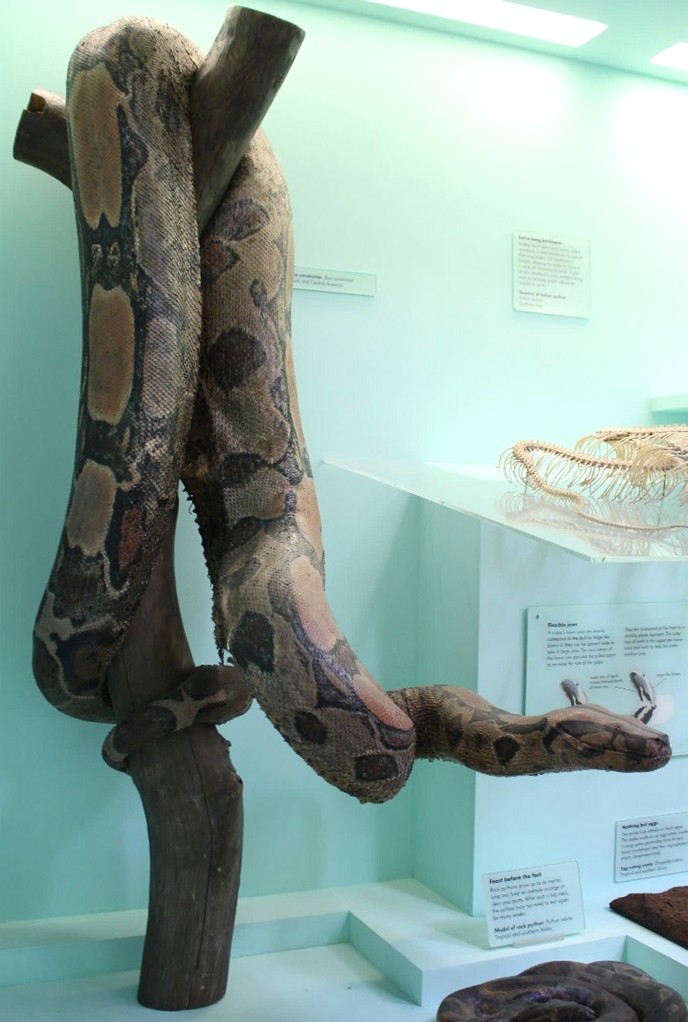
Boa Constrictor in Fishes, Amphibians and Reptiles Gallery at NHM ©The Trustees of the Natural History Museum

A Boa Constrictor on display in the Fishes, Amphibians and Reptiles Gallery at the Natural History Museum in London, UK was removed to undergo a considerable amount of remedial conservation treatment.

The taxidermy skin, dating from around the late 19th century, is mounted over a plaster form that was placed onto a wooden trunk. The skin exhibited severe deterioration with multiple splits in various areas located throughout the length of the specimen. The entire ventral seam had opened along with skin distortion and lifting around the splits without any stitched seam to hold it in situ. Most of the damage was at the ventral area of the specimen but some splits and distortion were visible whilst on display, along with material shed on to the case base.

Continue reading

“Our Irish Natural History”: Increasing the Accessibility of Natural History Collections through Community-Driven Interpretation

Written by Adriana Ballinger, Yale University Charles P. Howland Postgraduate Research Fellow at the National Museum of Ireland, Natural History.

Natural history specimens are often inaccessible to the communities from which they were collected. As a result, source communities lack opportunities to connect with elements of their local heritage, and museums and their publics overlook the place-based expertise that many of these communities hold about the specimens we research and see on display. Scientists lead the knowledge creation process surrounding natural history specimens, but source communities can also contribute valuable information, especially regarding the meanings that flora, fauna, and geological features embody in their environments of origin. Although these cultural contexts are often intangible and unquantifiable, they are nevertheless important facets of specimens’ natural histories. For the past year, I have led “Our Irish Natural History,” a community-driven research and exhibition project at the National Museum of Ireland (NMI). I set out to increase the accessibility of the NMI’s natural history collections, explore innovative avenues for community-led interpretation, and create new opportunities for public engagement.

Continue reading

From Deck to Decant: A Marine Biologist’s Déjà Vu After a Year in a Natural History Museum

Written by Dr Jamie Maxwell, Collections Assistant, National Museum of Ireland, Natural History.

Not every job takes you to a windswept beach on Ireland’s west coast to recover the head of a stranded True’s beaked whale calf. But then again, my past year as a Collections Assistant at the Natural History Museum in Dublin has been anything but ordinary. As we collected the head of the slightly decomposed whale calf, I was reminded of my previous fieldwork experiences, mainly on research cruises during my academic career. Before joining the museum, I spent a decade in education and research as a marine biologist, specializing in deep-sea invertebrates. During that time, I not only investigated freshly collected specimens but also engaged with museum collections. It wasn’t until I became a collections assistant at the National Museum of Ireland, Natural History that I became fully immersed in the day-to-day workings of a museum. Much of the past year was taken up with decanting the contents of the Merrion Street building in preparation for renovation. In this blog, I’ll explore how decanting a museum is remarkably like being involved with a research cruise. 

Continue reading

Seeing With Their Eyes A Poetic Reflection on the 2025 ‘From Collections to Connections’ NatSCA Conference Presentation

Written by Pauline Rutter – Independent Archival Artist, Community and Organisation Poet.

These words look out from the page with eyes I have borrowed. Eyes not shaped for vision through the specific disciplinary scientific lens. Eyes that strain to see beyond past centuries of debate on what, of all origins, is knowable and what is not. With these original eyes, would ways of seeing allow the light to travel outwards resisting funnelled perspectives and interpretations descended from imperialistic systems of Enlightenment science, colonial ideologies and narratives? In this context my eyes had opened up unevolved or re-evolved with lepidopteran vision, though not removed from all that had been taught to be seen. New eyes with sight of intensified colour that amplified nature’s interconnecting patterns, only visible outside the spectrum of the everyday, the expected, the predetermined. 

What use is butterfly sight that transforms configured objects and living matter with or without full binominal species names, into fragments like those of the intertwined and metamorphosed elements in ritualistic rapture spreading out across a Wangechi Mutu collage? 

Continue reading