Mary De La Beche: Lady Lepidopterist

Written by Kanchi Mehta, 2nd year BSc student, Swansea University, whilst on placement at National Museum Cardiff and Swansea Museum.

Born in Swansea in June 1839, the young Mary grew up in a house where she had every freedom. Taught in politics, photography, languages, art and science, young Mary was a smart, outspoken, and opinionated girl. As she grew up, she learnt from her father, Lewis Llewelyn Dillwyn, in the forests and beaches around Swansea. Over the years, she took a particular interest in the biology around her family home and kept that interest throughout her life.

She married in Sketty Church to John Cole Nicholl in 1860. He shared her adoration for the outdoors and over the course of their honeymoon the couple went all over Europe seeing the sights, scaling every mountain they could and documenting it all in their diaries. Mary alone filled roughly six diaries with her thoughts on the nature she saw, the people she met and the languages she learnt all accompanied by her sketches. By the Christmas of 1860, the pair made it home with two puppies in tow, brought for Mary by John, and a baby on the way.
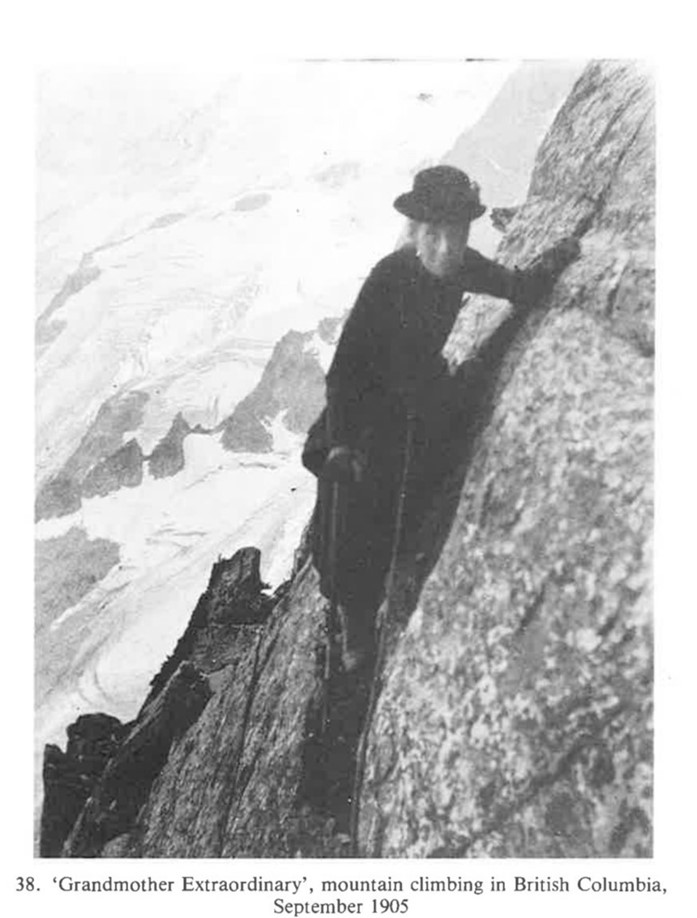
© Grandmother Extraordinary by Hilary M. Thomas
Continue reading

Rediscovering the Hancock Coelacanth

Written by Dan Gordon, Keeper of Biology, The Great North Museum: Hancock.

For as long as I’d worked at the museum, there’d always been a Coelacanth. People referred to it in passing, pointing out the large tub of orange tinted spirit where it lurked. I’d always rather taken it for granted; an interesting but rather mundane specimen, and I’d never been curious enough to fish it out of the murky liquid and examine it.

That is, until 2018, when staff at the National Maritime Museum Cornwall got in touch about an exhibition they were putting together called Monsters of the Deep. They’d asked us about Coelacanth fossils and I mentioned the Coelacanth in the fish collection, which was greeted with some surprise. A real one…Would we consider a loan? And as I thought about this, I came to realise that I knew very little about the Coelacanth at all.

There was next to nothing in the catalogue about it, so I decided, firstly, to get a better look. This was easier said than done. The Coelacanth is over a metre long and weighed over 20kg, sitting in a container of tea coloured alcohol bigger than a bathtub. Reaching in, I ran my gloved fingers over its flanks, which had the texture of coarse sandpaper. Lifting it out was like wrestling an alligator, but eventually it emerged, a gaping mouth with small sharp teeth, a ragged tear through the flesh of its head, and the huge eyes of a deep-water dweller.

Continue reading

Taking a ‘Leaf’ of Faith: Managing a Forgotten University Herbarium

Written by Anna Robson, Graduate Intern Archaeology and Bioscience Collections, Durham University.

Background to the Collection

At Durham University, an herbarium of international scope has recently been reawakened revealing unique plant specimens and important stories about the Bioscience Collection as a whole. Over the past 18 months, the Archaeology and Bioscience Curator and Intern have undergone a process of conserving, managing, and researching the ex-teaching Bioscience Collection. Once part of the Bioscience Department’s teaching materials, this collection comprises of skeletal material, antler trophy heads, taxidermy, entomology, oology, a spirit collection and an herbarium.

To give a brief history to the collection, Durham University used to teach Zoology (established 1946) and Botany (established 1932), with Botany in the founding four departments of science in the University. The Department of Botany was spearheaded by Benjamin Millard Griffiths (1886-1942), one of the first readers in Botany who is described as a ‘true scientist’ and ‘inspired great affection’. As scientific advances changed from macro to micro to molecular, Durham’s Biosciences current department is an amalgamation of the former Botany and Zoology departments. Due to this shift, hands-on teaching using herbaria and animal osteological specimens gradually halted.

Continue reading

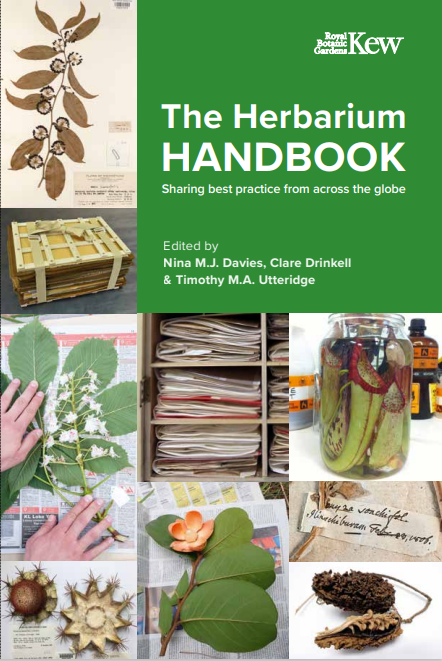
The Herbarium Handbook – Sharing Best Practice from Across the Globe.

Submitted by Clare Drinkell, Senior Curator Botanist at the Royal Botanic Gardens, Kew.

Editors: Nina Davies, Clare Drinkell, Timothy Utteridge. 290 pp, 234 x 156 mm. Over 700 colour photographs. Paperback, ISBN 9781842467695. Kew Publishing, TW9 3AE, UK 2023. £25.00. https://shop.kew.org/kew-herbarium-handbook

Cover page of The Herbarium Handbook

The new Herbarium Handbook is a key new addition to Kew Publishing’s series of handbooks, including The Plant Glossary and The Temperate Plant Families Identification Handbook. Unlike the other books in the series the Herbarium Handbook is a new version of a book first compiled and edited by Kew botanists some thirty-four years ago. The initial Herbarium Handbook came about following an extremely popular International Diploma Course in Herbarium Techniques at Kew. The demand to attend the course was so high that the number of applicants far exceeded places on the course. In view of the interest, the main information imparted during the course was published as a manual, widely recognised as an important reference for fundamental aspects of herbarium care and management.

Continue reading

NatSCA Digital Digest – November 2023

Compiled by Glenn Roadley, NatSCA Committee Member, Curator of Natural Science at The Potteries Museum & Art Gallery.

Welcome to the November edition of NatSCA Digital Digest.

A monthly blog series featuring the latest on where to go, what to see and do in the natural history sector including jobs, exhibitions, conferences and training opportunities. We are keen to hear from you if you have any top tips and recommendations for our next Digest, please drop an email to blog@natsca.org.

Sector News

GCG AGM and seminar – Building bridges between collectors and museums

The Geological Curators Group will be holding their annual AGM and seminar on November 28th – topics will include:

  • Many important specimens are held in private collections. How can museums gain an understanding of the scope of these collections and the needs of collectors?
  • How can museums gain the trust of collectors and start to find ways to work around the sometimes strict conditions imposed upon them?
  • How do collectors feel that museums can improve the way that they deal with such donations?
  • Lack of ‘proof of legal ownership’ or ‘documentation of permission to collect’ can be major sticking points for museums; however, such provenance was rarely required or given historically (or even more recently). How can we ensure that important historic specimens can be integrated into museum collections? Do we need a more flexible approach to the ‘ownership’ of geological specimens collected from casual sites that are not SSSI’s or other protected statuses?
  • What can we learn from previous experiences?
  • Can museums produce advice to help private collectors to document their collections and highlight or label specimens that might ideally end up in a museum in the future?

For more information and to register, see the GCG website: https://www.geocurator.org/events/162-50th-annual-general-meeting-and-winter-seminar

Continue reading