Exeter Shell Collection Designated by Arts Council England

Written by Holly Morgenroth, Collections Officer, Royal Albert Memorial Museum & Art Gallery (RAMM).

On 30 January 2020 Arts Council England’s (ACE) awarded Designated status to the George Montagu collection of Molluscs at the Royal Albert Memorial Museum & Art Gallery (RAMM). Just 152 collections in the country hold the coveted Designation award, and only a few of these collections are Natural History. Tullie House’s natural science collection recently received this accolade. The Designation scheme is a mark of distinction awarded to the finest cultural collections housed in non-national museums, libraries and archives across England.

Pioneering naturalist George Montagu (1753-1815)

George Montagu was the first person to collect and name British molluscs in a truly scientific manner. The shells were not just attractive curios. His work revolutionised the study of molluscs and his collection at RAMM is Britain’s most intact and taxonomically-important, early 19th-century collection of British shells (1800-1816). Today it is an essential resource for taxonomic research.

Continue reading

NatSCA Digital Digest – February

Compiled by Glenn Roadley, Curator (Natural Science), The Potteries Museum & Art Gallery.

Welcome to the February edition of NatSCA Digital Digest!

A monthly blog series featuring the latest on where to go, what to see and do in the natural history sector including jobs, exhibitions, conferences and training opportunities. If you have visited an exhibition/museum, have something to say about a current topic, or perhaps you want to tell us what you’ve been working on, please drop an email to blog@natsca.org.

Where Should I Visit?

Plenty of events and exhibitions to keep you busy this month. The Royal Academy of Arts (London) exhibition ‘Eco-Visionaries: Confronting a planet in a state of emergency’ runs until Sunday 23rd February. Through film, installation, architectural models and photography, the works in this exhibition interrogate how architecture, art and design are reacting to a rapidly changing world, From climate change to species extinction and resource depletion.

Exploration: From Deep Time to Outer Space’ continues at The Hunterian, Glasgow. The Hunterian is home to many important historical and modern natural history specimens and the associated materials related to them. Many of the most interesting and scientifically valuable are the product of fascinating field investigations and expeditions. This exhibition explores the scientific discoveries of the University of Glasgow’s staff, students and associates since the 18th century. Open until 15th March.

Continue reading

The Power of People and Collections in the Climate Emergency

Written by David Gelsthorpe, Curator of Earth Science Collections, The Manchester Museum and Jan Freedman, Curator of Natural History, The Box, Plymouth (formerly Plymouth City Museum and Art Gallery).

Museums are most powerful when they connect real objects and research with real people. Natural science objects elicit deep emotional responses to the climate emergency; they help people to care and when done right, empower action.

This message is central to the NatSCA conference this year:

Changing the World: Environmental Breakdown, Decolonisation and Natural Science Collections

We’d love to hear your experience in a talk at the conference, the deadline for submissions is the 7th February.

Natural science collections are unique records of past biodiversity and climate across Britain, and the world, and are essential for climate change research taking place in museums every day. They allow access to historical information about millions of different species, providing an incredible amount of detail. They show how plants and animals have responded to past climate change, they show long-term population trends, and they show what we have lost.

These are all stories essential to bring clear factual science to an emotionally-charged debate. Research on these collections has directly shaped conservation work and climate change mitigation. In short, natural science collections are a powerful way to help save the world and give people hope for a better future.

Continue reading

Decolonising Natural Sciences Collections

Written by David Gelsthorpe, Curator of Earth Science Collections, The Manchester Museum.

Decolonising museums is in the headlines a lot at the moment and so it should be. I’ve chatted to a few people about this recently and it isn’t very clear what it means, how it relates to natural science collections and how we can start to decolonise our collections, so I thought I’d share my own thoughts.

Much of the discussion in the museum sector has been around ethnography collections with some great work that goes some way to redress our colonial past (including from my own institution Manchester Museum who have returned sacred aboriginal objects). Some ethnography objects are made from bark, fur or ivory, but these materials don’t often form part of the decolonisation debate.

The reality is that many natural history collections, particularly in the western world have a colonial origin. Many objects were traded on slave ships and were an attempt to map and tame the British Empire. Miranda Lowe and Subhadra Das have done some brilliant work to highlight this and the Grant Museum’s new exhibition on their Colonial Histories is a great first step in bringing this to the public.

Continue reading

Diminished Scales – The Plight of The Pangolin and The Role of Museums

Written by Dan Gordon, Keeper of Biology, The Great North Museum: Hancock.

To explain grace requires a curious hand’ wrote Marianne Moore, in her 1938 poem, The Pangolin. Moore first learned about pangolins at college in biology class and remained fascinated by them for the rest of her life. Curiosity was what first drew me to pangolins, too. Not just about their curious, clawed hands – when I first encountered a stuffed pangolin at the Great North Museum, its whole appearance was like nothing I’d ever seen. A small quadruped, clad in precisely overlapping rows of jagged scales, like steel plating welded onto a badger. A huge tail at one end, a tapering snout at the other. It was an animal that suggested a host of comparisons – a pinecone, an artichoke, a dinosaur. What on earth was it? I decided to investigate.

I soon learned it was a Ground Pangolin (Smutsia temnickii), one of eight species of pangolin that make up the family Manidae. Pangolins are the only scaled mammals and are found in tropical Africa and Asia. Most species live nocturnal, solitary lives. They’re notable for all sorts of reasons. The Ground Pangolin can walk on its back legs, like a tiny T-rex in a suit of armour. The Black-bellied Pangolin has a tail so long it has more bones than any other mammal.

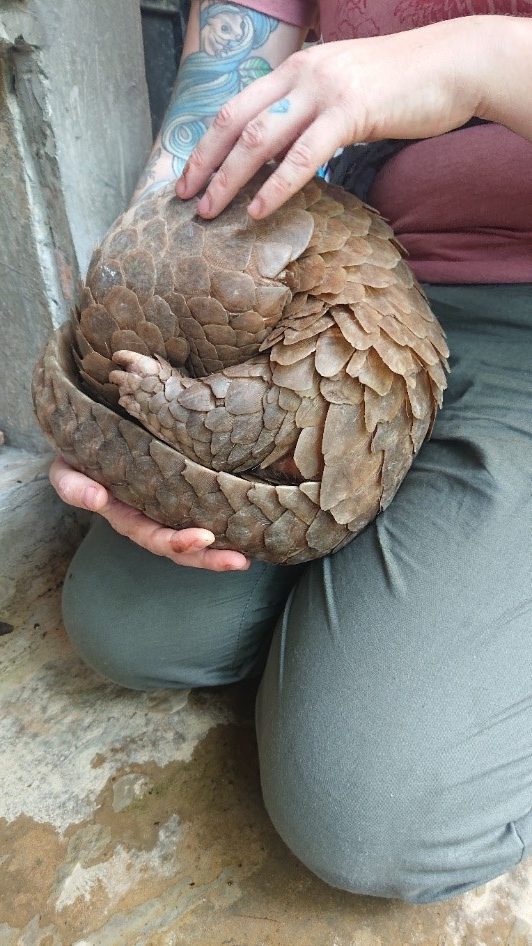
Sunda Pangolin (Manis javanica) at SVW Rescue Centre, Vietnam. When threatened pangolins curl into a defensive ball. This animal was found wedged beneath a seat on a bus travelling from Laos to Hanoi and rescued by SVW staff (© Dan Gordon)

Continue reading