
Written by Dan Gordon, Keeper of Biology, The Great North Museum: Hancock.
Sometimes you come across something in the stores that catches your eye. Something a little puzzling, maybe something hiding in plain sight, or in a drawer you’d never had cause to open before. For me, the specimen in question was a bright red bird. Clearly historic by its beady glass eyes, but seemingly lacking any other provenance, and identity unknown. The appearance was striking, with bright scarlet feathers and a long, curved bill like a scimitar. This made identifying it the easiest step – an I’iwi (ee-EE-wi) one of the Hawaiian Honeycreepers, and a little surprising, given its rarity. It sat alone, without context, among a flock of other small birds, drawing your eye as a patch of scarlet amongst the browns and greys. A mystery, then.
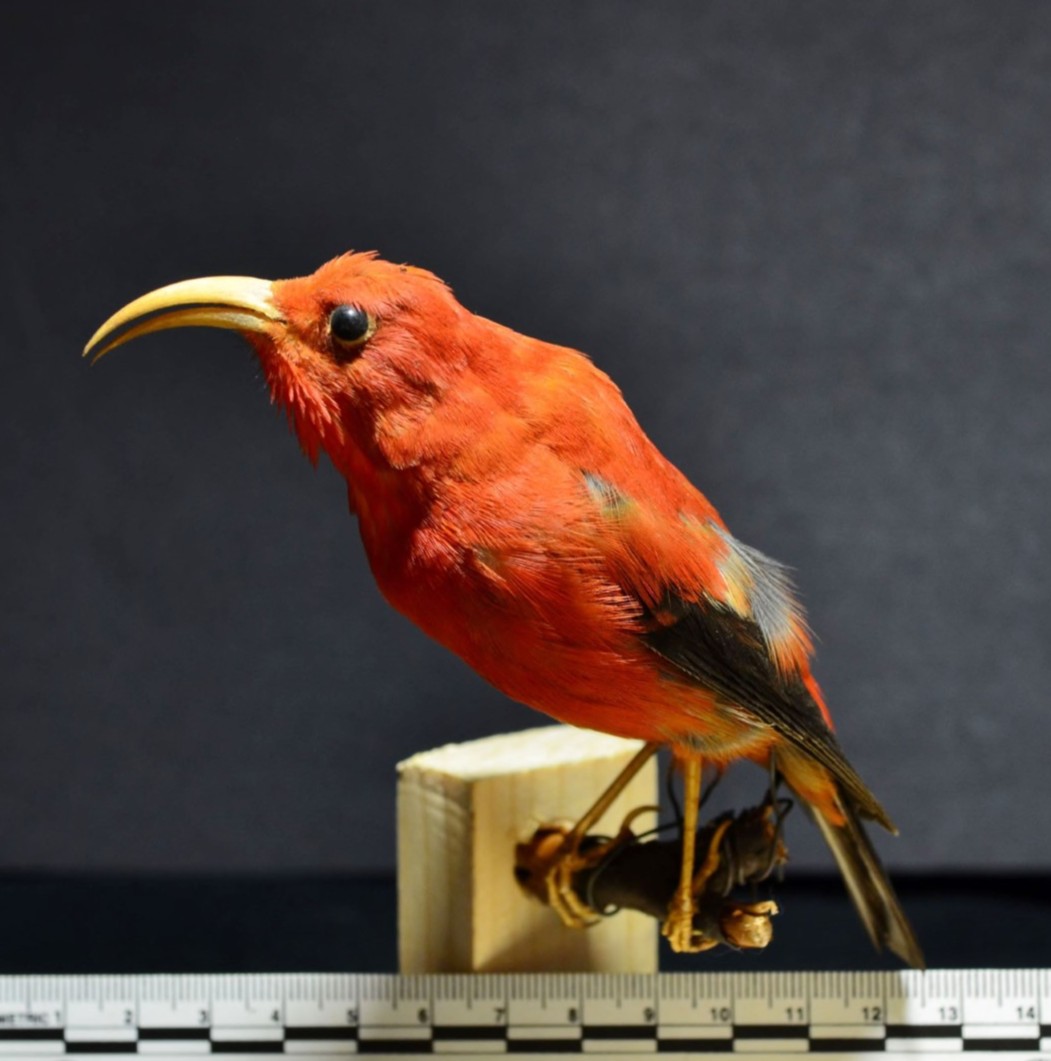
NEWHM : 2016.H5 – I’iwi (Drepanis coccinea) collected by Scott B. Wilson 1888. All images credited to The Natural History Society of Northumbria.
A bit of digging in the archives began to shed some light. Two of a Honey-Eater from Keauhou, Kona – Presented per J. Hancock by Scott Wilson Esq. looked like a likely candidate. One of a pair, collected from the Big Island, Hawaii, reached us here in 1889. The Natural History Society of Northumbria were keen collectors of specimens from all over the world at that time, but this one seemed unusual. Who was Scott Wilson, and why might he have sent them here?
Scott Barchard Wilson (1864–1923) turned out to be a fascinating figure, and important in the early scientific understanding of the birds of Hawaiʻi. He’s been the subject of much research (1) and partly inspired a novel (2). He was born into a rich industrial family alongside brother Herman and his sister, Alice. In a childhood typical of wealthy people in this period, the Wilson children were raised by nanny, sent to boarding school and seemingly rather apart from their parents. But it’s clear that Scott Wilson was influenced by his father’s interest in nature. While his father George Wilson’s passion was botany (3), Scott was fascinated by birds. In his various schools around Marlborough and Weybridge he collected eggs and nests. Through his father he met prominent naturalists of the time, such as William C. Hewitson and Alfred F. Newton, who would become a mentor, as well as our very own John Hancock.
As it turns out, the Great North Museum: Hancock holds a trace of Wilson’s early passion for collecting. The chiselled-off nest hole of a Nuthatch, clearly from his time at school in Weybridge, and still with the egg collector’s note included. Somehow, John Hancock must have acquired this from the young Wilson and brought it to Newcastle.
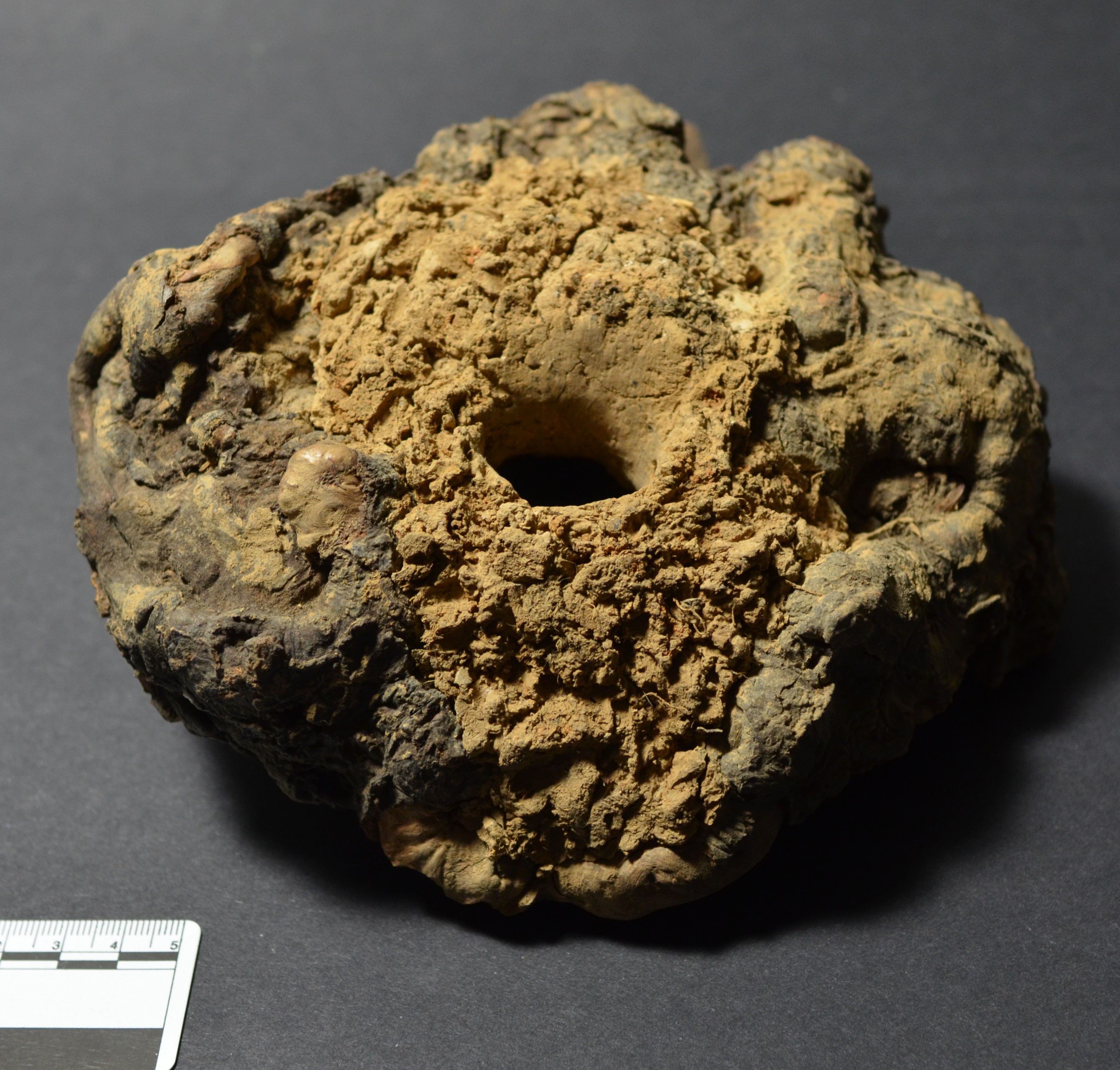
NEWHM : JH00.12 – Partial nest of a Nuthatch (Sitta europaea) collected by the young Scott B. Wilson 1883. All images credited to The Natural History Society of Northumbria.
Wilson was clearly a bright, passionate young man, and the years that followed seemed to bear this out – a degree from Oxford, collecting birds across Europe and, most significantly, using a family allowance to fund a trip in 1887 to the Hawaiian Islands. Wilson’s trip feels like a real adventure. He travelled to all the islands, and immersed himself fully in local life, collecting, photographing and learning to horse ride. He was close to his sister Alice and sent back letters filled with sketches and sheet music. He supplemented his income by selling bird specimens he would send back to collectors in the UK. This may be the origin story for our own I’iwi. In a letter from 27th March 1888, he wrote:
“…you will see that I have explored nearly every part of the island with the exception of Kau & that is mostly a waste of lava fields. I did not intend to stay so long this last visit but I found I was still obtaining new species of Birds so that I did not like to leave, any untraveled ground behind me…”
But he did leave in November 1888, having obtained a vast collection of specimens that informed the publication of the groundbreaking and monumental three-volume work, Aves Hawaiiensis: The Birds of the Sandwich Islands in 1890 (4)
It was a great early achievement for Wilson, but he seems to have gone on to live an unsettled life. Professional colleagues described him as ‘excessively moody’ and it seems his father may not have been entirely supportive of his choice of an academic career. He also seems to have been in poor health for long periods of time. However, the following years do seem to have borne out Wilson’s desire to leave no ‘untravelled ground behind’. He made trips to an extraordinary array of places; California, New Zealand, the Society Islands, South Africa and the Cook Islands among others. It was an almost restless pattern of travel that saw him move between Europe, Africa and the Pacific, often staying with friends or family.
Accounts at the time from Alice, his confidante, describe his growing distress in the years after 1920. On 13 January 1923, Wilson’s sister received an unsigned letter card
“I have been wandering in the Forest all day. I am up against a stone wall. You have been the staunchest of sisters.”
She immediately wired that she would come to see him – but he sadly died by suicide before her visit.
There are so many ways to understand a specimen, especially one as unusual and significant as this, but I have always been interested in the human lives that lie behind them. Looking at the I’iwi on the shelf now, I find myself thinking of Scott and Alice Wilson, lifelong friends as well as siblings. We never get the whole story. Maybe one thread of the story of this colourful bird is the trace of a man fascinated by the world around him, but who perhaps struggled to make peace with it.
Footnotes
- Scott Barchard Wilson 29 May 1864-20 January 1923. Arleone Dibben-Young and Jonathan S. Crocker. Elepaio ⋅ 75:6 ⋅ November/December 2015 (a detailed biography that much of this blog is based on).
- Killing Paradise – Andrew Esposito 2014
- George Fergusson Wilson (1832–1902) developed the gardens at Wisley, Surrey, which were later acquired by the Royal Horticultural Society and opened to the public in 1904.
- https://archive.org/details/AvesHawaiienses00Wils


[celebrate] Sedman, Leonie reacted to your message:
LikeLike
Pingback: NatSCA Digital Digest – May 2026 | NatSCA