How to Find Ectoparasites on Study Skins and Explore Natural Heritage Shared between Colonial and Provincial Museums

Written by John-James Wilson, Lead Curator of Zoology at World Museum, National Museums Liverpool & Jing Jing Khoo, Postdoctoral Research Associate at Institute of Infection, Veterinary & Ecological Sciences, University of Liverpool.

Selangor Museum was established in Kuala Lumpur by British colonial officials in 1887. A purpose-built museum building, opened in 1907, was designed by Liverpool-born architect Arthur Hubback, but there is a stronger link between Selangor Museum and Liverpool.

Selangor Museum’s early director Herbert Robinson was also born in Liverpool and had worked as an assistant at the Liverpool Museums, now known as World Museum. Selangor Museum wasn’t a large institution, with just three British curators and three museum hunters from Sarawak, one being Charles Ulok. But through the museum’s work, a European knowledge system was imposed onto the local wildlife.

The museum’s work included extensive hunting on the hill and mountains and islands of Malaysia, Thailand and Indonesia. The museum soon ran out of storage space in Kuala Lumpur and specimens were routinely sent to England. Hundreds of specimens were sent to Robinson’s former workplace, World Museum, in 1914.

https://archive.org/embed/from-selangor-museum-to-liverpool

Click link above for 3-minute video about Selangor Museum and its connection to Liverpool made for the Green Representatives Network at Monash University in Selangor.

Continue reading

William Thomas March, a Jamaican Collector, Naturalist and Early Pioneer of Biological Data Recording in Jamaica.

Written by Olivia Beavers, Assistant Curator of Vertebrate Zoology at World Museum, National Museums Liverpool.

Figure 1. William Thomas March’s bird skins stored in the Vertebrate Zoology collection at World Museum, National Museums Liverpool © National Museums Liverpool (World Museum: NML-VZ T1134, NML-VZ T760, NML-VZ T5652, NML-VZ 1989.66.1279, NML-VZ T19525, NML-VZ T12817, NML-VZ T9981, NML-VZ T1128, NML-VZ T14037, NML-VZ T14031/ Olivia Beavers)

August celebrates Jamaican independence, so what better way to celebrate than to talk about a Jamaican collector from the 1800s whose contributions to understanding Jamaican biodiversity are not yet fully recognised. 

I recently finished the project stage of the Associateship of the Museum Association (AMA). My project focused on helping to tell untold stories of the collections held at World Museum. 

Through trial and error, I started to look through World Museum’s database and Google the names of collectors to see if we had collectors who had black or brown heritage – with a focus on collectors with specimens from the Caribbean. I ended up finding William Thomas March. Only two previous papers were written about him, both by Catherine Levy (Managing Director of Windsor Research Centre, former President of the Caribbean Birds, and of BirdLife Jamaica). 

To coincide with the research and my project, I created a new dataset titled ‘Bird skins from Jamaica in the collections of World Museums Liverpool’ – now available on the Global Biodiversity Information Facility (GBIF) website. It includes specimens from William Thomas March.

Continue reading

People and Plants Workshop Three: Sharing Knowledge in the Amazon

March 10th, 2023, Royal Botanic Gardens, Kew

Written by Fiona Roberts (Collaborative ESRC PhD student, Cardiff University & Amgueddfa Cymru-National Museum Wales) and Violet Nicholls (Assistant Curator in Herbarium, Portsmouth Museums).

This post is dedicated to Dr Dagoberto Lima Azevedo (1979-2023), Tukano researcher, translator, scholar, author and a voice for the Indigenous peoples of the Rio Negro in the northwestern Amazon.

The third and final workshop of a one-year project ran in March 2023, at Royal Botanic Gardens, Kew. The project, “People and Plants: reactivating ethnobotanical collections as material archives of indigenous ecological knowledge”, began in January 2022, and was supported by NatSCA (Natural Sciences Collections Association). Funded by the Arts and Humanities Research Council (AHRC), it was led by National Museums Scotland, the Powell-Cotton Museum and Royal Botanic Gardens, Kew. 

The workshop ran in partnership with Museu Goeldi, Brazil and the Department of Cultures and Languages, Birkbeck, University of London. It addressed the question, ‘how ethnobotanical collections in museums can best be used to support Indigenous communities?’. Dr Dagoberto Lima Azevedo, from the Federação das Organizações Indígenas do Rio Negro, and Claudia Leonor López Garcés (Museu Paraense Emílio Goeldi) travelled from the Brazilian Amazon for the event. They met with fellow panellists Professor Mark Nesbitt (Royal Botanic Gardens, Kew), Professor Luciana Martins (Birkbeck, University of London), Cinthya Lana (University of Gothenburg) and Dr William Milliken (Royal Botanic Gardens, Kew).

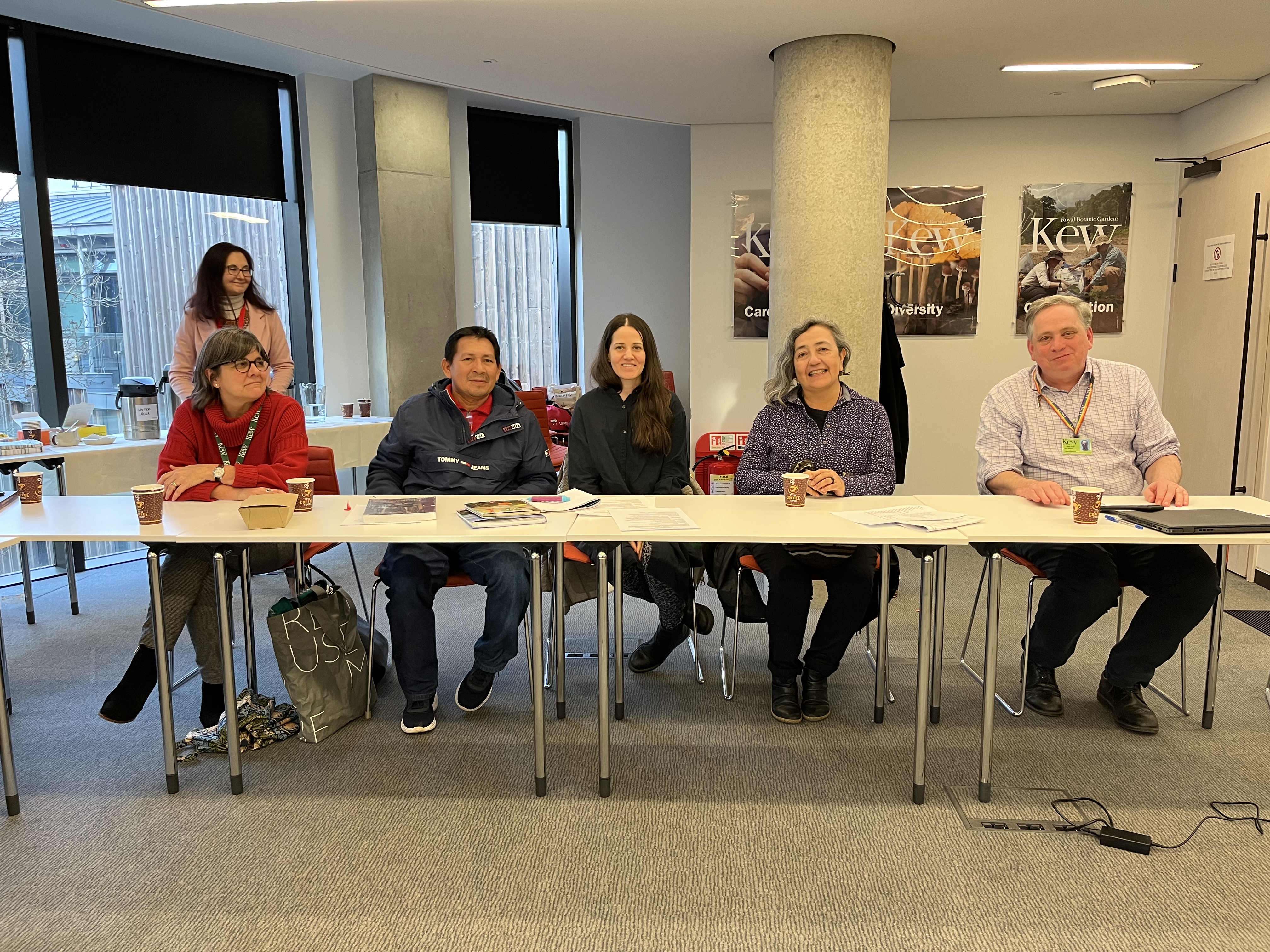
Fig. 1. Some members of the panel at the workshop with, from left to right, Cynthia Sothers, Luciana Martins, Dagoberto Lima Azevedo, Cinthya Lana, Claudia Leonor López Garcés and Mark Nesbitt. Photo by Gayathri Anand.

The Richard Spruce collection (1849-1864) was used as a case study. Spruce collected plants and recorded their uses in South America, and is considered to be an early ethnographer, as he also recorded the traditions and customs of the different communities that he met on his travels.1 He collected over 14,000 herbarium specimens in the Andes and Amazon regions, and 350 items are in his ethnobotanical collections.2

Continue reading

Listening and learning: Reflections on the Second Workshop of the People and Plants Project

Written by Fiona Roberts. Collaborative ESRC PhD student, Cardiff University and Amgueddfa Cymru-National Museum Wales Decolonising biocultural curation of South Asian medicinal plants.

Monday 7th November, National Museums Collections Centre

In early November, a group of academics, researchers, curators, artists and knowledge holders gathered at Edinburgh’s National Museums Collections Centre. The second workshop of the year-long AHRC-funded ‘People and Plants’ project focused on ‘reactivating ethnobotanical collections as material archives of Indigenous ecological knowledge.’

During the object handling session (Photo by Dr Ali Clark, National Museums Scotland)

The People and Plants Project

Led by National Museums Scotland, Royal Botanic Gardens, Kew and the Powell-Cotton Museum, the project investigates current debates on decolonising museum practices, including the interplay between natural history and ethnography collections, creating a conversation about these among varied experts.

The project’s previous workshop, held at the Powell-Cotton Museum in March 2022, brought together Somali knowledge holders from UK diasporic communities and was run in partnership with the University of Kent’s School of Anthropology and Conservation and the NOMAD project, which engages Somali communities in heritage projects. To read more, see this previous blogpost, and view workshop talks on YouTube [People and Plants – YouTube].

Continue reading

The ‘Social History of Natural History: People and Plants’ Workshop One

March 11th 2022, Powell-Cotton Museum

Written by Alexandra Slucky (Assistant Heritage Consultant & Environmental Archaeologist, Atkins, York Office) and Fiona Roberts (Collaborative ESRC PhD student, Cardiff University & Amgueddfa Cymru-National Museum Wales).

Decolonizing collections has been at the forefront of museums for quite some time. Thinking beyond the Western museum structure, many institutions have taken new opportunities to view indigenous knowledge from indigenous perspectives by revisiting old collections of anthropological material intermixed with botanical specimens. Four years in the making, Workshop One is part of a one-year project called People and Plants: reactivating ethnobotanical collections as material archives of indigenous ecological knowledge, beginning in January 2022. It is led by National Museums Scotland, Royal Botanic Gardens, Kew, and the Powell-Cotton Museum, and funded by the Arts and Humanities Research Council (AHRC).

Entrance to Powell Cotton Museum, Birchington-on-Sea, England, Photo by Alexandra Slucky

The main aim of the project is to engage with three unique indigenous collections located in UK institutions; Somalian, Amazonian, and Aboriginal Australian. The project examines the value and relevance of ethnobotanical collections, both in the present and the future, aiming to bring academics, researchers, museum professionals, botanists and indigenous knowledge holders together in conversation. To focus on sharing authority, it gives a museum voice to women of colour through a process of reactivation, recovery, and relationships, with the result creating more inclusive conditions for future collections.

Continue reading