Getting Funding for Natural Science Collections

With the current financial year almost at a close, many of our thoughts are firmly on next year’s budget. With this in mind, here is Clare Brown with some advice on obtaining funding for work on your collections:


The 2014 Geology Curators’ Group conference and AGM dealt with how to raise money for natural science collections. The first speaker of the day was Nick Poole, CEO of the Collections Trust. He gave a great talk on where to look for funding, and how to get it once you’ve found it. I’ve converted my notes from his talk below, and the slideshow of his presentation can be found here (the slides are comprehensive and brimming with tips).
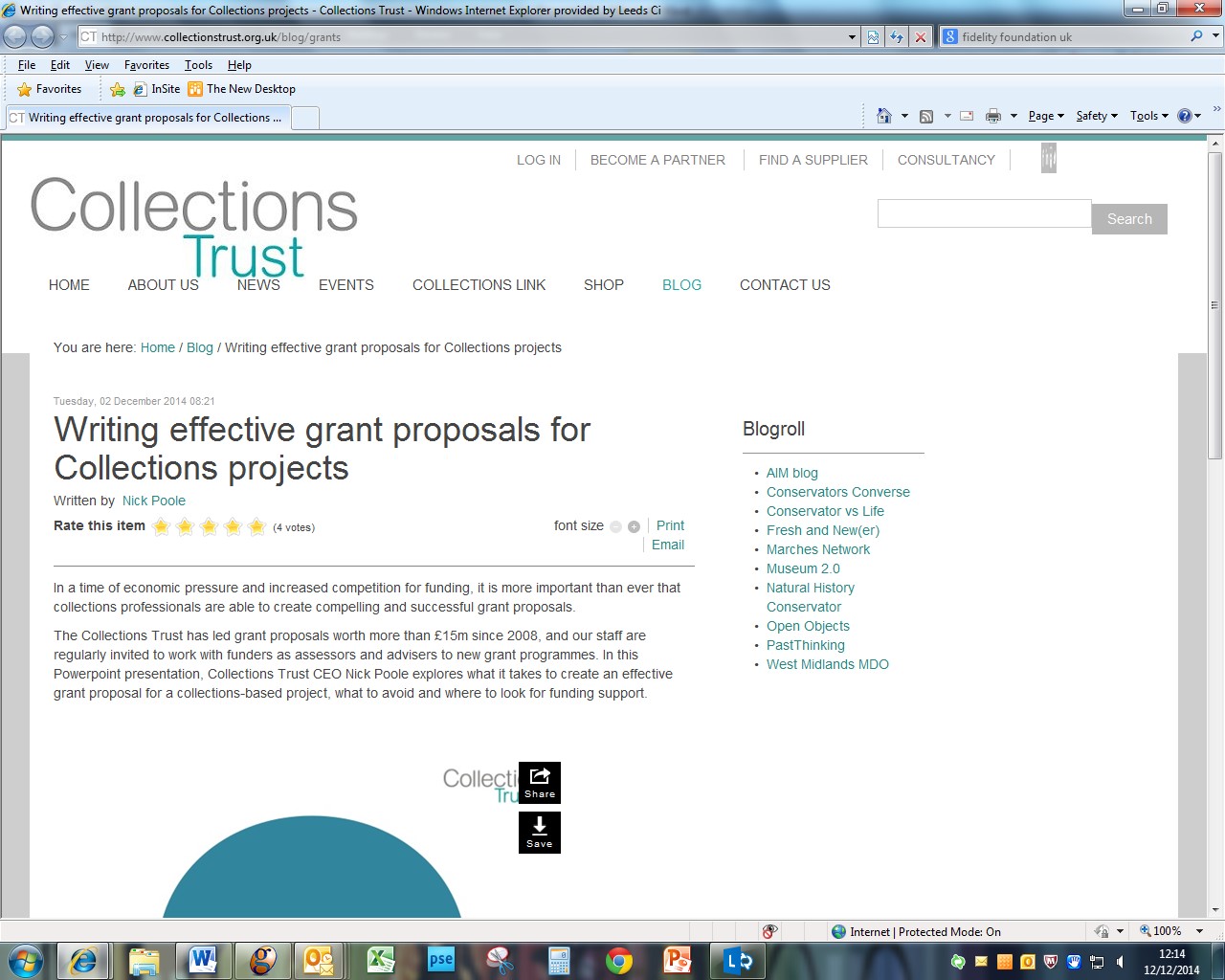
Screenshot of Nick Poole's web article on obtaining funding

Nick Poole’s advice on applying for grants

Sources of Funding

Nick Poole mentioned that the National Council for Volunteer Organisations has a good website for looking at who funds what, but after a bit of clicking around I couldn’t turn up anything particularly useful. If I’d had more time, and perhaps a membership number, I might have had a better experience.

A great resource is Funding Central. This website allows you to search 4,000 potential funders using the criteria of your choice.

At present the Heritage Lottery Fund (HLF) is in a cash-rich situation. However, they are concentrating on funding projects concerned with social utility or financial resilience. It’s quite hard to squeeze collections into those two titles.

At the end of Nick’s slides he has listed several organisations that fund UK museum projects and collections (slides 39 – 45). It’s well worth taking a look at. If you are lucky enough to work in London, Kent, Surrey, Birmingham or Manchester, the Fidelity UK Foundation also funds museum projects.

How do I get Funding?

When considering applying for a grant, only ever apply for money for a project that is consistent with your museum’s aims, otherwise delivering it will be hell.

Be prepared before the funding call goes out. Have a variety of projects ready to go, with need/scope/budget/supporting evidence available.

When writing a grant:

  1. RTFM (read the … manual).
  2. Give yourself time.
  3. Produce a good solid ‘hearts and minds’ story, with hard evidence to back it up.
  4. Many funders have one eye on the press release. Believe it or not, the projects with great names do seem to get funding. Create drama and make it unique and compelling.
  5. Don’t focus on your collections as a problem – focus on the problem to which your collection is the solution.
  6. Be realistic about cost.
  7. Understand how your proposal will be assessed.
  8. Always quote the funders to themselves: “As you yourselves said …”
  9. Don’t be insecure. Use the word ‘successful’. Don’t keep writing ‘if we get the grant’; write ‘when we get the grant’.
  10. Don’t bother with hubris (unless they ask for it). Avoid death by citation and focus on outcomes, not process.
  11. Build your reputation: become well known for delivering great projects.

If at first you don’t succeed, then ask for feedback, adjust your technique, and try again.


Clare Brown, December 2014

NatSCA Digital Digest

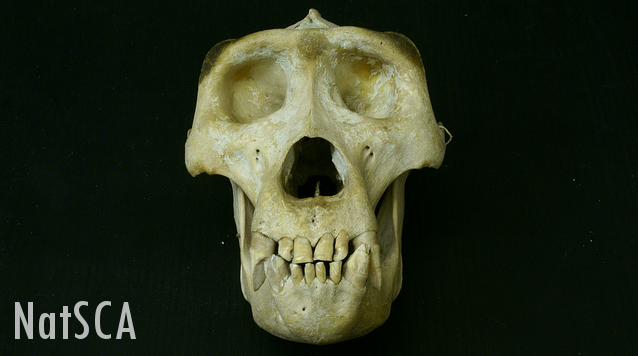
Gorilla skull on a black background

Your weekly round-up of news and events happening in the wonderful world of natural sciences!


Jobs

Unusually, there are a few natural science jobs out there in the UK at the moment:

Curatorial Assistant (Human Remains and Repatriation) – Natural History Museum. Applications close 29th March.

Curator/Lecturer in Vertebrate Palaeontology – Cambridge University. Applications close 3rd April.

Several interesting posts at Royal Botanic Gardens, Kew, including an Assistant Curator (applications close 7th April).

And, just in case you haven’t already seen it:

Collections Manager (Life Collections) – Oxford University Museum of Natural History. Applications close 10th April.

Events

Simon Moore’s renowned fluid preservation course will next run on 1st – 4th June at the Horniman Museum & Gardens. The four-day course costs £300 (NatSCA members can apply for a bursary). See here for details and booking.

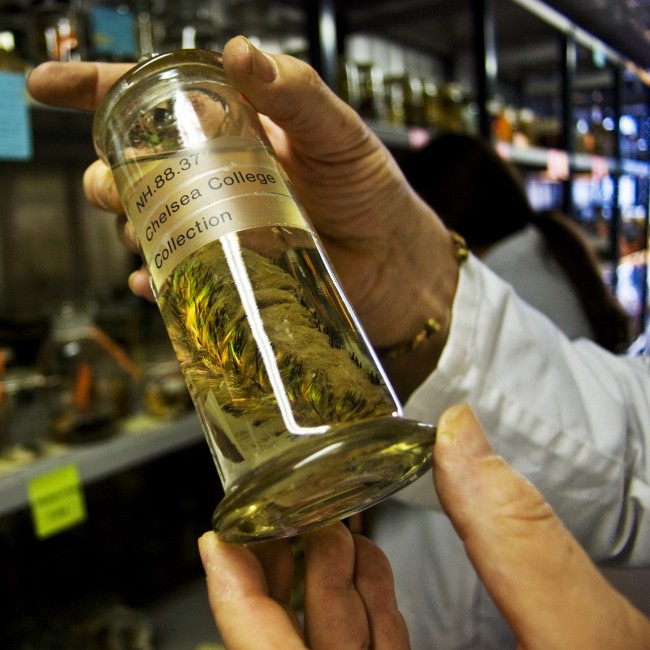
A fluid-preserved specimen in a jar is held up to the camera. Image: Russell Dornan

Learn the skills to care for fluid-preserved specimens (Image: Russell Dornan)

The Society for the History of Natural History (SHNH) has put out a call for speakers for their annual conference, to be held at Wakefield Museum on 31st July – 1st August.

The Museum Ethnographers Group (MEG) 2015 conference is entitled Nature and Culture in Museums, and will explore the relationship between natural science and ethnography. It takes place at the Powell-Cotton Museum on 20th – 21st April, and booking is open now!

In the Media

Today is Taxonomist Appreciation Day, a holiday devised by Dr Terry McGlynn, of California State University Dominguez Hills, to highlight the decline in taxonomic skills and the importance of museum collections.

These taxonomists definitely deserve some appreciation: A census of all known marine life by WoRMS (the World Register of Marine Species) has added many new species and removed 190,400 duplicates!

Darwin’s ‘strangest animals ever discovered’ finally find their place in the tree of life.


Got a submission for the blog or Digital Digest? Email us at blog@natsca.org!

Curating a Deep Sea Fish Collection at Glasgow’s Hunterian Museum

Hunterian Zoology Museum, Glasgow University. Photo: Glenn Roadley

Hunterian Zoology Museum, Glasgow University (Photo: Glenn Roadley)

The third week-long placement of my HLF Natural History Curatorial Traineeship took place at The Hunterian Zoology Museum, part of the University of Glasgow’s impressive campus. I had visited The Hunterian in Glasgow once before, in November, as part of a meeting with my traineeship mentor, Maggie Reilly, the Curator of Zoology. While before I only had time for a quick tour of the museum galleries, this time I was able to get hands-on with a full project.

Shelves of fluid-preserved animal specimens in jars, in the Hunterian's spirit collection. Photo: Glenn Roadley

The Hunterian’s spirit collection (Photo: Glenn Roadley)

During 2011, a research team from the University of Glasgow set out to trawl the Porcupine Abyssal Plain, ~4800m deep in the Atlantic Ocean, as part of an investigation into the effect of commercial fishing on the marine ecosystem. As fish stocks are depleted, commercial fisheries are trawling deeper and deeper. Much of life on the sea floor is unknown, and investigating the diversity of deep sea organisms will help us to understand the potential effects of deeper trawling. The fish collected during the research cruise were measured (body length, head length, tail length and wet weight), assigned a unique number, labelled, and preserved in a formalin solution. These were then transported to the Hunterian Zoology Museum, to be added to the spirit collection. The fish had been identified as well as possible, rinsed of the formalin, and transferred to 70% ethanol solution, but still needed to be separated out by taxon, stored in their own jars (rather than plastic buckets), and added to the museum database. This was to be my task.

A toothy anglerfish: a gloved hand holds a fluid-preserved specimen of an anglerfish. Photo: Glenn Roadley

A toothy anglerfish (Photo: Glenn Roadley)

Deep sea fish are definitely a bizarre and fascinating lot. The collection I was working with contained a wide range of taxa, with ghostly-looking members of the genus Coryphaenoides occurring particularly often. Anglerfish and common fangtooth also stood out for their menacing looks – the former rather closely resembling a scrunched up bin-liner with teeth. Some had been identified all the way to species level, while others were yet to be identified. Who knows, maybe I handled a yet-undescribed species during my time at the Hunterian?

After preparing a large batch of 70% ethanol solution, in which the fish are preserved, I set about recording them on the Hunterian’s database, KE Emu. Pulling a specimen from a bucket of mixed fish and laying it onto a tray, I was able to use the unique collection number and site of collection on the label to match it to the records on the research cruise data sheets, which contained the exact location co-ordinates, date, species ID, and measurements. I could then enter this data into KE Emu and assign the fish a unique museum accession number. Once the fish label had dried (though care had to be taken not to let the specimen dry out too), it could be permanently marked with the accession number, before the specimen was sorted into a jar of ethanol by site and species ID.

Coryphaenoides leptolepis: a fluid-preserved specimen of a fish sits in a clear container. Photo: Glenn Roadley

Coryphaenoides leptolepis (Photo: Glenn Roadley)

It was fascinating to work with such a wide range of rarely seen species, and served as a good boost to my knowledge of fish taxonomy. Most importantly, I was able to see the true context of the collection – working from start to finish to accession the collection – while using the cruise research data and reports to populate the database enabled me to really understand where these specimens had come from and their value to science. These deep-sea fish will now be housed in the Hunterian Museum, accessible for further scientific research for decades to come.

Glenn Roadley
Natural History Curatorial Trainee
batdrawer1.wordpress.com

NatSCA Digital Digest

Welcome to the weekly digest of posts from around the web with relevance to natural science collections. We hope you find this useful and if you have any articles that you feel would be of interest, please contact us at blog@natsca.org

1. Blog: Personal Space in Patagonian Cormorants

Chicago Professor Jerry Coyne’s blog Why Evolution is True this week contains a great example of modern technology, in this case drones, being used to observe the natural world. I wonder if drone footage will be mentioned as an example of ‘modern media’ at the NatSCA conference. I digress: The nesting sites are quite magnificent and reminiscent of frogspawn from a distance.

Synopsis

In Jerry Coyne’s own words:

From Grind TV we have lovely video and photographs of 5300 pairs of Imperial Cormorants (Phalacrocorax atriceps, also known as “Imperial Shags”) nesting en masse in Patagonia.  The nests cover an area of 2000 m², which is less than half the area of an American football field.

Follow the Link to see.

2. Event: Strange Creatures: the Art of Unknown Animals

Where: The Grant Museum of Zoology

Date: 16th March – 27th June

Open to: all

Admission: Free

Synopsis

From the Grant Museum website:

When new regions are explored and the animals in them discovered, how does the wider world get to experience these species? From the earliest days of exploration, art has been essential in representing creatures that are alien to people at home.

The Strange Creatures exhibition will explore the world of animal representations, featuring the painting of a kangaroo by George Stubbs which was recently saved for the nation. It was painted following Captain Cook’s first “Voyage of Discovery” and is Europe’s first image of an Australian animal.

Click here to find out more.

3. Job: Collections Manager (Life Collections)

Organisation: Oxford University Museum of Natural History

Salary: Grade 7: £30,434 – £37,394 with a discretionary range to £40,847

Duration: Full-time, permanent

Location: Oxford, UK

Closing date: 10th April 2015

Synopsis

Oxford University Museum of Natural History houses the University’s internationally important geological and zoological collections, which are used for research, teaching, and public engagement in science. It is seeking to appoint a new Collections Manager for the Life Collections.

The Life Collections comprise six million specimens, of which around 30,000 are zoological type specimens, and there are currently 10 staff with collection management responsibilities in this area. The collections have particular strengths in insects, crustaceans and vertebrates. The Collections Manager will work across all areas of Life Collections, but the role will have particular emphasis on the vertebrate and/or malacology collections. The successful applicant will be responsible for documentation, imaging, databases and conservation, and will facilitate research visits and loans. They will also be part of the teams developing new exhibitions and displays, and will participate fully in the museum’s outreach and public engagement programme. It is expected that the successful applicant will engage in field collecting and some collections-based research.

Click here for more details and to apply


On a different note, our very own Emma-Louise Nicholls is going to be doing the Richmond half-marathon next week. She is raising money for Save the Rhino – a cause dear to all our hearts. If you would like to donate, here’s how.


Compiled by Samuel Barnett, NatSCA Blog Editor

Unidentified, Not Unloved: On New Species and Stewardship

There are hundreds of millions of specimens held in natural history collections in museums worldwide, collected over centuries by thousands of experts and enthusiasts. It should come as no surprise, then, to learn that new species are ‘discovered’ in museums on a regular basis. These discoveries generally fall into two categories:

  1. Specimens that have never previously been identified
  2. Specimens that have been re-identified

All museums have unidentified and misidentified material in their collections. It is inevitable, given the enormous number of specimens and species that are involved. These are all potential new species, just waiting to be described.

Since I took on the voluntary role of Facebook Editor for NatSCA last year, I’ve read a lot of news stories while searching for content to share on the page, many of them about new species being found in museum collections. And I’ve been more than a little disappointed at the language chosen by the journalists to describe the specimens. The words ‘forgotten’ and ‘overlooked’ crop up frequently in headlines, and stories often describe specimens as having been ‘ignored’, ‘languishing’ in collections, or left ‘sitting in boxes’. This choice of words adds drama to a story for the papers, but it reflects poorly on the museums involved, and the inherent implications of neglect are both unfair and untrue. Having unidentified or wrongly identified specimens in a collection does not imply a failing on the part of the curatorial staff; nobody can be an expert in everything, and to identify one specimen among thousands as belonging to a previously unknown species requires an enormous amount of specialist knowledge and lots of research (often taking years). The important thing is that the specimens are preserved and cared for, so that experts are able to come in and examine them.

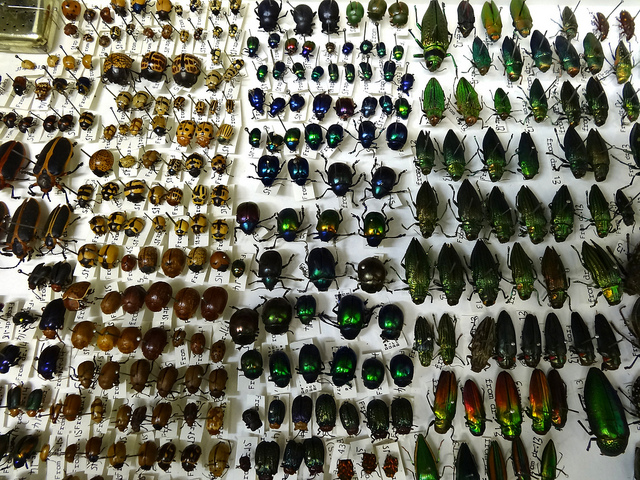
Drawer of various brightly coloured beetles, organised in neat rows with labels

Things Organised Neatly: Stewardship is fundamental to curatorship

Stewardship is the fundamental responsibility of the curators in charge of their collections. An unidentified specimen has not been forgotten. The average ‘shelf life’ of a specimen belonging to a new species, from discovery to publication, is over 20 years, and can be more than 200 years! This is due to the sheer volume of material that is collected in the field and donated to museums every year, and the expertise needed for identification. As the study of biodiversity (and the loss thereof) becomes more important to conservation efforts, more academics are turning to museums for data on population trends over time. The negative language used in these news articles could harm this relationship, and possibly deter specialists from engaging with museums. And with budget cuts increasingly affecting museum resources, curators want to engage with academics, artists, and other users, now more than ever.

The good news is that this problem is not entirely universal: recent news coverage of the discovery of a new species of ichthyosaur in Doncaster Museum was generally very positive about the value of natural history collections, mainly due to the enthusiasm of the researchers, which came across strongly in their quotes.

Rachel Jennings
NatSCA Facebook/Blog Editor