World Book Day

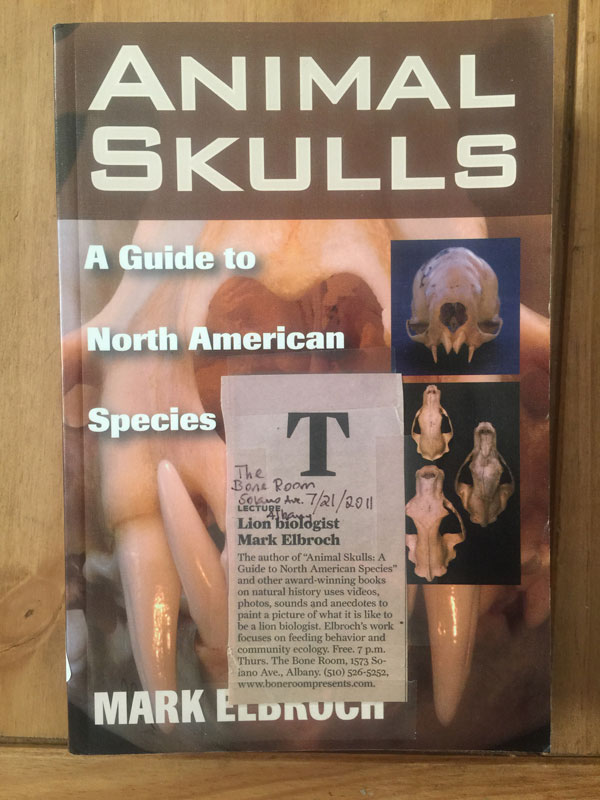
World book day is a time for sharing the books that have made an impact on you. Chances are, if you liked it, so will someone else. It has a tradition of being all about fictitious books but there’s no reason why that has to be the case. I’m going to share with you now a very interesting book that was loaned to me by Oxford Museum‘s own Gina Allnatt : the book is Animal Skulls, by Mark Elbroch. It’s a really handy resource for relative measurements of features and this particular copy came with a history: the previous owner before Gina was clearly researching big cats and had added this note to the front about a presentation by the author. There’s another note on the inside too.

Animal Skulls

A Guide to North American Species

We have some great book reviews coming in the near future so keep an eye out for those. Today I’d really like to hear what books have recently touched you – fact or fiction but specifically ones relating to natural history collections. Good books should spread faster than plagues.

NatSCA Digital Digest

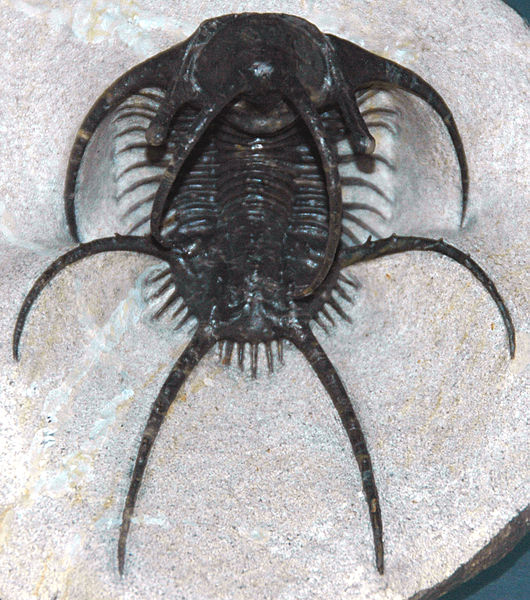
Ceratarges spinosus trilobite from Morocco (Obtained from www.wikimedia.org)

Welcome to the weekly digest of posts from around the web with relevance to natural science collections. We hope you find this useful and if you have any articles that you feel would be of interest, please contact us at blog@natsca.org


  1. One Day Conference: Curator of the Future

13th April 2015; British Museum

Synopsis

The conference will focus on three key themes:

  1. The Curatorial Survival Kit- what should be in the ‘curatorial survival kit’ to survive and thrive in the changing professional landscape?
  2. A Brave New World- what are the impacts and opportunities for curatorial practice?
  3. The Next Generation- how can we help support the current and future curatorial work force?

For further information please contact Katy Swift at kswift@britishmuseum.org


  1. Call for proposals: ‘Innovation’: The Emperor’s New Clothes?

Conference to be held on 14th May 2015 at the McDonald Institute for Archaeological Research, Cambridge.

Synopsis

Why are some projects described as ‘innovative’ while others aren’t? Have you ever been aware of pressure – from funders, from senior management, or from elsewhere – to come up with an innovative project?

Association with the innovation ‘label’ can be great in the short term for getting funding, but there is no point in ‘innovation for the sake of it’.

When you look back at all the projects described as innovative, the reality is that only some of them have brought lasting value. What does innovation mean for museums? Does it go beyond new technologies to include new ways of organising our work or interacting with audiences? How do we assess which innovations are useful and which are distractions? Do you have any examples where the term innovation has proved positive in the short term and/or in the long term? Does innovation have to be revolutionary, or can it be evolutionary? Are you aware of any innovative ways of evaluating digital projects, or evaluating projects in general, using digital technologies or methodologies?

We are seeking proposals from people willing to share their successes and failures in projects that have or could be described as innovative. However we also welcome sessions focused on debunking the ‘cult’ of innovation or addressing the questions above.

Fill in this form to submit a proposal here or contact Jessica Suess for further information jessica.suess@museums.ox.ac.uk


  1. Conference: Refloating the Ark- Connecting the Public and Scientists with Natural History Specimens

17th and 18th June 2015, 9-5pm; Manchester Museum

Synopsis

A two­‐day meeting exploring how natural history museums can contribute towards environmental sustainability, by engaging effectively with the public and the scientific research community.

For further information contact David Gelsthorpe david.gelsthorpe@manchester.ac.uk or visit the Manchester Museum website.


Compiled by Emma-Louise Nicholls, NatSCA Blog Editor

Specimens gone forever

Following on the heels of Paolo’s post last week on Collections at Risk, the International Business Times reports on a collection in Iraq that is actively being destroyed. Among the irreplaceable artefacts lost was the 7th Century Assyrian winged bull – whose twin and now only survivor resides at the British Museum, London. I don’t think we can take any comfort from the fact that it’s not a Natural History collection, or assume that Natural History collections are necessarily safe from these people: they have already condemned and murdered pigeon fanciers and banned the teaching of evolution (no surprises there). For the time being we must conclude that no collection, or indeed curator, is safe – but that has probably been true for other reasons for time immemorial.

Collections at Risk

The biggest problems facing collections today are almost certainly posed by reductions in funding. The financial support for museums of all sizes has been decreasing every year, with jobs being lost and stored collections often bearing the brunt of cuts, since they are usually out of sight and therefore out of mind for many decision makers.

Hidden treasurers? Specimens in storage can be overlooked by decision makers in favour of public-facing elements of museum business.

Hidden treasurers? Specimens in storage can be overlooked by decision makers in favour of public-facing elements of museum business.

NatSCA has been to trying to keep track of threats to collections and offer our support in an effort to make the vital role of collections, and the people with the skills to care for them, more clearly recognised by management. Much of this work in the UK has been alongside our colleagues in the Geological Curators Group.

The first issue of our new online publication NatSCA Notes & Comments provides a case study of decline from the Midlands, written by Geoffrey Hall. Although the picture painted is bleak, there have been some small wins, as Ludlow have since acknowledged the importance of maintaining a geologist to manage their globally important geology collection.

We have also been looking at the wider societal role of collections and have been working to raise their profile at a variety of levels, including internationally, alongside the Society for the Preservation of Natural History Collections. Our message about the importance of collections is being heard by a wider and more influential audience, something that is reflected in this week’s Nature, which features an article about the importance and decline of collections.

If you know of any collections that are at risk from staff loss or disposal, please let us know by editing our Natural History Near You map or emailing us at advocacy@natsca.org

Bill Pettit Memorial Fund: Discovery Collections Project

The Bill Pettit Memorial Award was set up a few years ago by NatSCA to support projects including the conservation, access, and use of natural science collections. One of the recent projects we have been able to help with was the curation of some amazing specimens from the voyage of the Discovery. Hear more about the project from Tammy below.

David Gelsthorpe

20150128_114015

In early 2013 we set about organising the task to begin with the curation of the largest, most recent and least organised of the three collections – that of the ECOMAR collection. The start of the ECOMAR project coincided with commissioning of the new UK Royal Research Ship James Cook officially named by the Princess Royal on 6 February 2007. The first ECOMAR cruise departed from Southampton on 13 July 2007. The ECOMAR project was designed to investigate the Charlie Gibbs Fracture Zone area which lies approximately mid-way between Iceland and the Azores. Four super stations were defined (two north of the Charlie Gibbs Fracture Zone and two to the south), all had the same bottom depth (2500m) and were revisited during voyages by the R.R.S. James Cook and the R.R.S. Discovery during the years 2007–2010 to replicate sampling, time-series investigations and flux studies.

The Discovery Collections have no full-time curatorial post and we rely on the goodwill and interest of students and other volunteers (including scientific visitors and work experience volunteers) to help with cataloguing, labelling, respiriting, and general curatorial jobs. The samples, though incredibly valuable should be considered at risk. I look after the collections in as much that I manage the visitors to the collections, host students, and manage public enquiries, visits and displays of the specimens. I am also a taxonomist employed to conduct research, describing new species and studying the ecology of the deep-sea benthic fauna. I was employed for four years to work on the ECOMAR program to describe the ecology of the scavenging fauna of the area. I therefore had a particular interest in the curation of this collection.

We employed Amanda Serpell-Stevens, to work on this project, but we had funds for only 8 weeks of her time. Thus the project was reduced from cataloguing the three large collections to just one. When Amanda’s contract ended there was still much reshelving and reordering of the material to be carried out which was carried out on an ad hoc basis by myself, a retired member of staff, Mike Thurston, and Amanda who returned on a voluntary basis to continue work on the project.

20150128_113759

The project began by working shelf by shelf to curate and to catalogue (in paper record) what was held including location and size of each jar, and to change containers for those specimens that were in plastic containers or inappropriate sized jars. The preservative was also replaced in most of the jars and a new label produced for each specimen, as many were poorly labelled. This curation and cataloguing process took the majority of the 8 weeks, with just enough time remaining to enter the data into Excel.

With the availability of a digital catalogue the task of reorganising the lots into taxonomic order was greatly eased. This meant adjustment of shelf heights to incorporate the various sizes of tubs and jars (some of the lots are 20 litre tubs full of holothurian specimens of a single species), and removing all the specimens in turn, which were then replaced first by taxonomic order then by station order using Excel to sort the data. The spreadsheet was updated with the new locations of the specimens as we progressed. The final part of the process involved cross referencing the specimens with the newly published papers and updating the names where they had changed (on both the specimen labels and in the spreadsheet).

There were numerous new species described during the ECOMAR project, which meant further problems in allocating the correct new name to specimens in the collections variously named as e.g. Peniagone sp. nov ‘pink’. While holotypes have been registered in the NHM, London, the rest of the material needs updating to current knowledge, a process which is often neglected, despite it being referenced in the many new publications resulting from the project.

It is very satisfying to have the ECOMAR collection properly curated and to know that I can locate any specimen needed easily. In total we curated, relabelled and catalogued a total of 1300 lots comprised of 1148 smaller jars, 88 tubs (between 5 and 20 litres) and 64 loan specimens. We plan to publish a detailed analysis of this work for the NatSCA journal, including a list of available species, and will make the catalogue available online when time and funding allow. In the meantime interested parties can contact Tammy Horton (tammy.horton@noc.ac.uk) for a copy.

Dr Tammy Horton
Ocean Biogeochemistry and Ecosystems
National Oceanography Centre,
Waterfront Campus,
European Way, Southampton SO14 3ZH
UK