Understanding Museum Taxidermy: Construction, Care and Commissioning

Taxidermy, the art and science of preserving an animal by placing the skin around an artificial body, has always been an important part of natural history collections. During the Victorian era, explorers would bring large and exotic animals back from their long voyages: the mounted skins would be displayed, enthralling the Victorian public, who had never seen creatures such as gorillas and giraffes before. While we thankfully no longer hunt and kill animals for display in museums, taxidermy is still as important as ever for teaching about the natural world – probably more so now as more and more species are threatened with extinction. While there has been a resurgence in the popularity of taxidermy, it is still the case that the number of experts capable of producing and preserving taxidermy is dwindling (in the UK, at least). With this in mind NatSCA, in association with Lancashire Conservation Studios, ran a day of talks and hands-on sessions, entitled ‘Understanding Museum Taxidermy: Construction, Care and Commissioning’, on the 1st April.

The day was led by Lucie Graham, Natural History Conservator at Lancashire Museums. Lucie began by demonstrating how taxidermy can be prepared using a wide variety of different methods, with internal moulds being formed from wood wool, balsam carvings, plaster and more. Taxidermy is an art, and each artist has their own methods. Lucie then went on to discuss how taxidermy can fall into disrepair if not properly cared for or prepared in the first place. We were able to get a close look an assortment of suffering taxidermy from Lancashire Museums, and discuss how we might treat each one to allow it to be better used and conserved. We had an adorable fox cub on our table, which had suffered from some fading, surface dirt and some loose digits on one paw. A bit of a clean and some adhesive to fix the paws, and this little cub could be looking much better!
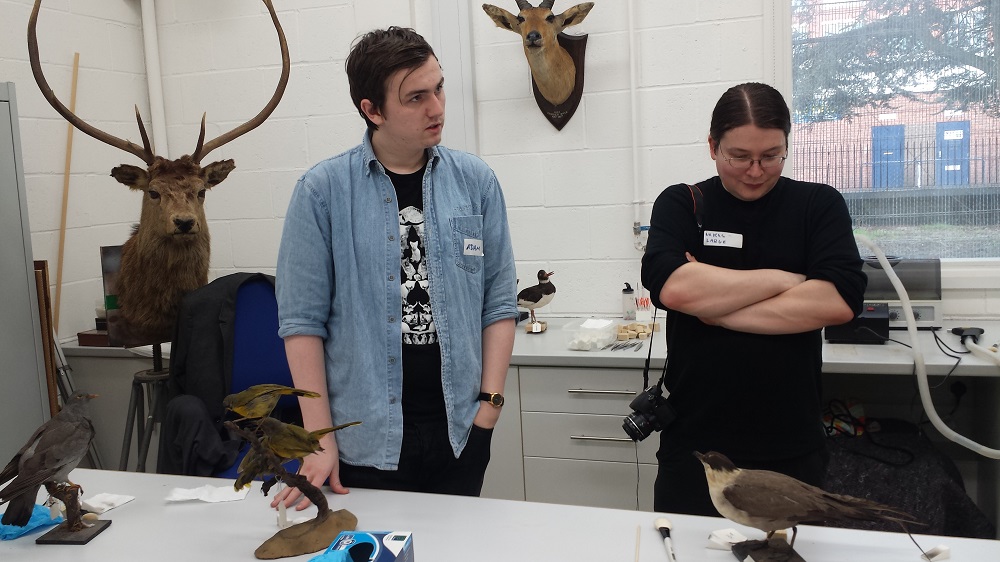
taxidermy day3

Next we went through to the conservation lab for some cleaning demonstrations, where many of us were amazed to find out that simple cosmetic sponges get thick dirt off taxidermy effortlessly! We were also shown how to preen and straighten the feathers of a taxidermy bird, using steam to ease the process.

taxidermy day2

Finally were talks from a couple of the country’s leading taxidermists. James Dickinson discussed how museums can go about commissioning taxidermy. The Guild of Taxidermists can offer lists of accredited practitioners, ensuring that museums are able to make informed decisions and seek the services of the best person for the job. Jack Fishwick, judge at international taxidermy competitions, showed us a sample of his vast collection of bird photographs, which he uses for inspiration and feel for a bird’s shape and movement in life – vital for producing realistic taxidermy. The day finished with passionate discussion about the shrinking pool of skilled taxidermists – Jack and James warn that we may have no dedicated taxidermists left within the next two decades, which could be a disaster for museums wishing to expand and preserve their collections.

Glenn Roadley
Natural Science Curatorial Trainee

A Tale of Two Playing Cards

The Museum Ethnographers Group conference is being held on Monday and Tuesday at the excellent Powell-Cotton Museum in Kent. The theme is ‘Nature and Culture in Museums’, and the relationship between the two.

I am a zoologist by background, but for the last three years I have been immersed in a different world, working on a review of the Anthropology collections at the Horniman Museum and Gardens. I have learned an enormous amount about material culture from all over the world, seen some incredibly stunning objects, and been surprised by how relevant my Natural History knowledge has been. Many of our objects are made of animal materials, and it’s been a great opportunity to learn new skills in identifying ivories, bone, and antler. Only a few weeks ago I was very excited to be able to identify an Inuit flint-sharpening tool as being made of mammoth ivory!

I have also been asked to add taxonomic data to some Anthropology object records in our Collections Management System, so that we can record the species that are represented by objects. This provides richer contextual data, and links between objects that can be navigated on our website.

Victorian playing cards featuring exotic species (Horniman Museum & Gardens)

Victorian playing cards featuring exotic species (Horniman Museum & Gardens)

One such group of objects is this set of Victorian playing cards. They are cute: on one side is a cryptic clue to the identity of an animal, and on the other is an illustration of that animal. I didn’t anticipate how much the taxonomic information would add to our understanding of the objects, or that it would enable them to tell a story about discovery and extinction…

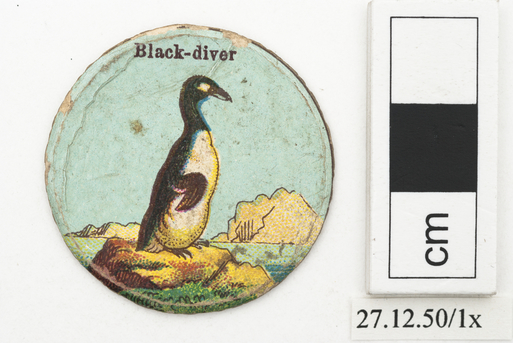
Two cards in the pack, together, tell this tale. The first is the ‘Black-diver’:

Black-diver playing card (Horniman Museum & Gardens)

Black-diver playing card (Horniman Museum & Gardens)

Mounted Great Auk specimen (Horniman Museum & Gardens)

Mounted Great Auk specimen (Horniman Museum & Gardens)

Which is actually a Great Auk (Pinguinus impennis). I have never heard ‘black diver’ used as a common name for this bird, but the likeness is unmistakable. The last recorded sighting of this species is from 1852, following the death of the last individuals to be shot, in 1844. I was intrigued to see this species represented in the pack, and was left wondering whether any of the Victorian children who played with the cards had ever actually seen a live Auk.

A second card could potentially hold the clue to this:


Reverse of animal playing card (Horniman Museum & Gardens)

Reverse of animal playing card (Horniman Museum &Gardens)

Gorilla playing card (Horniman Museum & Gardens)

Gorilla playing card (Horniman Museum & Gardens)

The Eastern Lowland Gorilla (Gorilla beringei) was not described until 1903, so it seems much more likely that this card represents the Western Gorilla (Gorilla gorilla), described in 1847.

The date of the discovery of the Western Gorilla, combined with that of the extinction of the Great Auk, could potentially narrow down the date at which these cards were made enormously: there is only a five-year period in which both species were known to exist together, between 1847 and 1852. However, the actual date of manufacture could be much later: following their discovery, gorillas were incredibly popular with the public for many years, particularly in the 1860s after the publication of Darwin’s Origin of Species in 1859, and the first live specimen reached a European zoo in 1876. ‘The Auk’ was taken as the title of the American Ornithologists’ Union’s journal, founded in 1884. So the Great Auk was clearly still in the public consciousness long after its extinction. Given this information, it seems quite possible that the original owners of the playing cards may never have seen either species in the flesh!

But that is as far as my research has taken me for now. This is a story that I hadn’t expected to find in these objects. As museum professionals, we are custodians of more than just collections: we are the keepers of specialist knowledge that we use to interpret our collections, to tell stories that will engage our audiences. Sometimes, to find their stories, you need to look at objects from more than one perspective. By working across disciplines and sharing our expertise, we can find new tales and new ways to tell them.


Rachel Jennings
Documentation Assistant, Horniman Museum and Gardens

NatSCA Digital Digest

Hectors swallowtail butterfly extracting nectar from a flower. © Cláudio TimmWelcome to the weekly digest of interesting things from around the web with relevance to natural science. We hope you find this useful and if you have any articles of interest, please contact us at blog@natsca.org

1. Blog: Crime scene micropalaeontology

Natural History Museum, London

Synopsis

‘Micropalaeontological evidence is increasingly being used to solve major crimes. Read on to find out about [curator of micropalaeontology] Steve’s involvement in Crime Scene Live, how our collections could help forensic studies and how our co-worker Haydon Bailey gathered some of the evidence that was key to convicting Soham murderer Ian Huntley’- Giles Miller

Click here to read the whole blog.

2. Museum altruism: Trip Advisor

Anyone, anytime!

Synopsis

Now that the sunshine is here (I hope I don’t jinx it by writing that) potential museum visitors will be looking ahead at inspiration for how to spend their weekends, days off, school holidays, etc. In this day and age it seems the way to find such inspiration is on websites such as Trip Advisor, on which you can read other people’s reviews of places they have visited. Obviously popping on a review of your own collection, if you work in one, would be a bit naughty, but if you have been anywhere else lately, why not help their visitor numbers out by inspiring people to visit too?

Click here to find out more.

3. Now open: Sensational butterflies at the NHM

2nd April to 13th September

Synopsis

It’s back for another summer of beautiful live insects, screaming kids and irritated academics in the offices above. Sensational butterflies in the garden of the Natural History Museum London is now open, complete with exhibition trail, and is well worth a look.

Click here for more details


Compiled by Emma-Louise Nicholls, NatSCA Blog Editor

Let’s Not Forget the Old Ways

Museums Unleashed is the conference to get to in 2015. The theme, as the title suggests, is unleashing your collections: getting them out ‘there’ using social media, blogs, TV, and newspapers. With an excellent programme of speakers, the conference will discuss inspiring new ways of sharing our collections, both to familiar audiences and new ones.

The conference will be an excellent opportunity to hear case studies on what other museums are up to and how different methods are being used. This is where wonderful, new, and exciting ideas are thought up, leading to the birth of outrageously different projects (this often happens in the pub).

As Viscardi (2012) writes, advocacy is essential for survival of the sector as a whole. We all do it, and more than we think. Probably eight or nine times a week. We talk to our colleagues and friends about our collections, or a cool specimen that we are working on. We get on the radio and talk about projects. This is great advocacy. Exciting discoveries or research in our store rooms are often accompanied by media reports highlighting the awesome museum collections.

Capricorn Beetle (Cerambyx cerdo)

Capricorn Beetle (Cerambyx cerdo) found at Plymouth University in 2007. Specimen is the first sighting of this species since 1947, and was donated to the museum. A short article was written for the local newspaper (http://www.plymouthherald.co.uk/Giant-beetle-time-Plymouth-city-native/story-23139707-detail/story.html)

As museum professionals, we should embrace new communication media without forgetting the old ways. One of the most effective means of letting staff at other museums know about your work or your collections is by writing an article for the Journal of Natural Science Collections. The Journal is fully peer-reviewed, and is written by those working with natural science collections for those working with natural science collections. This is a great way of sharing your expertise, your knowledge, and your passion for your collections with your colleagues.

All of the published articles are also made freely available online. The first two Volumes of the Journal are already available, with interesting and useful articles about conservation, collections reviews, education and the history of different collections. Some articles will be useful to your everyday work as a reference, others may spark ideas for future collaborative projects. We are now seeking contributions for Volume 3. If you have something you’d like to share, get in touch and send in an article!

The deadline for the next Volume is 15th July 2015. Please contact the Editor, Jan Freedman, for further information (editor@natsca.org). Guidelines for authors are available here, and are currently being updated.


Jan Freedman
Curator of Natural History, Plymouth City Museum and Art Gallery

NatSCA Digital Digest

ChameleonYour weekly round-up of news and events happening in the world of natural sciences


Conferences

Conference season is well and truly upon us! Here are some dates for your diaries:

The National Forum for Biological Recording and the British Ecological Society are holding a joint conference at Sheffield University on 23rd – 25th April.

The conference of the Society for the Preservation of Natural History Collections will be held at the Florida Museum of Natural History this year, on the 17th – 23rd May. The theme is ‘Making Natural History Collections Accessible through New and Innovative Approaches and Partnerships’.

Refloating the Ark: Connecting the public and scientists with natural history collections. A two­‐day meeting at Manchester University on 17th – 18th June, exploring how natural history museums can contribute towards environmental sustainability by engaging effectively with the public and the scientific research community.


Workshops

The Linnaean Society is holding a workshop on Digitising Natural History and Medical Manuscripts on 27th – 28th April.

The 2nd International Conservation Symposium-Workshop of Natural History Collections will be held in Barcelona on 6th – 9th May. The Symposium-Workshop will emphasize concepts relating to the protection and conservation of natural history collections.

Risk Management in Collections Care is a one-day seminar at Kelvingrove Museum in Glasgow on 21st May, discussing how heritage organisations can use risk management to set priorities and efficiently allocate limited resources to reduce risks to collections.

As always, keep an eye on the events page of our website for more upcoming conferences and courses!


In the Media

Illustration of a Brontosaurus skeleton by Charles Othniel Marsh

This week’s big news: Brontosaurus is back! A new specimen-level cladistic analysis of diplodocids found strong support for Brontosaurus as a valid genus distinct from Apatosaurus. The internet rejoiced.

Entomologists from the Natural History Museum of Los Angeles County found 30 new species of fly in urban gardens.

Skeletal collections can tell us about the history of welfare standards in captive animals (warning: the paper is behind a paywall, but the abstract is free).

Brian Switek revisits his old fossil friend Teleoceras.

Three new species of wood lizard have been discovered in Ecuador and Peru by museum researchers.


Got a submission for the blog or Digital Digest? Email us at blog@natsca.org