NatSCA Digital Digest – May 2021

Compiled by Glenn Roadley, NatSCA Committee Member, Curator of Natural Science at The Potteries Museum & Art Gallery.

Welcome to the May edition of NatSCA Digital Digest.

A monthly blog series featuring the latest on where to go, what to see and do in the natural history sector including jobs, exhibitions, conferences and training opportunities. We are really keen to hear more about museum re-openings, exhibition launches, virtual conferences and webinars, and new and interesting online content. If you have any top tips and recommendations for our next Digest please drop an email to blog@natsca.org.

NatSCA Conference 2021: Environmental Breakdown and Natural Science Collections

The NatSCA 2021 conference and AGM will take place on 27th and 28th May, online via Zoom. 9.50am-4pm BST (UTC +1). The #NatSCA2021 conference will explore the role of natural science collections in addressing or engaging with one of the planet’s biggest issues – environmental breakdown; as well as sharing other exciting developments from the sector.

The conference will include an engaging range of keynotes, presentations, panel discussions, quick-fire ideas lightning talks and virtual tours.

Tickets are now available, and all are welcome. This event is free for NatSCA members. Of course, new members are welcome, and Personal Membership costs £20 per year (which is the same as the conference registration fee for non-members).
You can join up here: http://www.natsca.org/membership
NatSCA has also made a small number of free tickets available for unwaged non-members who might not otherwise be able to attend.

Continue reading

Behind The Heads: Natural History, Empire and The Abel Chapman Collection. Part 1.

Written by Dan Gordon, Keeper of Biology, The Great North Museum: Hancock.

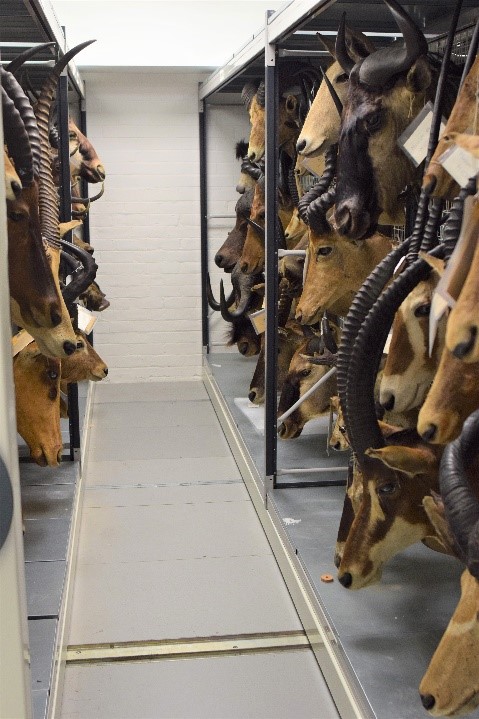
In the museum’s basement is a room filled with heads. Row after row of them stare out from metal racks, glassy eyed and bristling with every kind of horn and antler. Visitors to this room are sometimes awestruck at the breadth of species on display. The Kudu, its head crowned by spiralling horns like giant corkscrews. A tiny Klipspringer with horns like shiny black thorns. The huge Eland, its vast head armed with massive horns like tank shells. A parliament of Africa’s fantastic beasts, all in this small storeroom. These are hunting trophies from the Abel Chapman collection. When he died in 1929 they were taken down from the walls of his Northumberland home, and gifted to the museum.


Figure 1. A rack of game trophies from the Chapman collection in the Great North Museum resource centre (Copyright Tyne and Wear Archives and Museums.

In light of the current conversation about museums and colonialism, and the insightful work of Lowe and Das on the subject of Natural History collections in this context, I thought I’d try to learn more about the history of the great North Museum’s African collections, and my attention was caught on the horns of Chapman’s trophies. The more I’ve learned about their story, the more I’ve come to feel that trophy heads, some of the most recognisable Natural History objects, are great examples of the way that colonialism has both helped to shape naturalism, museum collections and even our ideas about wildlife conservation.

The story of our collection begins in 1851 when Abel Chapman was born into a wealthy Sunderland brewing family. Educated at the elite Rugby School, he joined the family firm as a young man and embarked on a successful business career. Chapman was intelligent and adventurous, making expeditions to places like Canada, Scandinavia and the Arctic. In detailed notebooks filled with deft pencil sketches he documented the things he heard, saw and shot, and used these to write a whole series of books. He built a reputation as a ‘hunter naturalist’ passionate about combining field sports with game preservation, and as well as amassing a horde of trophies, he became an influential figure in the emerging field of wildlife conservation.

Continue reading

The East India Company and Natural History Collecting

Written by Rachel Petts, Curatorial Assistant Zoology (part time), Manchester Museum.

Manchester Museum is currently undergoing an exciting transformation, building two new galleries, a South Asia Gallery and the Lee Kai Hung Chinese Culture Gallery. This sparked interest and further research into our natural history collections from Asia.

Manchester Museum has a large collection of 18,000 bird skins; including many specimens from the former British Empire. Further study of the collection has identified over 100 birds linked to the East India Company Museum.

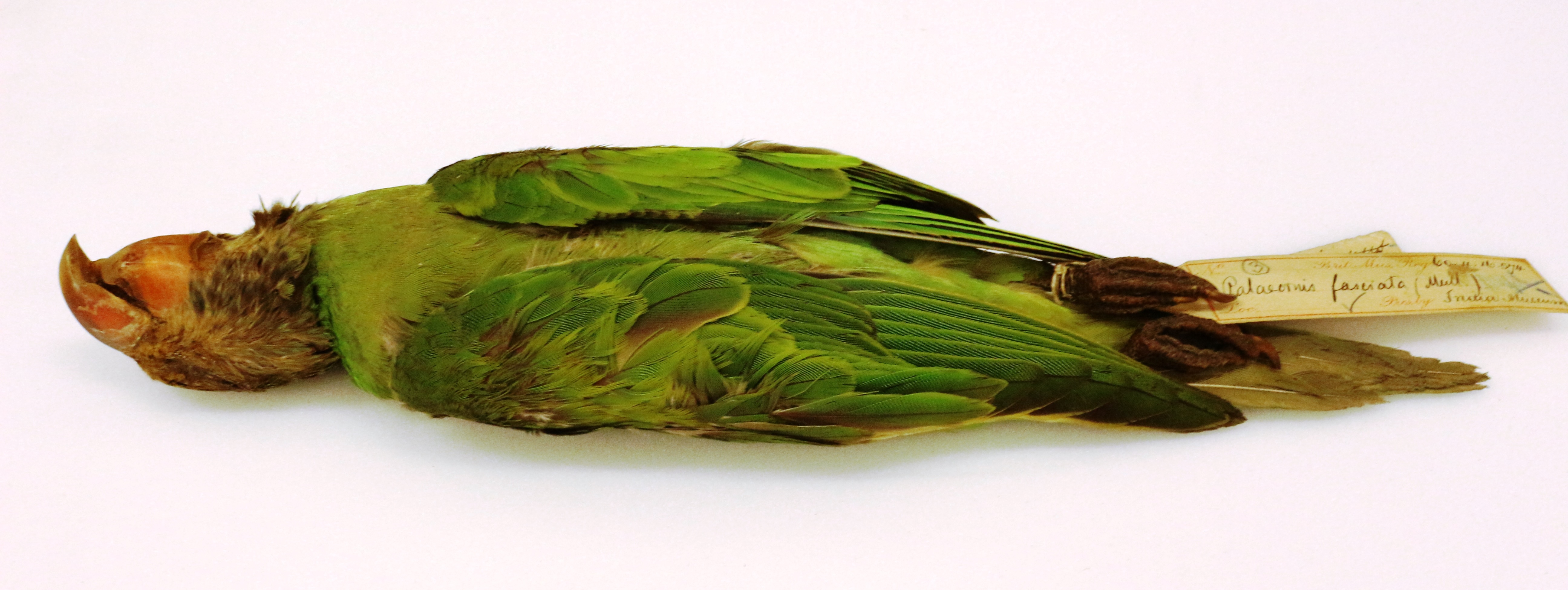
Figure 1: B.2574 Psittacula alexandri fasciata (Statius Muller, 1776) Red-breasted Parakeet, Andaman Islands, South Asia. Presented by the India Museum, London. © Manchester Museum, The University of Manchester

A Brief History of the East India Company Museum

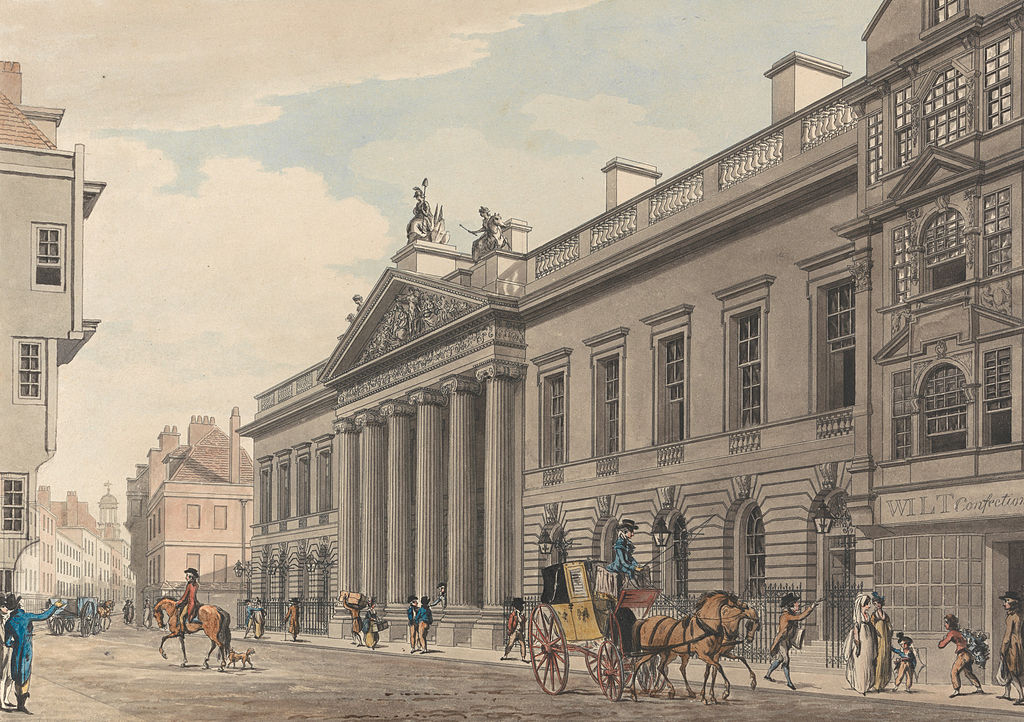
The East India Company was established in 1600 by a royal charter signed by Queen Elizabeth I. It gave the company the monopoly on trade in South Asia for over 250 years. The museum was established in 1798, as an ‘Oriental Repository’ to exhibit the returns of the East India Company’s commerce. It was known as the India Museum, and was housed in the company’s headquarters at India House, Leadenhall Street, London. Company servants were encouraged to expand their knowledge of South Asia in order to advance the company’s commercial and territorial ambitions.

Figure 2: East India House by Thomas Malton the Younger (1748-1804), Public domain, via Wikimedia Commons

Modelled on the Royal Society of London, the Asiatic Society of Bengal was formed in 1784 by a number of East India Company employees in Calcutta. The aim of the society was to carry out research into the history, arts, literature and Natural History of Asia. The Asiatic Society was closely associated with the India Museum in London. Charles Wilkins one of the founding members of the Asiatic Society would go on to propose the formation of the East India Company Museum in London and would become its first curator. The Indian Museum in Calcutta was established in 1814 with the founding collections from the Asiatic Society.

Continue reading

NatSCA Digital Digest – April

Compiled by Lily Nadine Wilkes. NatSCA Volunteer.

Welcome to the April edition of NatSCA Digital Digest.

A monthly blog series featuring some interesting things to see and do in the natural history sector including jobs, exhibitions, conferences and training opportunities. We are really keen to hear more about museum re-openings, exhibition launches, virtual conferences and webinars, and new and interesting online content. If you have any top tips and recommendations for our next Digest please drop an email to blog@natsca.org.

Where to Visit

The Lost-Wax for Lost-Species online exhibition brings together over 100 artists and five independent founders to collectively make a Noah’s Ark of endangered species.

Visit the Field Museum of Chicago’s egg vault with Alie Ward and Dr John Bates with this Oology podcast.

Virtually visit the Natural History Museum’s Wildlife Photographer of the Year Trail, search for clues to be in with the chance of winning some amazing prizes.

The third in City of Trees’ Natural World Webinars on Wednesday 14th April are joined by Rachel Webster, Curator of Botany at Manchester Museum, as the world of blossoms is explored. They will be taking a closer look at some flowers and thinking about the science of blooming.

Continue reading

Conserving Garden Plant Diversity

Written by Yvette Harvey, Keeper of the Herbarium, Royal Horticultural Society, RHS Garden Wisley.

We live at a period in time where we are very familiar with the concept of mass extinctions that are likely to be caused by human intervention (from burning of the rain-forests, hunting and desertification through to global warming). As the years/decades/centuries progress, our preserved plant and animal [by which I mean anything that moves] collections find themselves being useful tools to provide empirical evidence for the causes of the above, outside of their main purpose of pure taxonomy (Thiers 2020: 219-242).

Following the recent closure of Kew’s Red Listing department, conservation is a subject that readily springs to mind. With c. 390 million specimens contained within the World’s herbaria, information captured in specimen labels has ultimately provided the data for calculating the Area of Occupancy and Extent of Occurrence, both of which play a large part in assessing the IUCN (International Union for Conservation of Nature) Red listing of a plant.

I am lucky to work with a specialist herbarium collection – one that contains ornamental plants based at RHS Garden Wisley. Yes, highly unlikely to play a role in an IUCN assessment, but all the same, a dried ornamental plant collection does play a vital role in conservation. Whilst Plant Heritage aims to conserve living plants, a herbarium that specialises in ornamentals (cultivars) can preserve material of long lost or even recently lost garden plants.

Continue reading