Feeling Older than Your Age? The Importance of Museum Collections for Radiocarbon Dating, and a Request for Collections containing Bivalves Collected Before 1950 from the UK

Written by Rachel Wood, Associate Professor, Oxford Radiocarbon Accelerator Unit, School of Archaeology, University of Oxford.

Radiocarbon dating is routinely used to work out the age of archaeological and palaeontological sites, and often pops up in news articles and TV dramas. But some substantial problems remain. One of these is the calibration process, which allows us to convert the ratio of 14C (“radiocarbon”) and 12C (the common stable form of carbon) to an age estimate. This is particularly challenging when we are trying to date marine shells or any animal that has eaten food from the marine system. This means that it can be difficult for us to get an accurate age for a sample that should be straightforward – for example, the skeleton of Medieval person or a Mesolithic dog.

The Oxford Radiocarbon Accelerator Unit is starting a project looking for samples of marine shells to help resolve this problem (Fig. 1). Natural history collections in museums are key to its success, and we would be very grateful to hear if anyone has a collection of pre-1950 marine bivalve shells.
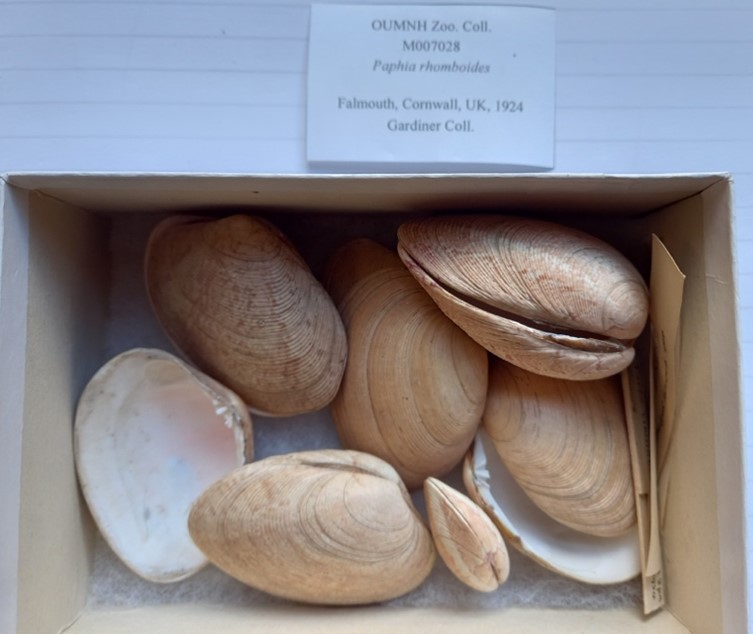
Figure 1. Marine bivalves, suitable for helping us to calibrate radiocarbon dates. Please let us know if you have similar material that can be analysed by sampling a small strip from the edge. (Photo Peter Ditchfield, Courtesy Oxford University Museum of Natural History)

The Problem

At school, we are taught that radiocarbon dating works because radiocarbon decays radioactively at a known rate. By comparing the amount of 14C to a stable form of carbon called 12C, we can work out the age of a sample (Fig. 2). This is true, but only partially so because the starting 14C:12C varies. To get around this problem, we need to calibrate radiocarbon dates. Most 14C is produced in the upper atmosphere, and is incorporated into plants by photosynthesis and then passed through the food chain. This means, that if someone is eating terrestrial food – they will have a similar 14C:12C ratio in their bodies as in the atmosphere.

Continue reading

Divorced or Separated? Naming the Specimens on Display at the Zoologisches and Palaontologisches Museum, Zurich.

Written by Richard Crawford, who has just completed a PhD thesis at the University of the Arts London, entitled ‘Re-presenting taxidermy, Contemporary Art interventions in Natural History Museums’.

Do people read labels in museums? If they do, what do they learn about the object on view? It has been the custom to use labels to give factual names to the things on display in scientific museum displays, but Art curators have taken a different approach and put titles to works that suggest a particular reading of the artwork. These may be suggested by the artist. A good example of this style of labelling is Damien Hirst’s ‘Mother and Child divided’, an artwork that used preserved specimens.

For this work, Damien Hirst famously sawed a cow and a calf in half and exhibited the separate halves in tanks filled with formaldehyde, which he placed apart with sufficient space for a viewer to walk between the two halves of each animal carcass so that they could observe the internal organs of both cow and calf. When it was exhibited at the Tate Gallery in 1995, it helped win him the Turner Prize. The title was ironic. Hirst’s work critiques romantic depictions of the animal as part of harmonious natural order, a place in which mothers protect and nurture their young according to supposedly universal maternal instincts. In place of natural harmony, he presented the viewer with the disjuncture and division brought about by human intervention that brought early death to these two animals, destined for the meat market.

Continue reading

The Institute of Biology of the National Autonomous University of Mexico Celebrates its 95th Anniversary

Written by Fernando A. Cervantes and Yolanda Hortelano-Moncada, National Mammal Collection, National Biodiversity Pavilion. Institute of Biology, UNAM. Mexico City, Mexico.

The Instituto de Biología (IB) will celebrate its 95th anniversary on November 9, 2024 and is a dependency of the Universidad Nacional Autónoma de México (UNAM) (Fig. 1). This date coincides with the same time that the Mexican government granted “autonomy” to the then National University of Mexico.  

Fig. 1. Central buildings of the Institute of Biology, National Autonomous University of Mexico, Mexico City (Photograph: Institute of Biology, UNAM).

The central buildings of the IB are located in the south of Mexico City, in the area known as Pedregal de San Ángel, which is characterized by a rocky substrate of volcanic origin. Currently, a large part of the IB campus is an ecological reserve that protects the flora, fauna, and fungus of the natural ecosystem of the area, which corresponds to xerophytic scrub (Fig. 2). 

Fig. 2. Xerophytic scrubland growing on volcanic rock in the Ecological Reserve of Pedregal de San Ángel, where the Institute of Biology, UNAM, is located in Ciudad Universitaria, Mexico City (Photograph: Dirección General de Comunicación Social, UNAM).
Continue reading

Mainstreaming Biodiversity in Museums

Written by Henry McGhie, Curating Tomorrow henrymcghie@curatingtomorrow.co.uk.

Link to the guide: https://curatingtomorrow236646048.files.wordpress.com/2023/11/mainstreaming-biodiversity-in-museums_2023.pdf

‘Mainstreaming’ is a policy and planning approach that means that we don’t just create a new programme or strand of work, but that we embed it across all activities. We can embed support for biodiversity and environmental concerns across museum activities. Why is this important? Well, for a few reasons. Firstly, biodiversity is not yet fully mainstreamed into museum thinking – in terms of their goals, actions, or evaluation. Second, museums present a massive potential to support biodiversity in different ways, notably through education, research, public awareness and partnerships. Third, museums make big negative impacts on biodiversity and the environment, through their contributions to climate change (from use of energy, waste, and visitor emissions), and their involvement in environmentally damaging activities (e.g. how their investments are used). Fourth, because biodiversity is in deep crisis: species continue to decline, major challenges are getting worse, and there is no clear prospect of a change for the better. Lastly, fifth, because people and nature are interdependent: if the environment suffers, people and communities suffer.

Continue reading