Liverpool, Natural History and Extinction: The Case of a Real Liver Bird

Written by John-James Wilson (Lead Curator of Zoology, World Museum), Jude Piesse (Senior Lecturer in English Literature, LJMU) & Alyssa Grossman (Senior Lecturer in Communication and Media, University of Liverpool).

The interdisciplinary public engagement project ‘ENLivEN: Empire, Nature and Liverpool: Investigating and Engaging with Natural History’, is a collaboration between University of Liverpool, Liverpool John Moores University (LJMU) and 14 city-wide partners. In this blog we bring together reflections from a workshop held at World Museum, Liverpool in October 2025, where we trialled approaches for the project with LJMU undergraduates. ENLivEN will develop further workshops on similarly evocative ‘catalyst’ specimens and objects held across participating institutions.

John-James Wilson (Lead Curator of Zoology, World Museum)

Spotted Green Pigeons are a species that became extinct at the beginning of the nineteenth century.

In 1793, Dr John Latham noticed two unusual taxidermized pigeons in private natural history collections in London. He described them as a new species that he called Spotted Green Pigeons. One of the specimens is now lost but the other was bought by the 13th Earl of Derby. In 1851, the 13th Earl of Derby left his specimen to the people of Liverpool in his will. Because the specimen is kept at World Museum, this specimen became known as the Liverpool Pigeon.

The Liverpool Pigeon is now the only known Spotted Green Pigeon specimen in existence. Uncertainty about the status and nearest relatives of Spotted Green Pigeons continued for over 200 years. DNA analysis in 2014 convinced scientists that Spotted Green Pigeons were a genuine, extinct species. Spotted Green Pigeons were only very distantly related to Feral Pigeons found in Liverpool and cities around the world.

Continue reading

Seeing With Their Eyes A Poetic Reflection on the 2025 ‘From Collections to Connections’ NatSCA Conference Presentation

Written by Pauline Rutter – Independent Archival Artist, Community and Organisation Poet.

These words look out from the page with eyes I have borrowed. Eyes not shaped for vision through the specific disciplinary scientific lens. Eyes that strain to see beyond past centuries of debate on what, of all origins, is knowable and what is not. With these original eyes, would ways of seeing allow the light to travel outwards resisting funnelled perspectives and interpretations descended from imperialistic systems of Enlightenment science, colonial ideologies and narratives? In this context my eyes had opened up unevolved or re-evolved with lepidopteran vision, though not removed from all that had been taught to be seen. New eyes with sight of intensified colour that amplified nature’s interconnecting patterns, only visible outside the spectrum of the everyday, the expected, the predetermined. 

What use is butterfly sight that transforms configured objects and living matter with or without full binominal species names, into fragments like those of the intertwined and metamorphosed elements in ritualistic rapture spreading out across a Wangechi Mutu collage? 

Continue reading

NatSCA Digital Digest – March 2025

Compiled by Olivia Beavers, Assistant Curator of Vertebrate Zoology at World Museum, National Museums Liverpool.

Welcome to the March edition of NatSCA Digital Digest.

A monthly blog series featuring the latest on where to go, what to see and do in the natural history sector including jobs, exhibitions, conferences, and training opportunities. We are keen to hear from you if you have any top tips and recommendations for our next Digest, please drop an email to blog@natsca.org.

Sector News

NatSCA Annual Conference & AGM 2025: Registration Now OPEN!

Booking is open for the 2025 Natural Sciences Collections Association (NatSCA) conference. This year’s theme is: Making a Difference: Showing the Positive Impact of Natural History Collections, and it will be hosted by the University of Manchester: Manchester Museum, UK.

Due to the size of the venue there are only a limited number of spaces, so please book promptly to avoid disappointment. Visit the webpage to find out more: https://www.natsca.org/event/2881

This year’s conference meal is at Zouk and we would love to see you there. Please make sure to add the separate ticket to your basket.

Don’t hesitate to get in touch if you any questions. If you would like to become a member, which would qualify you for the conference discount or bursaries, please see our website NatSCA.org for details. 

30th Symposium on Palaeontological Preparation and Conservation: Call for abstracts

Please send abstracts of up to 250 words plus an image to sppc@geocurator.org by 10th April. Abstracts will be considered on any topic of earth science excavation, conservation, preparation mount-making and exhibition. Please state if the abstract is for a poster or platform presentation.

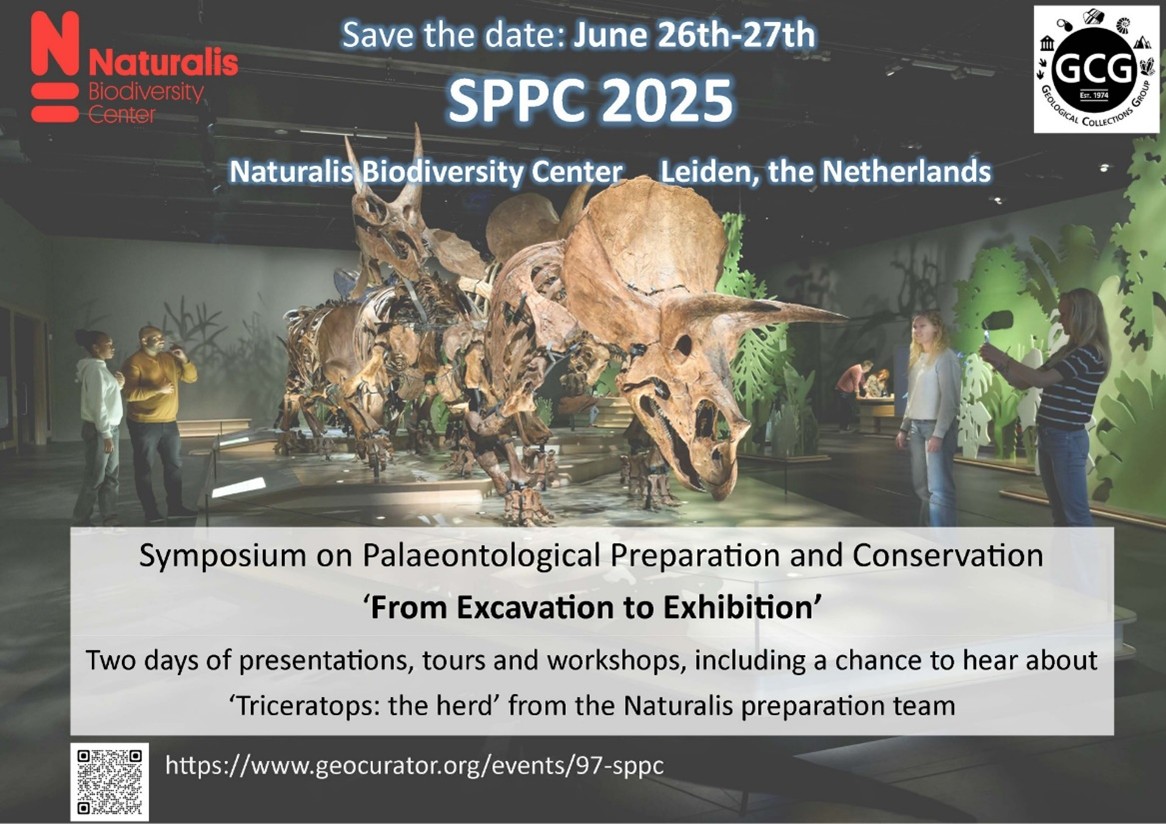
The 30th Symposium on Palaeontological Preparation and Conservation will be held in the Netherlands this year on 26 – 27th June.

The theme will be ‘From Excavation to Exhibition’ and they hope to broaden their usual remit to include more aspects of the story of how geological collections end up on display in our museums, as well as their conservation and preparation. Examples of previous years’ abstracts can be found online at https://www.geocurator.org/events/97-sppc

Continue reading

NatSCA Digital Digest – February 2025

Compiled by Ellie Clark, Collections Moves Team Leader at the Natural History Museum

Welcome to the February edition of NatSCA Digital Digest.

Digital Digest is a monthly blog series featuring the latest on where to go, what to see and do in the natural history sector including jobs, exhibitions, conferences, and training opportunities. We are keen to hear from you if you have any top tips and recommendations for our next Digest, please drop an email to blog@natsca.org.

Sector News

Save the Date: SPPC, June 26th – 27th 2025

The 30th Symposium on Palaeontological Preparation and Conservation will be held in the Netherlands this year on 26-27th June.

The theme will be From Excavation to Exhibition including aspects of the story of how geological collections end up on display in our museums, as well as their conservation and preparation. A call for abstracts and registration is coming soon. For more details visit: https://www.geocurator.org/events/97-sppc

Continue reading

Collecting Coventry, a Temporary Exhibition at the Herbert Art Gallery & Museum

Written by Ali Wells, Curator (Herbert Collections), Herbert Art Gallery & Museum.

This blog post details a temporary exhibition at the Herbert, how it was presented, how decolonisation and feedback were integrated into the show. This is an overview, please get in touch if you would like more information on any aspect of the exhibition.

In May 2024 the Herbert launched its latest major temporary exhibition, Collecting Coventry. The display focuses on the history of collecting in Coventry museums and showcasing the breadth of the collections.

The main aims were to

  • Present the Herbert’s collections after several years of external or predominately loan-based temporary exhibitions.
  • Get out visitor favourites like the Lowry and display stored objects for the first time.
  • Look like a museum store.
  • Give visitors the opportunity to comment on aspects of museum work and ask questions relating to collections and displays. For example, Collections Development policy, display of human remains, use of technology, future exhibitions, representation.
Continue reading