Compiled by Olivia Beavers, Assistant Curator of Vertebrate Zoology at World Museum, National Museums Liverpool.
Welcome to the June edition of NatSCA Digital Digest.
A monthly blog series featuring the latest on where to go, what to see and do in the natural history sector including jobs, exhibitions, conferences, and training opportunities. We are keen to hear from you if you have any top tips and recommendations for our next Digest, please drop an email to blog@natsca.org.
Sector News
From Collections to Connections, May – November 2024
This Changing Chalk commission/ Natural Trust funded project is a collaborative archival art and environment initiative. Artist Pauline Rutter invites Black and minoritised young people, their families and communities to explore the rich history of flora and fauna across several locations of the Changing Chalk area within the South Downs National Park.
‘From Collections to Connections’ offers opportunities for learning and sharing about collections held at the Booth Museum which relate to the Sussex locations of Mill Hill, Truleigh Hill and Devils Dyke. Through walks, talks and creative interventions, opportunities are provided for exploring the museum collections and their related histories. Individuals will be invited to find their own connections between these elements and their experiences within the natural and museum environments. To find out more, follow this link to the summary outline: https://drive.google.com/file/d/1cJQh4UYMTeRB_HqsM7EydOmNBLGKYQpb/view
Written by Amanda Callaghan, Curator/Director of the Cole Museum of Zoology at the University of Reading.
The narwhal Monodon monoceros is one of the rarest and oddest-looking whales. Cousin to the white Beluga whale, narwhal means “corpse whale” in Icelandic, (nar corpse and hvalr whale) a reference to its blotchy grey pallor1. Male narwhals (and a small number of females) have a canine tooth on the left-hand side of the upper jaw that grows through the upper lip into a long spiral “tusk.” The function of this strange tooth is unclear, but the horns are used for duelling or ‘tusking’ when the males compete for females.
From medieval times through to the 17th century, the legend of the mythical horned horse, or unicorn, was reinforced by the spectacular spiralling horns brought to Europe. Those observed live in the seas around Greenland and Iceland were known as “sea unicorns”2. Today, although we know they are not unicorn horns, there remains a fascination and high price for these rare and beautiful teeth.
Written by Rachel Wood, Associate Professor, Oxford Radiocarbon Accelerator Unit, School of Archaeology, University of Oxford.
Radiocarbon dating is routinely used to work out the age of archaeological and palaeontological sites, and often pops up in news articles and TV dramas. But some substantial problems remain. One of these is the calibration process, which allows us to convert the ratio of 14C (“radiocarbon”) and 12C (the common stable form of carbon) to an age estimate. This is particularly challenging when we are trying to date marine shells or any animal that has eaten food from the marine system. This means that it can be difficult for us to get an accurate age for a sample that should be straightforward – for example, the skeleton of Medieval person or a Mesolithic dog.
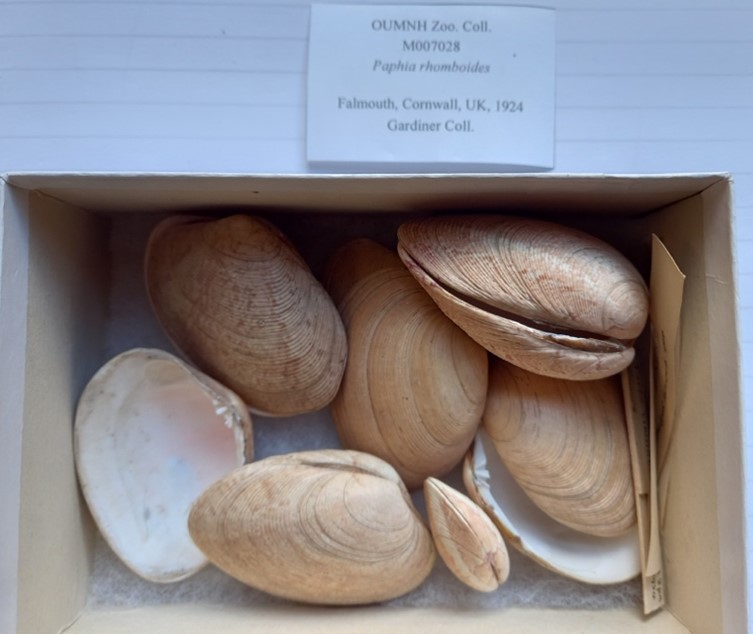
The Oxford Radiocarbon Accelerator Unit is starting a project looking for samples of marine shells to help resolve this problem (Fig. 1). Natural history collections in museums are key to its success, and we would be very grateful to hear if anyone has a collection of pre-1950 marine bivalve shells.
Figure 1. Marine bivalves, suitable for helping us to calibrate radiocarbon dates. Please let us know if you have similar material that can be analysed by sampling a small strip from the edge. (Photo Peter Ditchfield, Courtesy Oxford University Museum of Natural History)
The Problem
At school, we are taught that radiocarbon dating works because radiocarbon decays radioactively at a known rate. By comparing the amount of 14C to a stable form of carbon called 12C, we can work out the age of a sample (Fig. 2). This is true, but only partially so because the starting 14C:12C varies. To get around this problem, we need to calibrate radiocarbon dates. Most 14C is produced in the upper atmosphere, and is incorporated into plants by photosynthesis and then passed through the food chain. This means, that if someone is eating terrestrial food – they will have a similar 14C:12C ratio in their bodies as in the atmosphere.
Written by Su Liu, BA English Language and Literature student at the University of Sheffield, formerly summer intern (2023) at Amgueddfa Genedlaethol Caerdydd – National Museum Cardiff.
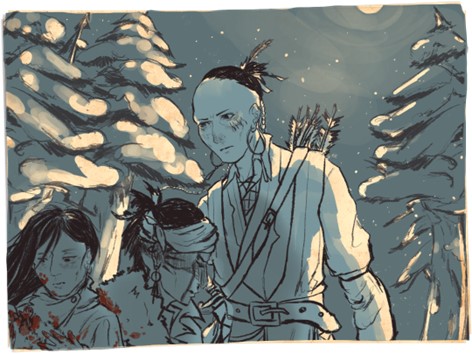
Thomas Drummond, a Scottish naturalist, witnessed the tragedy of his accompanying Native American family – the Iroquois hunters had just lost their beloved and a newborn in the severe winter of Saskatchewan, Canada. Yet their journey had to be continued to collect the 286 specimens in Drummond’s Musci Americani, one of the richest collections of North American mosses.
‘…the whole of the continent of North America has not been known to possess so many Mosses as Mr. Drummond has detected in this single journey.’ – Sir William J. Hooker (1830)
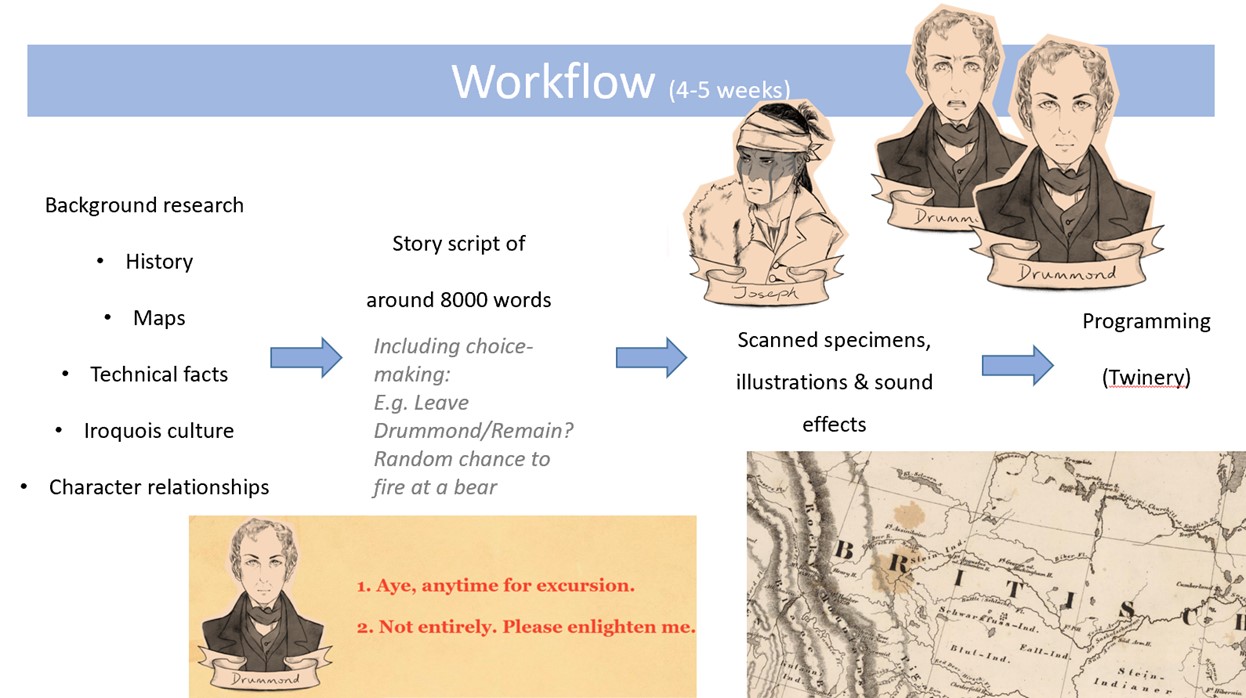
Above is a real event in Drummond’s Sketch of a Journey to the Rocky Mountains and to the Columbia River in North America, which records his excursions during Franklin’s second land expedition. It has been adapted into an interactive digital narrative, Snow, Bonfires and Mosses, in which the reader engages with a combination of novel, visualisations, sound effects and choice-making. Choice-making allows the reader to experience different narratives and explore possibilities amid ambiguities in history.
This browser game is accessible on most devices and comes with an ‘encyclopaedia’ that includes a selection of Drummond’s moss specimens and external links to the biographies of all historical characters.
Lost stories of a distant adventure and forgotten collectors
The story of Drummond’s adventure began in Saskatchewan, 1825, where he parted ways with Franklin’s party and was joined by Iroquois hunters employed by Hudson’s Bay Company, a dominant fur trading company at the time. Their journey near the Rocky Mountains was an underdeveloped version of Man vs. Wild, surrounded by hunger, blizzards, wildlife, and humans – conflict between different tribes continued regardless of the Europeans’ intrusion.
Drummond made excursions whenever he had the opportunity, followed by sleepless nights when he had to treat his specimens before the fur brigade departed. At times, he failed to follow the fur brigade’s pace and consequently much of his work was lost or destroyed. By the time he was brought back to reality from work, he realised that he had been left ‘alone with the Indians’.
In contrast with Drummond’s objectives, the emphasis of the expeditions had been more on the exploitation of new trading routes. The capitalist powers were eager to establish colonial influence in North America and appeared to have taken local labour for granted, so the natives were not having a great time either. Drummond sometimes found the ‘fickleness’ in them hard to deal with but nevertheless depended on their work.
My colleague and BA history student Harry Pointon has pointed out the conventionalised indifference towards local hunters in the early 19th century, whose contributions are acknowledged in Drummond’s Sketch due to the complexity of his journey, as the natives play essential roles in the naturalist’s survival and are experienced guides to the flora in their natural habitat. With that in mind, my digitalisation of the exsiccatae (numbered collections of dried herbarium specimens with a common theme or title) goes in tandem with decolonising the history of the participants, especially the Native Americans.
Behind the scenes of Snow, Bonfires and Mosses
I had a blast writing, drawing and programming to make historical science approachable without being a bore, especially for slightly older children. It was hard to imagine myself working on two-hundred-year-old mosses as an English student, but I was beyond excited to see moss specimens in a great variety of sizes and colours. With the help of the Biodiversity Heritage Library (BHL) and my supervisors, I was able to put together a full timeline of events without much barrier to scientific knowledge.
The historical accounts were quite a fun read. Early modern science writing (approximately from the 17th century onwards) consisting of all sorts of information, from each step of the experiments (even if it results in failure) to personal remarks from the researchers. Unlike contemporary science writing which aims to be brief and impersonal, these accounts are vividly descriptive, and they highlight the presence of all participants: naturalists, hunters and fur traders. Drummond’s Sketch is an excellent resource that conveys his passion for botany and has proven itself practical in helping me construct my storytelling of the specimens. It is also proof of Native American involvement in naturalist excursions.
Apart from the emphasis on Drummond’s excursions and specimens, the narrative also presents parts of Native American culture throughout the characters’ dialogues. Iroquois people, for example, tend to have a strong belief in astrology and female leadership. This will hopefully create a fuller image of the Indigenous collectors, their lives, and the ways they were treated by the Europeans.
As a literature student, my understanding of decolonising history is the liberation of artefacts from hidden archives and unravelling the stories of neglected participants in the most accurate detail as possible. Drummond’s Sketch is perhaps a fortunate case for decolonising the archive, considering the common lack of credit for Native Americans. It is encouraging to see readers entertained and captivated by the story, and hopefully this has been an inspiring attempt at digitalising and decolonising museum archives for educational purposes.
Written by Richard Crawford, who has just completed a PhD thesis at the University of the Arts London, entitled ‘Re-presenting taxidermy, Contemporary Art interventions in Natural History Museums’.
Do people read labels in museums? If they do, what do they learn about the object on view? It has been the custom to use labels to give factual names to the things on display in scientific museum displays, but Art curators have taken a different approach and put titles to works that suggest a particular reading of the artwork. These may be suggested by the artist. A good example of this style of labelling is Damien Hirst’s ‘Mother and Child divided’, an artwork that used preserved specimens.
For this work, Damien Hirst famously sawed a cow and a calf in half and exhibited the separate halves in tanks filled with formaldehyde, which he placed apart with sufficient space for a viewer to walk between the two halves of each animal carcass so that they could observe the internal organs of both cow and calf. When it was exhibited at the Tate Gallery in 1995, it helped win him the Turner Prize. The title was ironic. Hirst’s work critiques romantic depictions of the animal as part of harmonious natural order, a place in which mothers protect and nurture their young according to supposedly universal maternal instincts. In place of natural harmony, he presented the viewer with the disjuncture and division brought about by human intervention that brought early death to these two animals, destined for the meat market.






 NatSCA