
Written by Lydia Amies, Caitlin Jenkins, Emanuele Casafredda, Lucia Petrera, Tanya Nakamoto and Fabiana Portoni, Natural History Museum, London.
The Natural History Museum, London (NHM) is moving a third of its collection (28 million) specimens to a to a new, purpose-built centre at Thames Valley Science Park near Reading. Under the umbrella of the Unlocked Programme a new facility is being designed and built to house natural history specimens, research laboratories, working space, and digitisation facilities. The project started in 2020 and the moves stage will commence in 2028.
The Unlocked Conservation Team is working to assess, treat and stabilise at-risk specimens that are due to move. Our focus is to futureproof collection storage while using materials in a sustainable and cost-effective way. Our work will improve access to the collections and enable safe handling of specimens. One of the largest and most complex collections we are working on is the Fossil Mammal Collection which is made up of a wide variety of species, from tiny extinct rodents to woolly mammoths.


Examples of the Fossil Mammal Collection at NHM London. © The Trustees of the Natural History Museum, London.
The collection contains approximately 350,000 specimens consisting of fossilised bones and teeth, rare hair and soft tissues, as well as important casts and replicas. These different materials require a varied approach that considers the specimens’ diverse vulnerabilities. The sheer scale of the collection is a challenge, and surveying the specimens in order to prioritise conservation work has been a massive task. Many specimens are oversized, heavy and fragile and difficult to fully assess in situ. Other specimens are partially or fully articulated on armature and mounts, which can affect their stability and increase the risk associated with handling and moving them.
A key consideration for this collection is the specimen ‘footprint’, which is the horizontal space it occupies within a drawer or on a shelf. We have limited collections space and specimens need to fit back into their original locations wherever possible. Even just adding a few centimetres to a single specimen can result in a significant increase in space requirement across an entire cabinet location. Specimen mounts and armature add further complexity when trying to pack collections in a space-efficient way.
Another challenge within this collection is the large number of fossilised specimens affected by pyrite oxidation that are actively deteriorating.
Remedial work
Remedial conservation treatments have been kept to a minimum and are carried out only when it is absolutely essential for the stability of specimens. We use reversible adhesives to repair unstable cracks and consolidate vulnerable areas that are susceptible to further damage during the move. We also carry out ammonia treatment on specimens with active pyrite oxidation, as well as creating anoxic storage solutions to prevent them degrading completely.
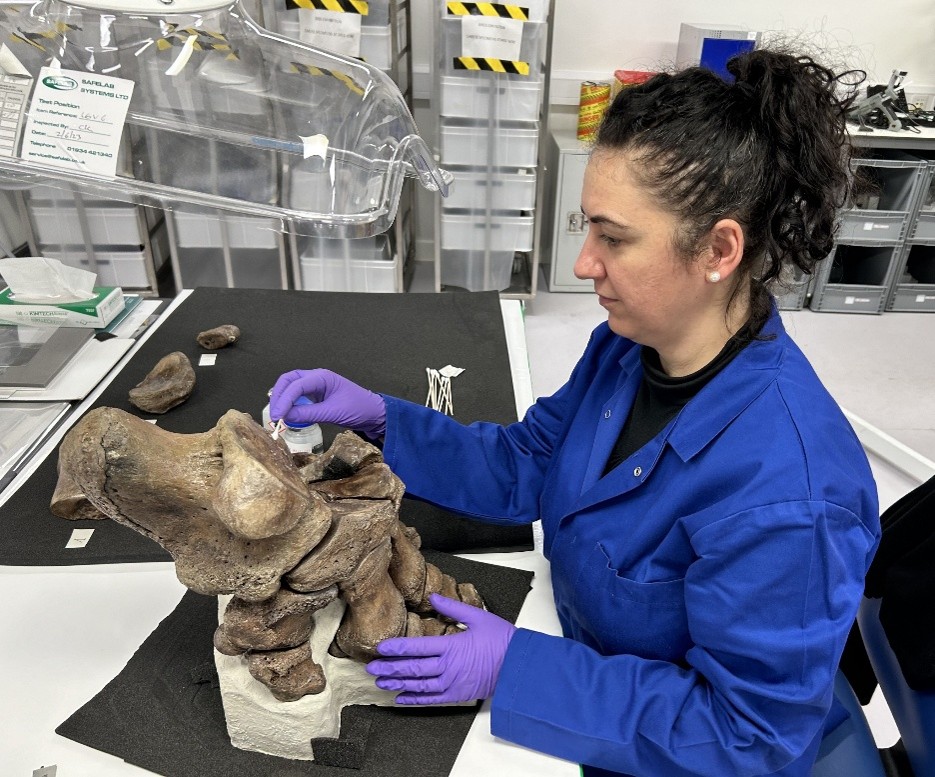
Lucia Petrera stabilising cracks on NHMUK PV M 82706cu to NHMUK PV M 82706dn Palaeoloxodon antiquus (an extinct elephant foot fossil). © The Trustees of the Natural History Museum, London.
Custom Re-housing and Storage Solutions


Left: Lydia Amies and Caitlin Jenkins returning a specimen with a new mount and handling board. Right: Emanuele Casafredda creating an epoxy jacket. © The Trustees of the Natural History Museum, London.
With so many specimens moving, we have to focus our time and resources on the most fragile and vulnerable.
Small to medium specimens are stabilised within pre-made and bespoke conservation-grade boxes and trays supported with Plastazote® foam to prevent movement and abrasion. Larger specimens are more challenging because they’re often unevenly weighted and too heavy for card boxes. For these specimens, we create bespoke solutions such as corrugated aluminium handling boards or epoxy ‘jacket’ mounts.
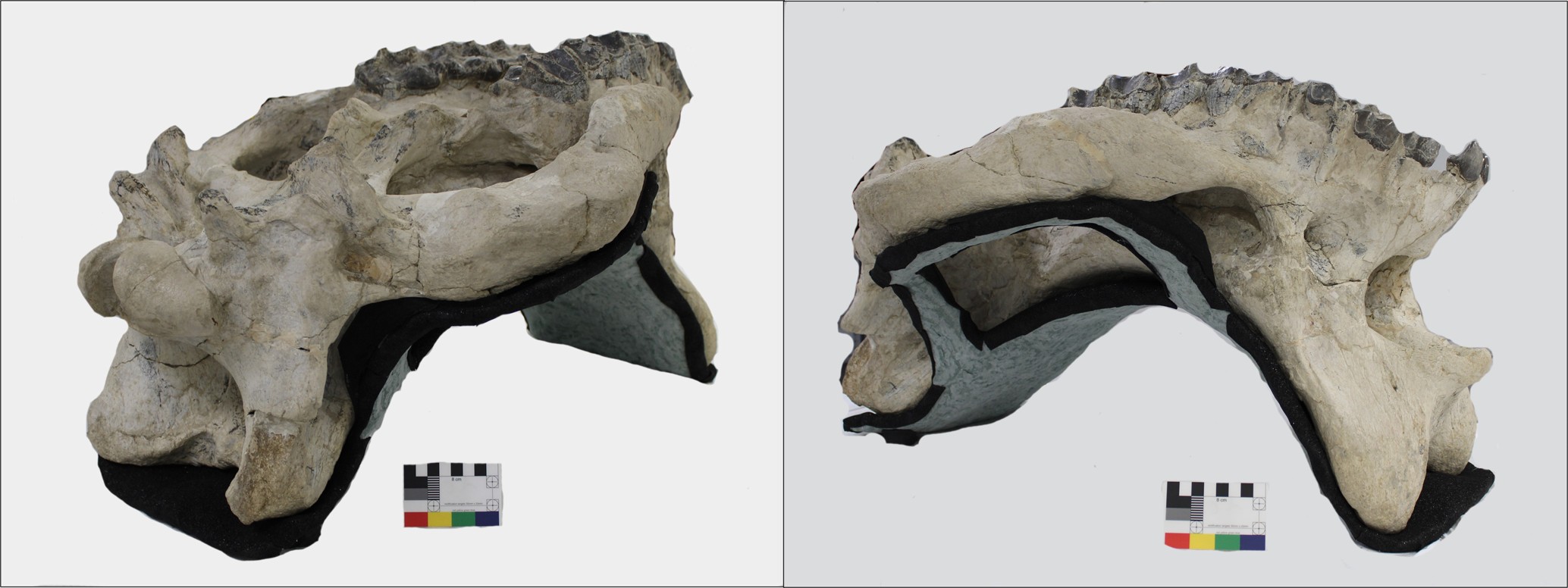
Specimen: NHMUK PV M 5629 Megacerops coloradensis in a new epoxy mount. © The Trustees of the Natural History Museum, London.
Above is an example of a completed epoxy mount. For skulls, we often position the teeth facing upwards to allow them to be easily viewed and studied, but this leaves the underside of the specimen unsupported. A two-part epoxy resin (EMP 60) is shaped to closely fit the underside contours then left to harden. The top surface is then padded with thin foam; the resulting mount supports the specimen’s weight along its entire length meaning it can now be handled with significantly less risk.
Sustainability and Materials Use
Collection moves projects often use a great amount of packing materials and generate a lot of waste, so we are trying to re-use and re-purpose materials. Wherever possible, leftover materials are kept and used elsewhere in the project. For example, we save offcuts of Plastazote® foam and turn them into soft support pillows to use during treatment or transport.


Left: Examples of specimen support pillows made from scrap and repurposed materials. Right: A specimen on an amended mount. © The Trustees of the Natural History Museum, London.
In the Fossil Mammals Collection, we also reuse existing mounts where possible. Even if they were originally made for display rather than transport, adapting them is often quicker, cheaper, and more sustainable than starting from scratch.
Some historic mounts can be modified to provide better support to the specimen by adding extra foam padding or structure.
Case Study: Ground Sloth Spine
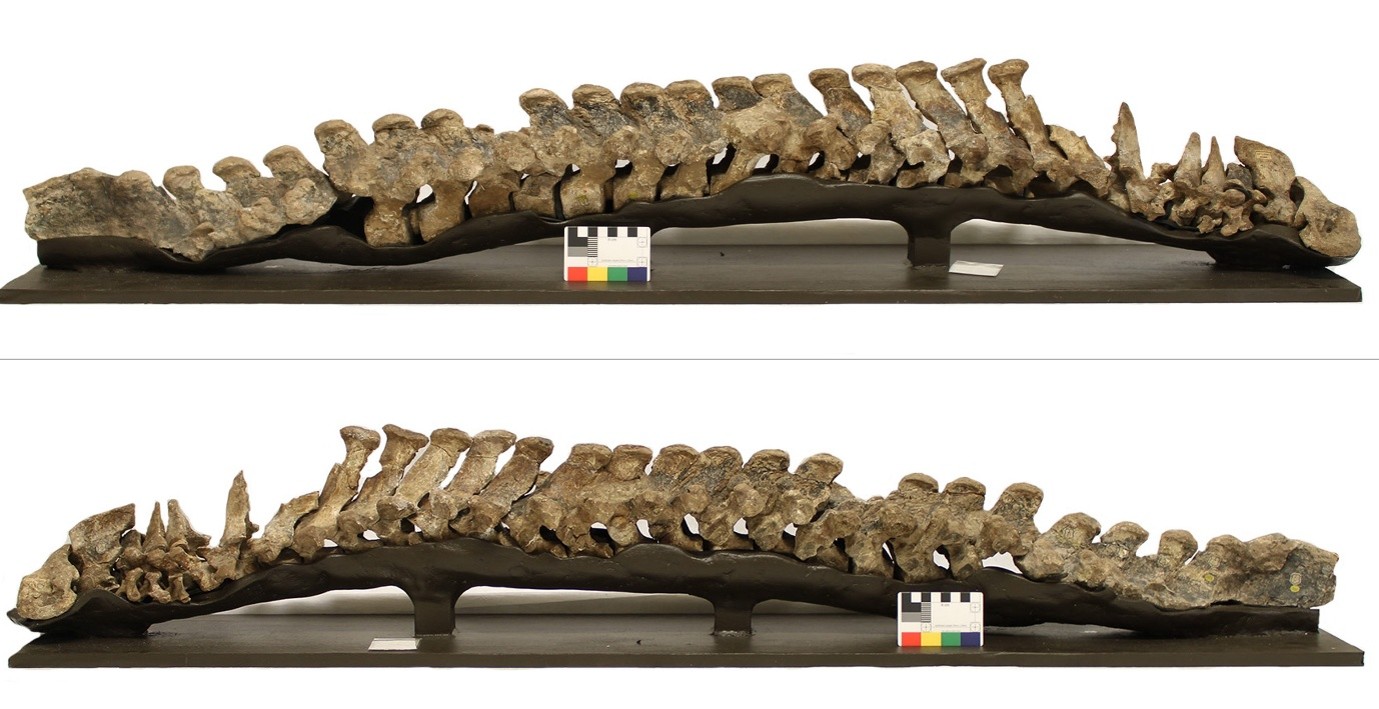
Specimen NHMUK PV OR 33028 to NHMUK PV OR 33052 Scelidotherium leptocephalum before stabilisation. © The Trustees of the Natural History Museum, London.
Before stabilisation this partially articulated sloth spine was resting on an old custom-made mount. However, some vertebrae were loose and likely to fall when the specimen was lifted, possibly leading to damage and disassociation. The board to which the mount was attached was difficult to handle because there was no finger space underneath it.
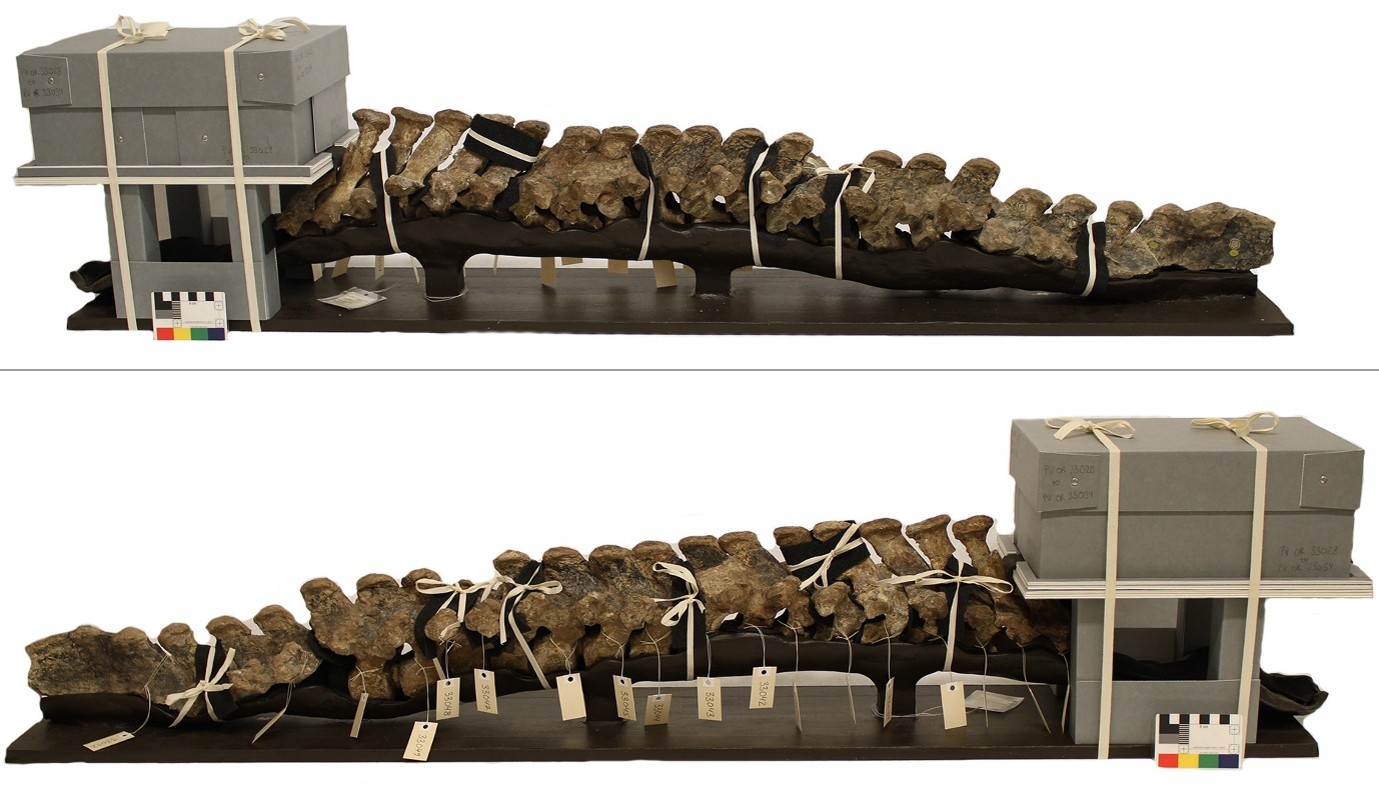
Specimen NHMUK PV OR 33028 to NHMUK PV OR 33052 Scelidotherium leptocephalum after stabilisation by Claire Embree-Lalonde. © The Trustees of the Natural History Museum, London.
To stabilise the specimen and improve the existing mount, fused articulated sections of vertebrae were tied to the mount with foam padding to prevent abrasion. The smaller, unfused vertebrae were too delicate to be stabilised in this way, so they were boxed separately. The conservation-grade box was attached to a robust card bridge which meant that the footprint of the specimen didn’t increase. Each section was labelled with the specimen number to prevent disassociation. Finally, small feet were added under the mount’s board making it easier to grip and lift safely.
This conservation project will continue over the next two years to ensure that the Fossil Mammal Collection is safe and ready to move to its new home.
We’d like to thank Claire Embree-Lalonde for her work on this project, our colleagues Dr Spyridoula Pappa and Dr Neil Adams in the Fossil Mammals Curatorial Team, and the wider NHM Conservation Department for their support.
NHM Unlocked is funded by the UK government with additional funding from the Wolfson Foundation.


Pingback: NatSCA Digital Digest – September 2026 – NatSCA