
By John-James Wilson, Lead Curator of Zoology, World Museum, National Museums Liverpool.
It started with the discovery of a letter tucked away in the collection history files. In 1948, the curator of the Raffles Museum in Singapore was trying to track down the type specimen of Zosterops difficilis (a subspecies of Mountain White-eye) and had written to the director at Liverpool Museum (now World Museum) to ask if the specimen was there. What began as a simple curiosity-led search for a single specimen quickly snowballed. This 77-year-old enquiry had suddenly launched me into a deep dive into entangled stories of colonial history, war time losses and bird taxonomy.
I found myself re-examining the records of 250 White-eye specimens from the Liverpool collection, many with outdated or ambiguous taxonomic names, obscure references in scientific literature, and possible name-bearing-status. My recent article – Ghosts and entanglements in one drawer of a natural history collection – explains how I cross-referenced historical documents, species descriptions, and records of specimens in other collections around the world to establish modern names and types status for these specimens.
I tallied 218 specimens that had probably been destroyed when Liverpool Museum was bombed and burned out during a German air raid in 1941. The director’s reply to the 1948 enquiry explained that although the bird skin collection had been moved to North Wales for safety at the start of the war, in a sad quirk of history the drawer containing the White-eyes had been brought back to the museum for study. This included many types, rare and extinct species. There are still 31 White-eyes at World Museum which includes a few skins kept separately from the other White-eyes, some unprovenanced mounts and some more recent acquisitions.
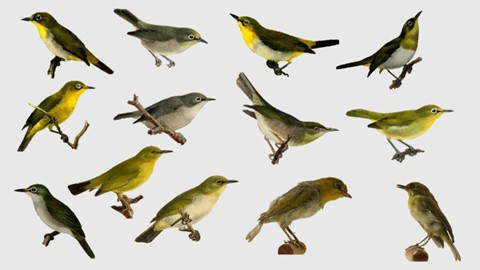
Illustrations of some White-eyes from World Museum’s collection, including several type specimens destroyed during the 1941 bombing and two surviving mounts.
One of the most fascinating parts of this research was tracing the suppliers. These birds had been gathered by a web of missionaries, colonial officials, freelance naturalists, and dealers. Piecing together this network added a rich human dimension to the taxonomic work and revealed the colonial entanglements behind the Liverpool collections. In my article I couldn’t go deep into each supplier’s story but try to provide a starting point for further work.
White-eyes are a ‘great speciator’ group of birds, with over 250 subspecies spread across Africa, Asia, and the Pacific. Many are island endemics, making them key to understanding biogeography and evolution. Robust taxonomy, grounded in historical collections, is essential for tracking species and managing conservation efforts. But this research reminded me that curatorial work is not just about taxonomy – it’s about uncovering the stories behind the specimens, trying to understand the motivations of the people who collected them, and making collection histories more accessible. Sometimes, all it takes is one letter to spark a journey.


Pingback: NatSCA Digital Digest – June 2026 | NatSCA