
Written by Becky Desjardins, Senior Preparateur, Naturalis Biodiversity Center.
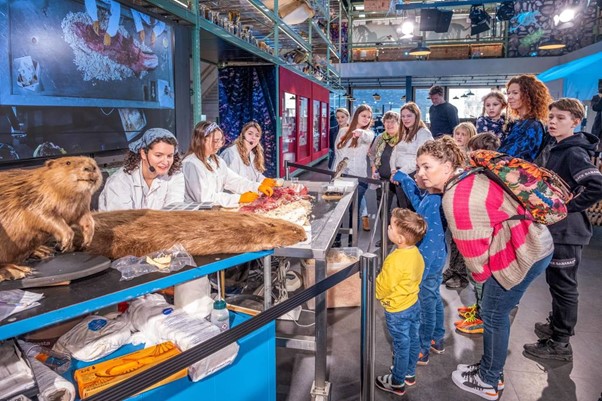
It is a Wednesday afternoon in Naturalis’ Live Science Hall. An older woman walks by, holding her nose, but watching us intently. Shortly after, teenagers on a school trip yell “eeeewww gross!” but then come in closer to check it out. A young girl says loudly “I think this is sad” while she drags her mom by the hand up to our silver lab table. On the table is a large Eurasian eagle-owl, now in two pieces. I am removing muscle from the detached wing, and my co-worker Liselotte is busy pulling the skin from the body. This owl, found dead by the side of the road, is being prepared as a study skin for the museum’s collection. But instead of in the lab, we are doing it live in front of the public in a hall that has free entry.
We prepare vertebrates, mostly mammals and birds (though we have worked on a giant ocean sunfish here too) live twice a week, all the while talking to visitors who stop by. On a quiet day, visitors can come right up to the table (they are kept at a bit of a distance by a stanchion) and on a busy day, people sit on the risers in the hall and interact with us via a science educator who walks around with a microphone taking visitor questions. We have a camera mounted in the ceiling zoomed in on the table. This is shown on the screen behind us so that even the smallest visitors can see what we are doing.
Continue reading


 NatSCA