How to Foster Empathy with Endangered Animals: Developing a Creative Writing and Drawing Workshop Toolkit

Written by Dr Christina Thatcher, Lecturer in Creative Writing & Dr Lisa El Refaie, Reader in Language and Communication, Cardiff University.

With biodiversity declining at an alarming rate, we need to find ways of encouraging people to care about all endangered animal species, not just the ones with the most obvious appeal, such as pandas and polar bears, for example. According to the International Union for Conservation of Nature’s ‘Red List of Threatened Species’, 27% of mammals are threatened with extinction, but so are 44% of reef corals, 41% of amphibians, 37% of sharks and rays, 21% of reptiles, and 12% of birds.

In 2023, we—Dr Christina Thatcher and Dr Lisa El Refaie from Cardiff University—met and discovered our shared interest in the expressive arts, metaphor, empathy and nature. We then designed a project which aimed to use the power of creativity to increase public awareness of, and empathy for, endangered animals, focusing on species that have few or no obvious human-like features. The project was funded by the Arts and Humanities Research Council (AHRC) Impact Acceleration Account and ran from November 2023 until the autumn 2024, in collaboration with Natural History curators at the National Museum Cardiff. Continue reading

A Time Capsule of Extinction: Scotland’s Iconic Wildlife

Written by Caitlin Jamison, Museum Collection Technician, Montrose Museum: ANGUSalive.

Montrose Museum in Angus, northeast Scotland, houses an impressive natural history collection. Everything from taxidermy to fossils to rare minerals are housed in a modest, Greek-revival style museum off the high street. Built in 1842, it is one of the first purpose-built museums in Scotland.

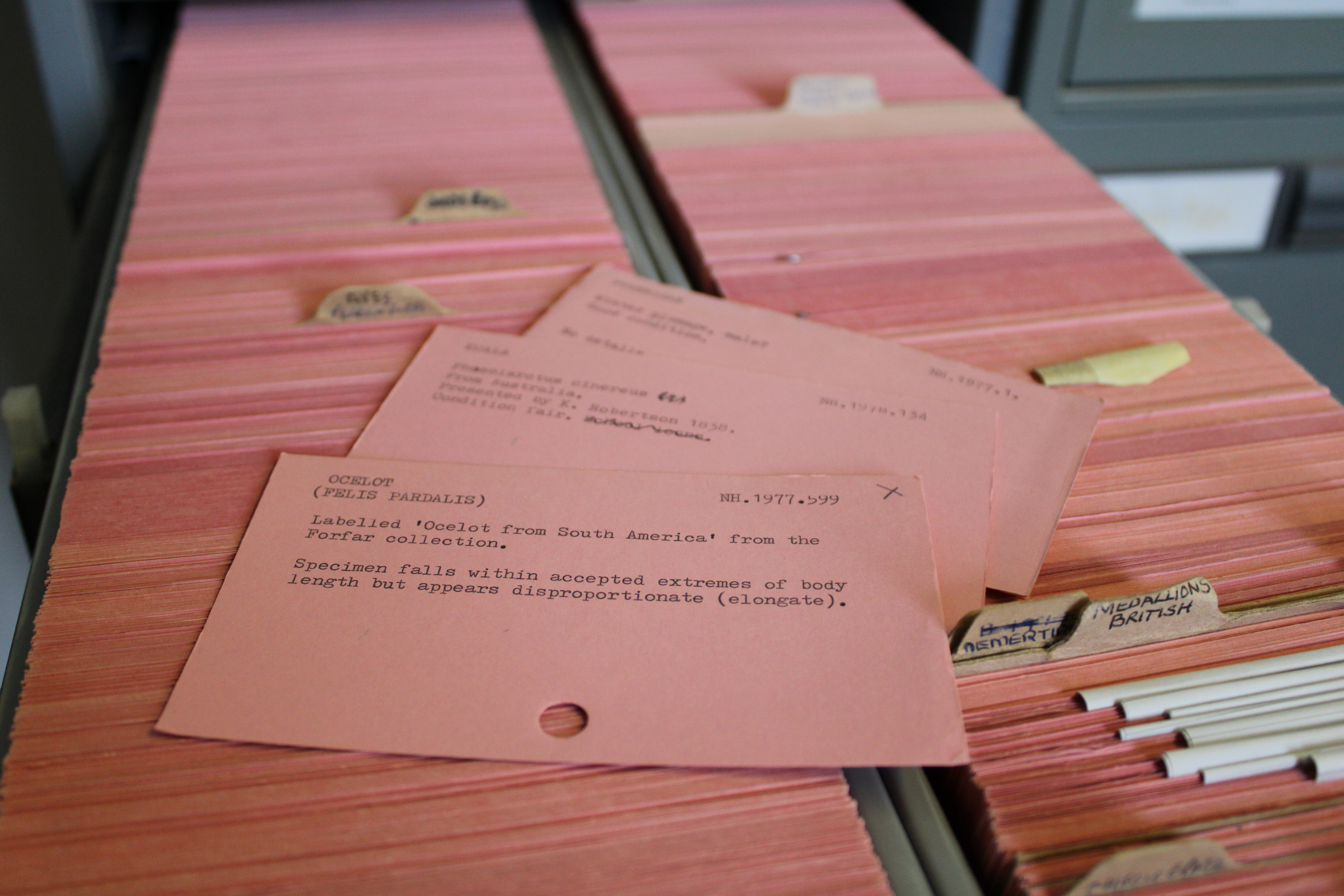
Sadly, due to changing public interest (and the challenging funding situation facing many local authority museums) the collection has been somewhat forgotten since it was catalogued onto neat pink index cards in the late 1970s.

Montrose Museum’s 1970s card catalogue (author’s own photo)
Continue reading

Addressing Biodiversity Loss and Climate Change Together: A Great Opportunity for Museums with Natural History Collections

Written by Henry McGhie, Curating Tomorrow, henrymcghie@curatingtomorrow.co.uk

This year has seen not one but two ‘COPs’ (Conference of the Parties), the big meetings where governments monitor their progress towards international agreements. In early November, COP16 for biodiversity was held in Cali, Colombia. In the second half of November, COP29 was held in Baku, Azerbaijan. These big meetings get a lot of press attention, but they are rather poorly understood and are not always reported that well. If you think the COPs are where the leaders of the world get together to hammer out the world’s future, the reality is much more humdrum. By the time countries gather together, they have usually made up their minds on their negotiating positions and not much will change from there on. COP has also become too big and has many ‘layers’ to it. For the climate COPs, there is the Blue Zone, which you need to get a special accreditation to enter (referred to as a ‘badge’), and within that there will be really big plenary events and smaller side events that everyone with a badge can attend. There are also lots of negotiations taking place, inside rooms, that you often can’t access as well as a mass of pavilions, mostly from countries and in some years, businesses. Outside the Blue Zone, there is a public-facing Green Zone that the public can access (sometimes it is in a museum, as it was in 2021 when it was in Glasgow Science Centre). When the climate COP is on there is also a lot of activity going on outside of COP itself, mostly organized by civil society groups, and also by businesses. So, when people say they’ve ‘been to COP’ it can mean a few different things.

Continue reading

Mainstreaming Biodiversity in Museums

Written by Henry McGhie, Curating Tomorrow henrymcghie@curatingtomorrow.co.uk.

Link to the guide: https://curatingtomorrow236646048.files.wordpress.com/2023/11/mainstreaming-biodiversity-in-museums_2023.pdf

‘Mainstreaming’ is a policy and planning approach that means that we don’t just create a new programme or strand of work, but that we embed it across all activities. We can embed support for biodiversity and environmental concerns across museum activities. Why is this important? Well, for a few reasons. Firstly, biodiversity is not yet fully mainstreamed into museum thinking – in terms of their goals, actions, or evaluation. Second, museums present a massive potential to support biodiversity in different ways, notably through education, research, public awareness and partnerships. Third, museums make big negative impacts on biodiversity and the environment, through their contributions to climate change (from use of energy, waste, and visitor emissions), and their involvement in environmentally damaging activities (e.g. how their investments are used). Fourth, because biodiversity is in deep crisis: species continue to decline, major challenges are getting worse, and there is no clear prospect of a change for the better. Lastly, fifth, because people and nature are interdependent: if the environment suffers, people and communities suffer.

Continue reading

Extinct – A New Exhibition At The Manx Museum

Written by Laura McCoy, Curator of Natural History for Manx National Heritage.

Wednesday the 8th September saw the opening of the new temporary exhibition ‘Extinct’ at the Manx Museum on the Isle of Man, in partnership with Manx Wildlife Trust, which also coincided with the launch of the Red Data bird list published by Manx BirdLife. There are many species that have become locally extinct on the Isle of Man, particularly birds and plants, and this trend is not slowing down, with the Yellowhammer, once one of our most ubiquitous farmland birds, disappearing from our Island only in 2019. Some may ask how these absences impact our day-to-day lives, why this matters, but as we are becoming increasingly aware, the complexity and variety of our environment is what sustains us; if you knock out enough of the bricks the wall will come tumbling down. These disappearances are symptomatic of a grave state of affairs and islands are particularly sensitive to changes in management and climate. The more protected and supported our environment is, the better it is able to withstand and buffer us from the global shifts that are to come.

When Manx Wildlife Trust came to Manx National Heritage with the idea of this exhibition we were fully on board; learning about these stories of the Isle of Man’s countryside has been a journey, sometimes an upsetting one, but it has also been a call to arms. I had no idea that currently 29% of our current resident bird species, never mind the ones that are already gone, are red listed, and 41% are amber. An estimated forty five species of plant are extinct, seventy seven are red listed. We are still trying to compile what invertebrates and fungi we have, never mind assess what has been lost. 

Continue reading