NatSCA Digital Digest

natscaYour weekly round-up of news and events happening in the world of natural sciences
Jobs

Curator of Natural Sciences, Tullie House Currently seeking to become a designated collection, the natural sciences collections are looking for a curator who will get involved in ‘engagement activities, acquisitions, collections care projects, research, exhibitions and collection displays’. Deadline 10th August.

Curator, Grant Museum of Zoology Time is running out to apply for a job that has not been vacant for over ten years. If you think you could be the new Curator of this fantastic natural history collection, you have until 3rd August.

See the job page of the NatSCA website for more exciting opportunities!

News

The University Museums Group (UMG) are joining forces with the University Museums in Scotland (UMiS) to bring you Science and Society, their 2015 conference. It will take place on the 23rd and 24th September at Durham University. Bookings are now open so help yourselves to places.

Around the Web

A great blog came out recently by Jake of Jake’s Bones in which he says, I quote, “I’ve had a lot of T-rex action this week” in Learning about Tyrannosaurus. Now that’s a good week. Full of great images, Jake’s blog asks some interesting questions. He writes with the enthusiasm we all have but often don’t show, which makes the blog a great escape from the day.

Worth a look this week is an image on the National Geographic website (not that there’s ever really a day that it isn’t worth looking at). I don’t want to say much about it as it would risk spoilers, so I’ll let the image doing the impressing for itself. N.B. Make sure you read the caption, it may change what you think you’re looking at…

Something else definitely worth a gander is the tumblr page of Paleocreations. Past the impressive life-size Ichthyostega model at the top are eight images you can scroll through to show how Paleocreations produced the beautiful official artwork of Sophie, the most complete Stegosaurus skeleton ever found, for the Natural History Museum London.

NatSCA Digital Digest

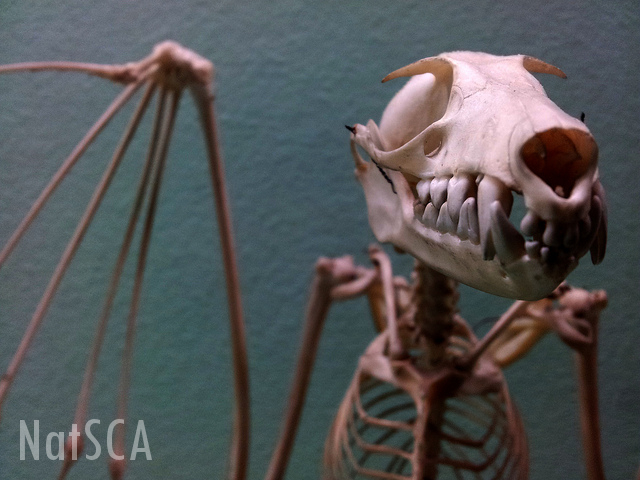
A mounted skeleton of a fruitbat leers at the cameraYour weekly round-up of news and events happening in the world of natural sciences

Jobs

Curator of Natural Sciences, Tullie House Museum. Fixed term for 12 months (with potential for extentsion). Tullie House is also looking for a Collections Access Manager at the moment.

Operations and Project Officer, Lyme Regis Museum. A great opportunity to work on the iconic Jurassic Coast.

UK Flora Collections Assistant, Royal Botanic Gardens, Kew. An interesting role combining field work, lab work, and collections!

As always, see out jobs page for more opportunities.

Events

SVPCA (The Symposium of Vertebrate Palaeontology and Comparative Anatomy) is coming up on 29th August – 4th September. This year it is to be held at the National Oceanography Centre in Southampton.

#AskACurator Day is back on Twitter on 16th September. It’s a great way for people to talk to museum staff who are normally ‘behind the scenes’, and for us to get exposure for the amazing work we all do with our collections.

Around the Web

Dinosaurs on tour: Dippy the Diplodocus will be leaving his home at the NHM for a holiday, and the museum is looking for host venues. Must have large gallery.

The genome of the kiwi (Apteryx mantelli) has been sequenced, revealing insights into its strange physiology.

Giant animals that are almost impossible to find! Did you know that the largest stick insect recorded is in the collection of the Natural History Museum (NHM), and is over half a metre long?

Brymbo Fossil Forest in Wrexham has been designated as a Site of Special Scientific Interest (SSSI), protecting the future of its precious 300 million year-old fossils. Sadly, many fossils were lost in arson attacks on the site last year.

The Most Natural Science Positive Film of Recent Times?

holmes-bee

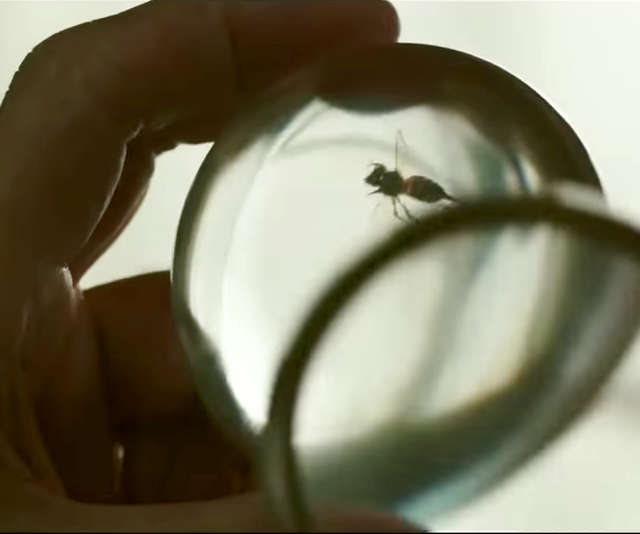
Hollywood hasn’t always portrayed the natural sciences in the best light. From the entomology nerds in Silence of the Lambs to the evil taxidermist in Paddington, the people who live it daily don’t often come off looking good. Even when museums are the star of the show, it is the night watchmen, not the curators and conservators, who steal the glory. Where, then, is cinema’s role in encouraging the next generation to pursue a career in the natural sciences? Some have said they watched the original Jurassic Park and that sparked their interest in genetics. Did you watch a film and think “that’s the life for me?” If so I’d love to hear from you. Nature inspires movies all the time. It behoves the film industry to keep this passion alive.

Enter a new film into the UK top ten (no, we aren’t talking about Jurassic World). Mr. Holmes is the latest adaptation of Sir Arthur Conan Doyle’s famous detective. Set in war-ravaged Sussex, Sherlock Holmes is an old man, retired and trying to cope with the changes in his life. I won’t give away the plot for you but I will say this: The plot depends upon an accurate  understanding of the natural world, specifically botanical and entomological. The film is filled with beautiful species and fascinating facts about nature. I can quite easily see someone leaving the cinema thinking “I want to know more about this world”. Holmes’ personal collection is lovely and I want to know whose skull that is on his desk.

Further refreshing news, if you’re as sick of explosions and CGI as I am right now, this film has the fewest special effects of any new film I’ve seen for a long time. Less definitely is more in Mr. Holmes. The performances are superb – not just Sir Ian McKellen but I don’t think there’s a bad actor in the entire movie. I’d highly recommend you go and see this.

NatSCA Digital Digest

ndd-llama

Conferences, Workshops, and Events

It’s not too late to book tickets for our Osteology workshop in August. The deadline to book is 31st Jul 2015.

When: 8th Sep 2015
Where: University Museum of Zoology, Cambridge

Hot off the press last night, this year’s Tetrapod Zoology Conference (#Tetzoocon) has just been announced. Several NatSCA members attended last year, including myself (here’s the review). It was a great event with lots of interesting talks, ranging in topic from under-appreciated amphibians to future pterosaur literature to speculative zoology – including one by our Paolo. They haven’t announced the speakers this year but they’re sure to be great.

When: 14th Nov 2015
Where: The London Wetland Centre

If you’re in town this evening, come along to the drinks thing at the Horniman Museum in Forest Hill.

And now an appeal to our out-of-town readers: There is some great stuff going on in London almost all the time but I want to hear from you if you have any information regarding natural history related events outside of the London area. Our readers who can’t reach London regularly want to know that these events are. Contact us.

In the News

With applicants rushing to fill the space that Mark Carnall is leaving in the Grant Museum, as he goes off to his new home in Oxford, we thought it would be a good time to tell you about a new email address here at NatSCA Towers. It’s joblistings@natsca.org and, if you have a job that you’d like advertised, this is the best address to send it to.

No news coverage would be complete this week without a hat-tip to Pluto, the little dwarf planet that surprised us all. Although it will take 16 months for all the data to return to Earth, we’ve had some very interesting geological features already, including huge mountain ranges on a par with America’s Rockies; areas with no impact craters, suggesting there may be geological activity resurfacing it (it is unlikely that a large body in the Kuiper belt could be that lucky to avoid impact); and a large reddish brown icecap on Charon nicknamed “Mordor”. We look forward to more information as the data is disseminated. In the meantime, here’s an overview of the changing face of Pluto, by NASA.

In the Blogosphere

The RVC‘s John Hutchinson honours the contributions of R McNeil Alexander in this touching installment of What’s in John’s Freezer.

NatSCA Digital Digest

natscaYour weekly round-up of news and events happening in the world of natural sciences

Jobs

Curator, Grant Museum of Zoology, UCL I can tell you from three years of first-hand experience (pseudo-first-hand; as curatorial assistant) that this is the job all curators should be applying for. The Grant Museum of Zoology is an amazing place to work and in this role I know you will have the opportunity to spread your curatorial wings and make a real difference in the natural history sector. The kind of job where you don’t mind getting up in the morning. Closing date for applications is 3rd August. Good luck!

If only for the superb job title, anyone with experience of learning programmes for families and children with ASC (Autistic Spectrum Condition) should definitely take a look at the current vacancy for the Dawnosaurs Programme Co-ordinator at the Natural History Museum. This looks like an amazing opportunity for the right person. The closing date for applications is the 22nd July.

See the job page of the NatSCA website for more exciting opportunities.

News

The next Museums Association exhibition and conference is due to take place on 5th and 6th November, in Birmingham. There is still time to register as an early bird who gets the cheaper worm rates. Early bird registration ends on the 7th August, click here for more.

Around the Web

Sun bear, fox, hippo or pangolin. What tickles your natural history bones the most? Choose your favourite to be the new museum mascot for Derby Museum and Art Gallery! If you are on Twitter, you can whip up some support for the sun bear, errr, I mean, your favourite using: @DMNature and @derbymuseums. The winning specimen will be announced on the 7th August. I’ve already chosen mine, can you guess what it is…?

The Friends of Crystal Palace Dinosaurs have been working up a storm of support lately, with ongoing events at the park complemented by a very dynamic talk at the Grant Museum by the master of science comedy- Prof Joe Cain, from UCL. These incredible statues are a vivid reminder of the evolution our concept of dinosaur appearances has gone through. They are also an important part of our British cultural heritage, that helped shape the palaeontological world in the mid 1800s. Find out more about these iconic statues that are in desperate need of conservation on the Friends of Crystal Palace Dinosaurs website.