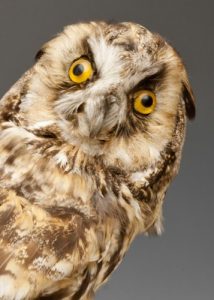
The formerly googly-eyed owl

The long-eared owl: BEFORE. LDUCZ-Y1604

In a move unprecedented in Specimen of the Week history, I have chosen to blogify the same specimen as I selected in my last Specimen of the Week. The reason is that in many ways it is not the same specimen as it was six weeks ago: it has undergone a profound transformation. We used to call this specimen “the googly-eyed owl”, due to its comedy wonky eyes, but it is googly-eyed no longer. This week’s Specimen of the Week is…

Continue reading

Stirring the hornet’s nest – are natural science collections even legal?

I was wrapping up a particularly difficult male peacock with a helper a few weeks ago and we were discussing natural science collections. “Do you think one day they’ll just be made illegal?” she asked, straight-faced and sincere. I was miffed – this was someone saying to a natural science curator that really, it shouldn’t be allowed. I sighed and spent the rest of the wrapping session (porcupine was also tricky) explaining how wonderful – and legal – natural science collections are.

Continue reading

Meet the NatSCA Committee – Lucie Mascord

Meet the NatSCA Committee: Ordinary Member

Name: Lucie Mascord

What is your role on the NatSCA Committee? I am the new Conservation Representative

Job title and institution: Conservator of Natural History, Lancashire Conservation Studios

Twitter username: @LuceGraham

Tell us about your day job: I am a specialist natural history conservator, working for a museums service and my own business. In both, I provide conservation services to the heritage and private sector. This is mainly in the North West – everywhere from Cumbria or to Cheshire, but my work has taken me all over the country which means I get to visit lots of new collections.

My role covers all scope of natural history collections but I specialise in bone, fluid preserved collections and taxidermy. My work is incredibly varied; as well as a conservator I am a preparator – preparing bone, skins, taxidermy and fluid preserved material. I can spend 200 hours plus conserving a single specimen, or carry out a whole collection survey in 72 hours! I also provide training to institutions in natural history collections care.


Visiting the Galerie de Paléontologie et d’anatomie comparée

Natural science collections are very popular with visitors. Why do you think this is?

Overall, I think it is about innate curiosity – the natural world is deeply fascinating and diverse. The reason natural history collections are popular with children is they are still in that stage of uninhibited curiosity.

Continue reading

NatSCA Digital Digest – July

What Should I Read?

If you like a good nose, the second part of TetZoo’s Elephant Seal article has just been published, which you can read here. And here is a thoughtfully placed link to the first part in case you missed it and wanted to catch up.

For a fun bit of ‘history of natural history’, this article is all about the secret that the Natural History Museum’s blue whale has been hiding since the 1930s, unknown to anyone until it’s recent clean prior to the big unveiling next week. Those naughty conservators… chuckle.

Whilst some of this article raised my quizzical-shark-scientist’s-eyebrow, such as the scale bar for instance, researchers believe they have uncovered a big clue as to why the Megalodon went extinct. Definitely worth a read if, like everyone, you like sharks. Although this article came out in January, it is receiving media attention at the moment so I thought I’d treat you to it.

Continue reading

Private Bone/Taxidermy Collection: The Good, The Bad and The Illegal

This article is re-posted from the Adventures in Natural History Illustration blog by natural history illustrator Beth Windle.

This blog has taken a while to write. It’s a complicated subject that can be hard to condense into a simple blog post. However, I feel that it is now necessary to write about it due to growing, worrying, illegal, and unethical trends that are resurfacing due to a private natural history collection resurgence in recent years. Aside from this, I am aware of the positive aspects of private collections and therefore I do not want to come across as too preachy or completely ridicule those with private collections who work extremely hard to promote conservation and education. But I feel that some things now need to be said, as well as how these new problems need to be fixed with realistic solutions. Continue reading