NatSCA Digital Digest

Hectors swallowtail butterfly extracting nectar from a flower. © Cláudio TimmWelcome to the weekly digest of interesting things from around the web with relevance to natural science. We hope you find this useful and if you have any articles of interest, please contact us at blog@natsca.org

1. Blog: Crime scene micropalaeontology

Natural History Museum, London

Synopsis

‘Micropalaeontological evidence is increasingly being used to solve major crimes. Read on to find out about [curator of micropalaeontology] Steve’s involvement in Crime Scene Live, how our collections could help forensic studies and how our co-worker Haydon Bailey gathered some of the evidence that was key to convicting Soham murderer Ian Huntley’- Giles Miller

Click here to read the whole blog.

2. Museum altruism: Trip Advisor

Anyone, anytime!

Synopsis

Now that the sunshine is here (I hope I don’t jinx it by writing that) potential museum visitors will be looking ahead at inspiration for how to spend their weekends, days off, school holidays, etc. In this day and age it seems the way to find such inspiration is on websites such as Trip Advisor, on which you can read other people’s reviews of places they have visited. Obviously popping on a review of your own collection, if you work in one, would be a bit naughty, but if you have been anywhere else lately, why not help their visitor numbers out by inspiring people to visit too?

Click here to find out more.

3. Now open: Sensational butterflies at the NHM

2nd April to 13th September

Synopsis

It’s back for another summer of beautiful live insects, screaming kids and irritated academics in the offices above. Sensational butterflies in the garden of the Natural History Museum London is now open, complete with exhibition trail, and is well worth a look.

Click here for more details


Compiled by Emma-Louise Nicholls, NatSCA Blog Editor

Bringing the Dead Back to Life, with Paolo Viscardi

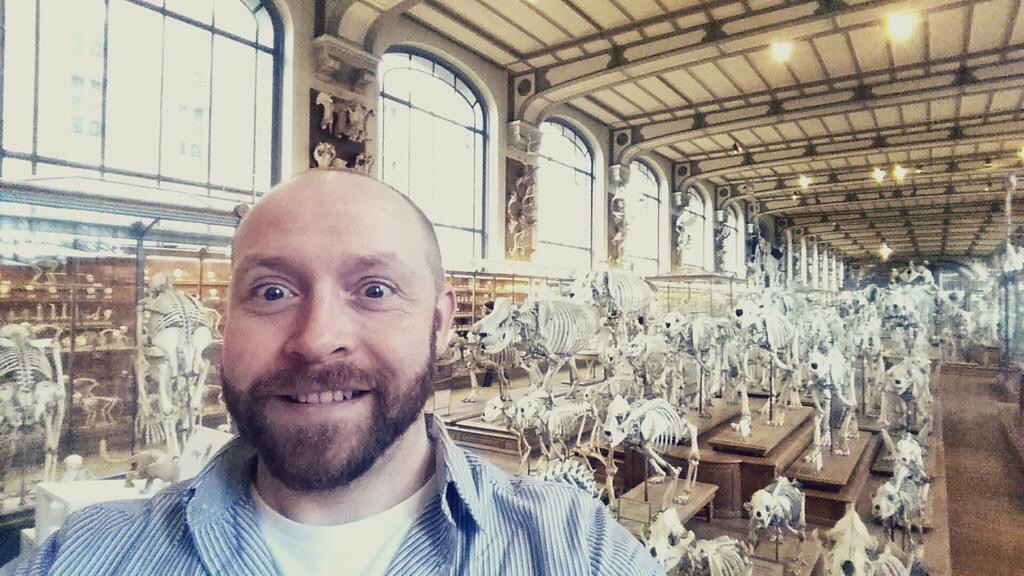
Paolo at the Museum of Comparative Anatomy, Paris

Last week saw the first PubSci talk by NatSCA Chair Paolo Viscardi since we moved venues to the King’s Arms near London Bridge. The subject, Bringing the Dead to Life, is less a Frankenstein manual and more of a description of his role as Deputy Keeper of Natural History at the Horniman Museum and Gardens. He works with dead things every day and he does so for the public’s benefit, because these collections are yours: both yours as a national collective, and yours as an individual if you want to do something with them.1

A large part of the reason we have these amazing collections is due to massive amount of world exploration by wealthy industrialists, tradesmen, and philanthropists. Frederick John Horniman was a tea trader, and collected all sorts of things in his travels. The stuff he brought back captured the public imagination because it introduced them to international cultures they would otherwise have no idea about. We take global information for granted today because we all have access to internet resources in our pockets, so it is hard for us to grasp how unusual it must have been for people in 1948 to see frescoes from Ceylon temples for the first time.

One of the fun side effects of this close encounter with the unusual is that oftentimes people preparing the specimens from overseas were only going by descriptions, and were not at all familiar with the species they were working on. A great example of this is the iconic Horniman Walrus, who was overfilled until he was wrinkle-free – in the style of a seal. There is an exhibit at the Grant Museum of Zoology at the moment discussing this phenomenon and featuring a lovely Stubbs painting of a kangaroo that resembles a giant mouse. Knowing how meticulous Stubbs was about his animal anatomy, one has to believe that this is exactly how he understood them to look and is not in any way an accident of the proportions.

The topic of proportions and measurement brings me on to a study done by Paolo et al. in 2010, looking at the variation in measurements taken of a section of owl bone, so naturally the paper was titled How long is a piece of Strix. Comparative measurement is a fundamental part of species identification, so naturally one would assume a consensus of readings taken by professionals. The results were somewhat different: when working alone, the measurements were accurate. When working as part of a team, the measurements strayed, and the more people collaborating, the greater the disparity between measurements.

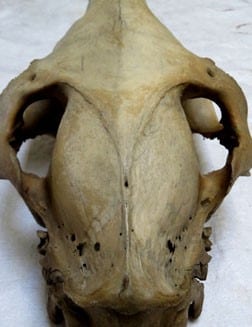
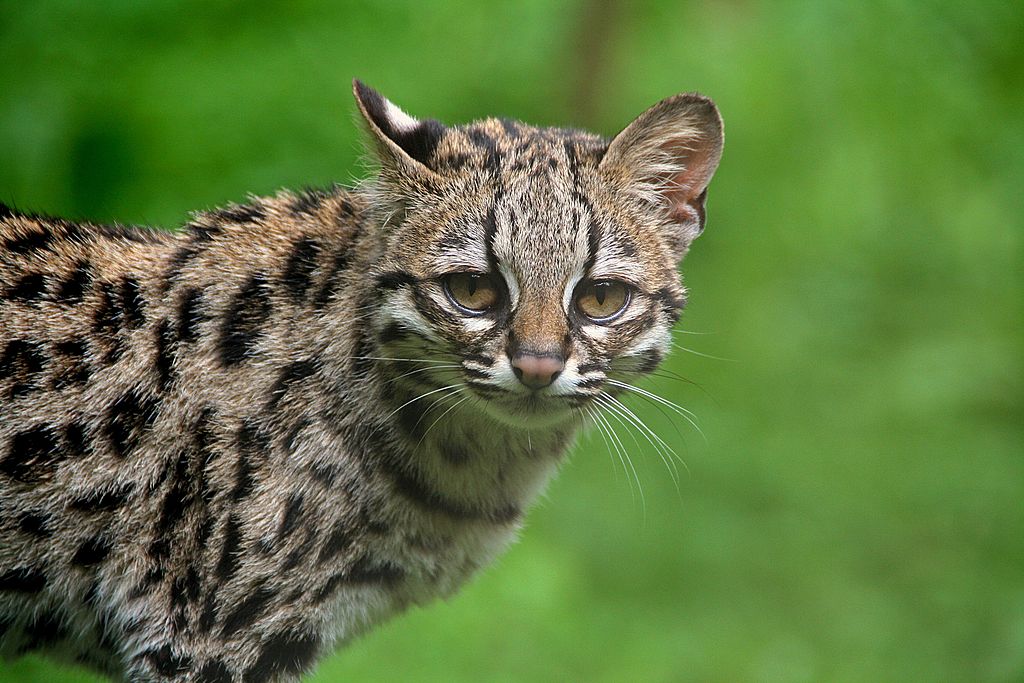
As a science communicator both at the museum and through his blog, Paolo has had the opportunity to work on some interesting projects: he has advised BBC television series such as our patron Ben Garrod‘s Secrets of Bones and he has been interviewed for The One Show to explain why cats get stuck up trees (they can’t rotate their ankles). This allowed Paolo to introduce the viewing audience to the Margay (Leopardus wiedii): a cat that can rotate its ankles. He has shared his love of osteology with 13-year-old fellow-blogger Jake McGowan-Lowe, which led to Jake publishing a book on the subject! To promote a recent Horniman exhibition on extreme animal adaptations, Paolo was subjected to the harshest elements in nature, which earned him the title ‘Extreme Curator’, and his very own Lego action figure.

Margay

Margay. By Clément Bardot (Own work) [CC BY-SA 3.0 (http://creativecommons.org/licenses/by-sa/3.0)%5D, via Wikimedia Commons

Where next for Paolo’s science communication? You’ll have to ask him at the next PubSci with Professor Ian Barnes. If you’re a fan of pleistocene megafauna (and, let’s face it, who isn’t), I wouldn’t miss it.

Sam Barnett, NatSCA Blog Editor

1. Depending on what it is you want to do with them and how run-ragged the museum staff are.

Unidentified, Not Unloved: On New Species and Stewardship

There are hundreds of millions of specimens held in natural history collections in museums worldwide, collected over centuries by thousands of experts and enthusiasts. It should come as no surprise, then, to learn that new species are ‘discovered’ in museums on a regular basis. These discoveries generally fall into two categories:

  1. Specimens that have never previously been identified
  2. Specimens that have been re-identified

All museums have unidentified and misidentified material in their collections. It is inevitable, given the enormous number of specimens and species that are involved. These are all potential new species, just waiting to be described.

Since I took on the voluntary role of Facebook Editor for NatSCA last year, I’ve read a lot of news stories while searching for content to share on the page, many of them about new species being found in museum collections. And I’ve been more than a little disappointed at the language chosen by the journalists to describe the specimens. The words ‘forgotten’ and ‘overlooked’ crop up frequently in headlines, and stories often describe specimens as having been ‘ignored’, ‘languishing’ in collections, or left ‘sitting in boxes’. This choice of words adds drama to a story for the papers, but it reflects poorly on the museums involved, and the inherent implications of neglect are both unfair and untrue. Having unidentified or wrongly identified specimens in a collection does not imply a failing on the part of the curatorial staff; nobody can be an expert in everything, and to identify one specimen among thousands as belonging to a previously unknown species requires an enormous amount of specialist knowledge and lots of research (often taking years). The important thing is that the specimens are preserved and cared for, so that experts are able to come in and examine them.

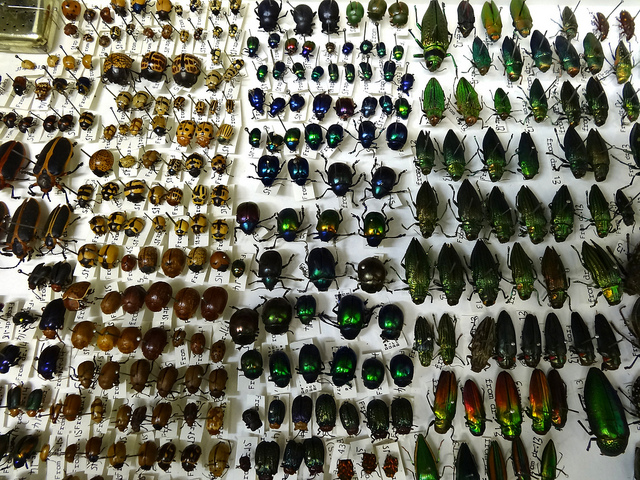
Drawer of various brightly coloured beetles, organised in neat rows with labels

Things Organised Neatly: Stewardship is fundamental to curatorship

Stewardship is the fundamental responsibility of the curators in charge of their collections. An unidentified specimen has not been forgotten. The average ‘shelf life’ of a specimen belonging to a new species, from discovery to publication, is over 20 years, and can be more than 200 years! This is due to the sheer volume of material that is collected in the field and donated to museums every year, and the expertise needed for identification. As the study of biodiversity (and the loss thereof) becomes more important to conservation efforts, more academics are turning to museums for data on population trends over time. The negative language used in these news articles could harm this relationship, and possibly deter specialists from engaging with museums. And with budget cuts increasingly affecting museum resources, curators want to engage with academics, artists, and other users, now more than ever.

The good news is that this problem is not entirely universal: recent news coverage of the discovery of a new species of ichthyosaur in Doncaster Museum was generally very positive about the value of natural history collections, mainly due to the enthusiasm of the researchers, which came across strongly in their quotes.

Rachel Jennings
NatSCA Facebook/Blog Editor

Accessing Staffordshire Lepidoptera

by Don Steward, Curator (Natural History),

The Potteries Museum & Art Gallery, City Centre, Hanley, Stoke-on-Trent ST1 3DW

email: don.steward@stoke.gov.uk

In 2013 the Potteries Museum & Art Gallery, Stoke-on-Trent Museums (PMAG) were awarded an Arts Council England PRISM Fund grant for the purchase of 4 dedicated insect storage units containing a total of 80 glass-topped entomological drawers to provide conservation quality enclosures for a collection of moths and butterflies, part of Designated Natural History collections held at PMAG. The cabinets and drawers were purchased from Preservation Equipment Ltd.

The 4 insect cabinets installed in biology store

The 4 insect cabinets installed in biology store.

Work has started on the long-term task of transferring a collection of c.8000 specimens amassed by the former Staffordshire Lepidoptera Recorder, Richard G. Warren. It is an amazing resource waiting to be utilized. Over a period of 40 years up until the late 1990s Warren collected specimens locally in this County that is pivotal in the north / south distribution of species. The data associated with these specimens is significant in plotting the distribution of Lepidoptera nationally.

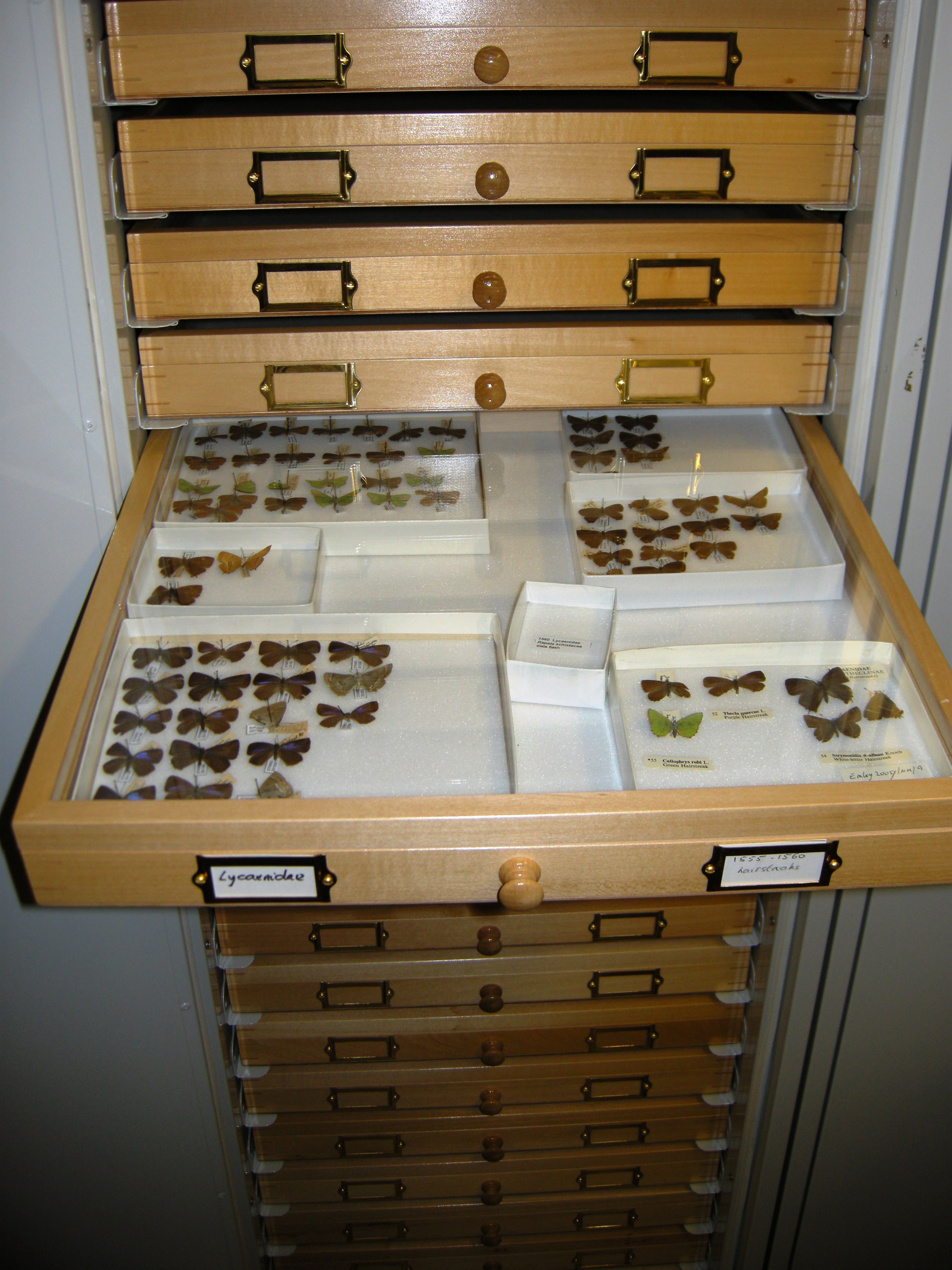
Using volunteer and core staff, the Warren collection is now being systematically moved into the new cabinets and drawers that are housed in the dedicated and environmentally controlled biology store within PMAG. The ultimate aim is for each species to be in individual Plastazote-lined card trays within the drawers. They are arranged according the Bradley & Fletcher 1986 indexed list of British butterflies and moths. Already work experience and volunteer students from the Staffordshire University MSc. course in Ecology and Conservation are involved in collection cataloguing and management to extend their taxonomic knowledge.

Lycaenidae being arranged in the new drawers.

Lycaenidae being arranged in the new drawers.

The new storage will facilitate the long term preservation of the specimens, allow access to specimens and the data associated with them. It will standardise access and we hope to continue this approach to other collections in the future to eliminate a backlog of collections held in user unfriendly hinged wooden storage boxes.

Data associated with specimens is being recorded electronically for the first time. This information will be batched in suitable units and sent to the Staffordshire Ecological Record which records and publishes species data in map form to a dedicated website and passes the data onwards to the National Biodiversity Network (NBN).

Mark Ashby, Joanne O'Keeffe and Lindsay Selmes, Staffordshire University MSc student volunteers sorting lepidoptera.

Mark Ashby, Joanne O’Keeffe and Lindsay Selmes, Staffordshire University MSc student volunteers sorting lepidoptera.