NatSCA Digital Digest – February

Compiled by Sam Barnett, NatSCA Volunteer and PubSci Committee Member.

What should I read?

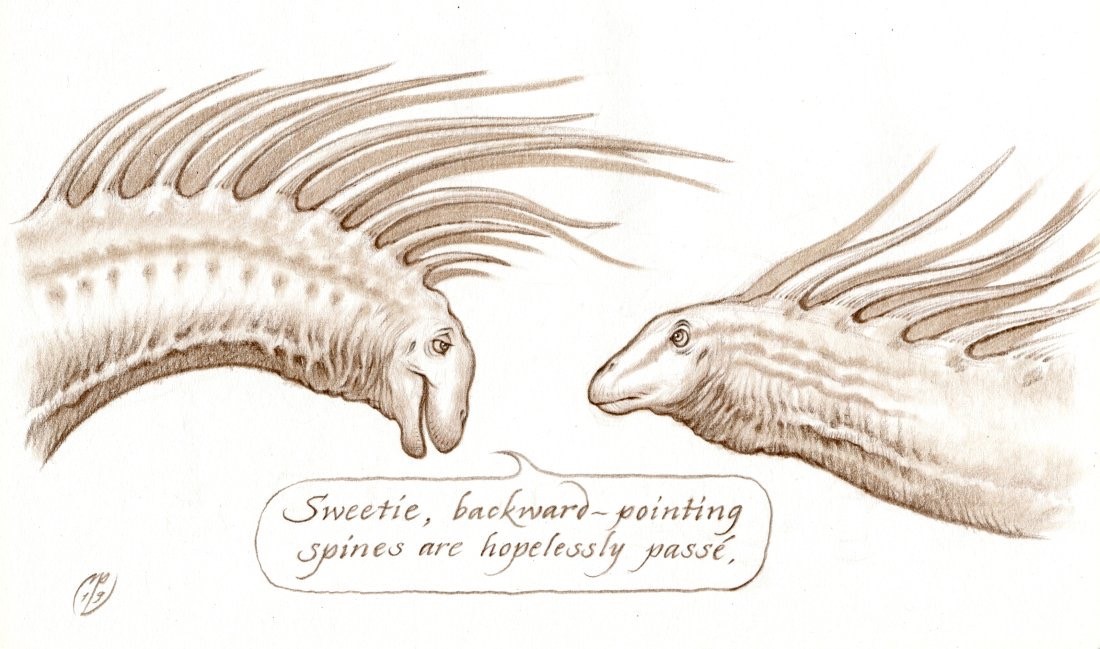
If you’ve not been keeping up with your South American sauropod discoveries, this next item might have completely passed you by. A new dinosaur has been named Bajadasaurus pronuspinax and hails from the Bajada formation of Patagonia. It bears a similarity to Dave Hone’s favourite dinosaur Amargasaurus but with far more flamboyant adornments – as illustrated here by Natee Himmapaan. You can read all about Bajadasaurus over at Nature or you can find a very good piece on it by Ed Yong here.

Bajadasaurus pronuspinax. (C) Natee Himmapaan.

In China, Qiang Fu and colleagues have proposed an earlier date for flowering plants; much, much earlier. This has been met with some cynicism from the palaeobotanical community and we’re looking forward to seeing how that plays out. Continue reading

NatSCA Digital Digest – January

Compiled by Dr Emma Nicholls, Deputy Keeper of Natural History at the Horniman Museum and Gardens.

What Should I Read?

Prolific author Darren Naish (of TetZoo) has pulled together a collection of exciting tetrapod-based scientific discoveries of 2018 in his latest article The Most Amazing TetZoo Themed Discoveries of 2018.

The government of New Zealand is under pressure to act on the trade of moa bones. This article is good food for thought re private sales of fossils; Moa for sale: trade in extinct birds’ bones threatens New Zealand’s history.

Of interest to many more of us than just curators, the top three most popular 2018 blogs posted on the Geological Curators’ Group website are:

1) Pyrite Oxidation: Where Are We Now? an excellent and informative article on the menace of pyrite decay

2) Up Inside Historic Dinosaurs about the Crystal Palace Dinosaurs, and

3) Contradictions, Conundrums and Lies which looks at the issues we face in museums!

Continue reading

Caring for Natural Science Collections – My First NatSCA Conference

Written by Hannah Clarke, Curatorial Assistant (Collections Access) University of Aberdeen, Museum Collections Centre.

This October I was lucky enough to attend my first ever NatSCA conference, thanks to funding from one of the NatSCA bursaries. I was originally a little daunted, as this was my first Natural History Conference, but I knew that I had to throw myself in the deep end!

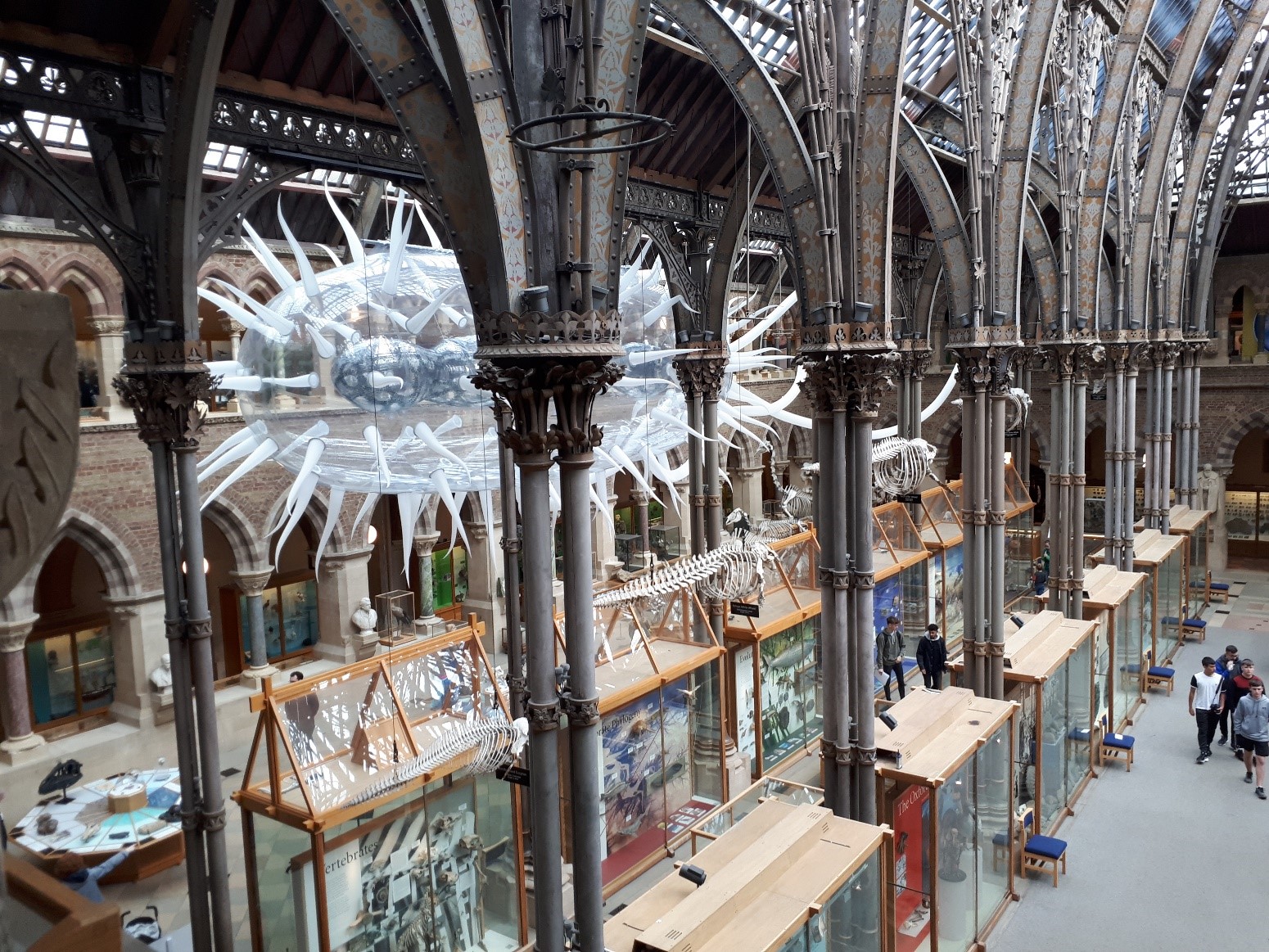
However, these worries soon dissolved, as everyone was really friendly, passionate about their specialism and eager to share their knowledge and experiences with everyone else in the room. Not only this, but the setting at Oxford University Museum of Natural History was a real treat, and I had a chance to take in the collection from above during coffee breaks.

View from the first floor at Oxford University Museum of Natural History, showcasing the impressive architecture and collections below. © Hannah Clarke.

Having originally trained as a conservator, I am now working in a collections access role, with responsibility for the upkeep of the Zoology Museum within my institution. Having been more focused on collections care in the last few years, I was keen to learn more about current advances in the conservation of natural history collections.

There were many highlights from the day, and as always at these kinds of events, new connections were made and advice offered openly to those with questions in the audience.

Continue reading

NatSCA Digital Digest – December

Written by Jan Freedman, NatSCA Committee Member and Curator of Natural History at Plymouth Museums Galleries Archives.

It’s the most wonderful time of the year! Festive celebrations are beginning, and this monthly digest is a bonanza of great things!

What Should I Do?

Big Natural Science conferences: Dates for your diaries!

Dead Interesting: Secrets of Collections Success: The NatSCA 2019 conference and AGM will be held at the National Museum of Ireland, Dublin between 1st and 3rd May 2019. The conference aims to unlock the secrets of collections success by sharing how we have used collections to benefit their organisations, communities and the wider world. The conference will focus on three themes:

  • Collections: Reveal your collections care, research and access secrets.
  • Engagement: What are your engagement success stories and how did you make them happen?
  • Museums and Tech: How has technology helped you unlock, understand and unleash your collections?

The call for abstracts is open, so have a look and present some of your amazing work to colleagues! All the information is here.

Continue reading

And the Winner is…

Written by Lucie Mascord, Natural History Conservator, and NatSCA Committee Member.

Through August to October this year, NatSCA ran its very first competition. Running up to the Caring for Natural Science Collections one-day conference at Oxford University Museum of Natural History (on 17th October 2018), the competition asked participants to post natural history conservation themed photographs to Twitter with the hashtags #NatSCAConservation and #photocomp.

Whilst it took a little while to warm up, buoyed by some fantastic images posted by the NatSCA conservation working group, we received some excellent entries, resulting in a close competition for first place.

The entries ranged from geology to taxidermy, from the humorous to the technical. This was the exact response we were looking for, illustrating the variety and accessibility of conservation.

When it came down to it, the winning photograph was an excellent composition, highlighting the complexities of conserving an unusual object.

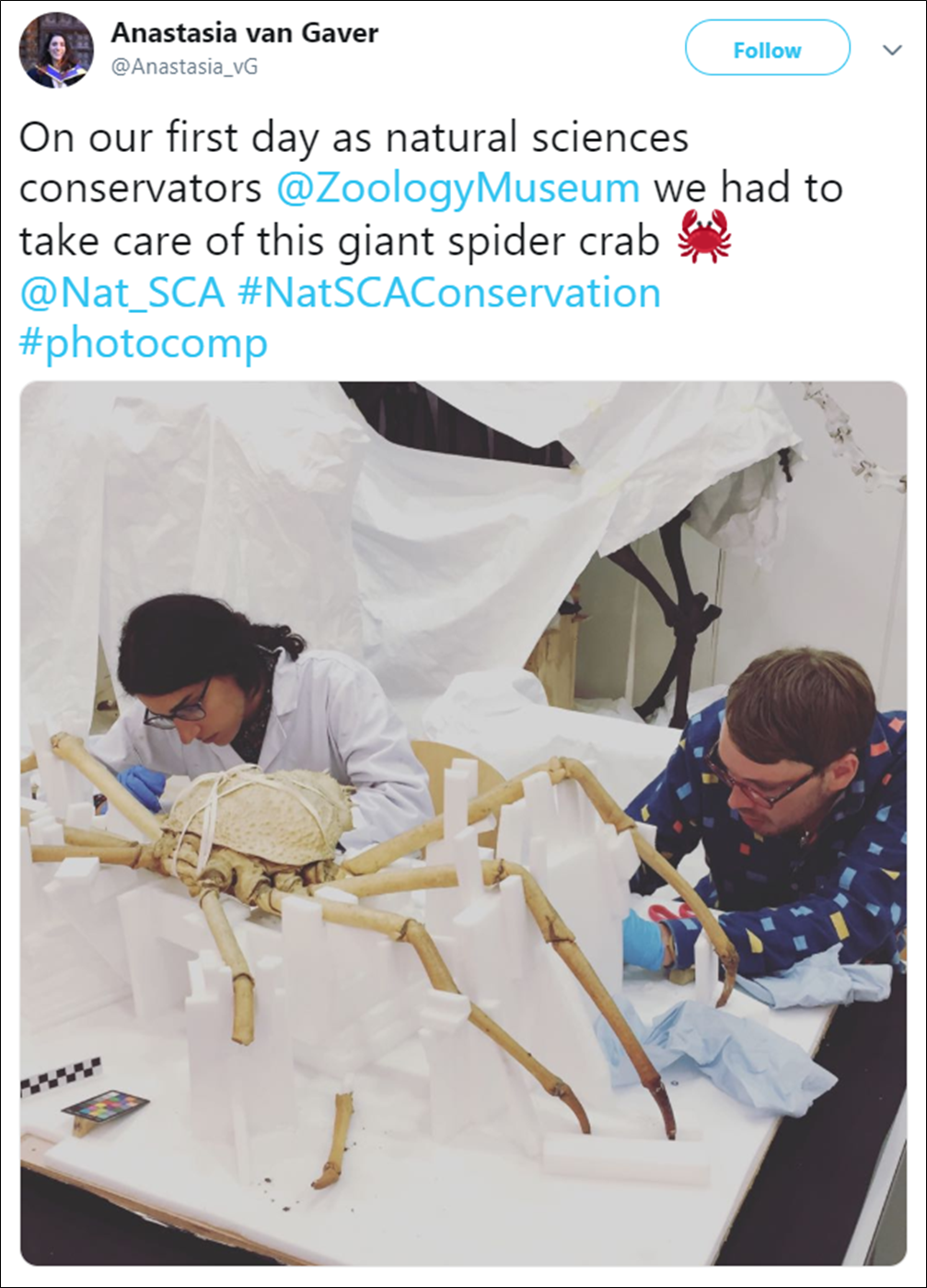
The winner is this fantastic entry from Anastasia van Gaver, which features Anastasia and her colleague Samuel Suarez Ferreira on their first day at work at the Museum of Zoology, University of Cambridge, (@ZoologyMuseum), image taken by Natalie Jones. Talk about being thrown in at the deep end with this monster of a giant spider crab. Both Anastasia and Sam attended the conference in October and gave talks on specific conservation experiences during their contracts at the Museum of Zoology. To be able to spotlight emerging professionals working with natural history collections was one of the main achievements of the conference and competition.
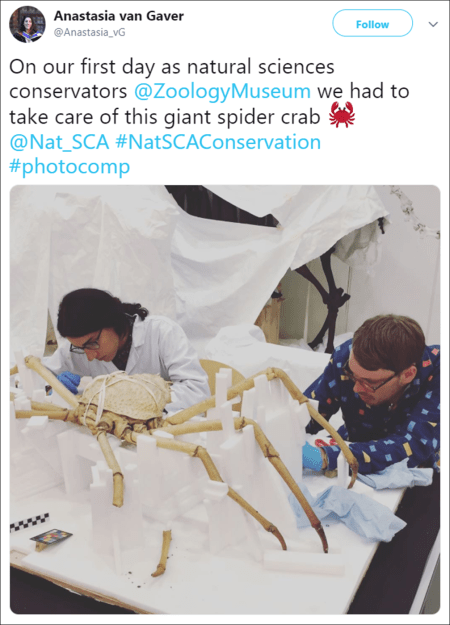
The winning entry from Anastasia van Gaver, Natalie Jones, and Samuel Suarez Ferreira. © Museum of Zoology, University of Cambridge.

Anastasia says; “The Cambridge University Museum of Zoology reopened in June, following a major HLF funded redevelopment. I was lucky to be one of the conservators to join the team for this project and this picture was taken on my very first day at the Museum, in August 2017. Having just visited the stores and the lab, my new colleague Samuel Suarrez Ferreira and I got given the task of making this Japanese spider crab fit for display! I submitted this picture for the competition not only because of the great memories I have of the best possible first day a natural sciences conservator could ask for, but also because it is a good example of team work: Sam and I decided on treatment together, then each conserved one side of ‘Krabby’, before the mountmaker Rebecca Ash designed an intricate bespoke metal support for it.”

Continue reading