
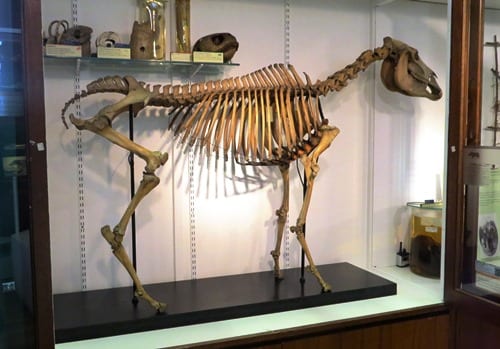
The quagga after conservation and remounting. LDUCZ-Z581. Courtesy of Nigel Larkin
In November 2015, the Grant Museum of Zoology, UCL launched one of the most ambitious conservation projects undertaken at the museum, and our first ever public fundraising campaign, generously supported by NatSCA’s Bill Pettit Memorial Award.
Bone Idols: Protecting our iconic skeletons aims to secure the long-term future of 39 of our rarest and most significant skeletons, some of which have been on display in the museum for 180 years. This includes what can be considered the rarest skeleton in the world: our extinct quagga – an unusual half-striped zebra.
Preserving the uncollectable
It is the only mounted quagga skeleton in the UK, and no more than seven quagga skeletons survive globally. In April the quagga returned to the museum, having been treated by natural history conservator Nigel Larkin. The work involved completely dismantling and chemically cleaning the irreplaceable skeleton, and then remounting it on a modified skeleton-friendly frame in a more anatomically correct position.
This major treatment has also been given to the Museum’s largest skeleton – that of a (hornless) one-horned rhino. This has been on open display since 1911, in a room once lit by oil lamps. The particulate pollutants that were removed as part of the project had significantly discoloured the bone. The rhino now stands in a more rhino-like pose, with its legs on the ground and its limbs meeting their sockets – all steps that will safeguard the impressive skeleton for hopefully centuries to come. More about the rhino’s treatment can be read on the museum’s blog.
Curing the quagga
A condition assessment of the museum’s most famous object had uncovered a wealth of problems. The sternum was oozing a black, sticky fat deposit; the femur was far from the pelvis, which is both unsightly and left the skeleton unstable; the neck vertebrae were on upside-down (a feature I’m embarrassed to say I hadn’t spotted, despite being a mammal nerd who has worked with this skeleton for ten years); the spine was held unnaturally straight by a horizontal rod; and much of the iron frame was rusting.
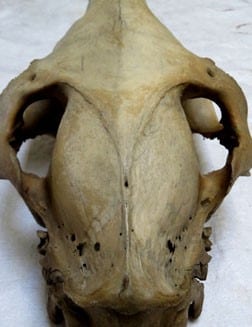
The quagga’s skull half cleaned. Courtesy of Nigel Larkin
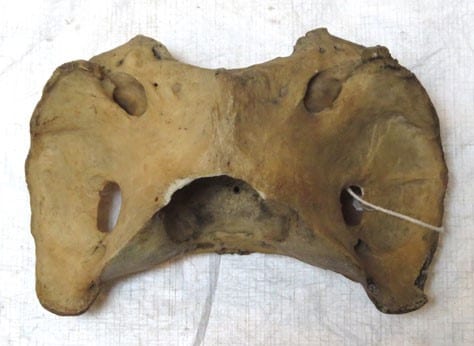
The quagga’s atlas half cleaned. Courtesy of Nigel Larkin
These ills, and many others, have been remedied. Although the specimen is the only one of the Bone Idols that has not been on open display, nor had it been regularly handled, the bone had still accrued a shocking amount of dirt and grime. This has been cleaned off using an alcohol ethoxylate (Synperonic A7) in distilled water.
A more detailed account of the quagga’s work appears on the Grant Museum’s blog.
Conservation in the public eye
Another aim of the Bone Idols project was to bring as much of the conservation work as possible to the gallery, allowing the public to engage in this critical work, which normally takes place behind the scenes.
Nigel Larkin is working on 13 of the 39 skeletons (those that require complex metal work), while the remaining 26 are being treated by UCL Museums Conservators. Days were set aside to prepare the large specimens for transport. We scheduled the work so that nearly all of it took place during opening hours (except that which involved dangerous equipment), at the heart of the museum. Staff and Nigel were on hand to explain what was happening.
For the in-house specimens, we have been advertising when this work is going on in the gallery, and even giving visitors a chance to take part in cleaning the skeletons themselves.
We are keeping the public engaged in the project through social media (#BoneIdols) and on our blog, and this content has proved very popular.
I’ll be talking more about the public aspect of the Bone Idols project at NatSCA’s Bone Collections event in September.
We are very grateful to the support of NatSCA and the Arts Council England’s Museum Development Fund for this project, as well as the thousands of pounds of public donations we have received. The work is ongoing, and will cost in excess of £30,000 to complete. If you would like to support the campaign you can make a donation on our online giving page, use this postal donation form (.docx, 63kB), or visit us in person in the museum.
Collectively each small gift will make this project possible, preserving these irreplaceable skeletons for the long-term future.
Jack Ashby is the Manager of the Grant Museum of Zoology, UCL





 NatSCA