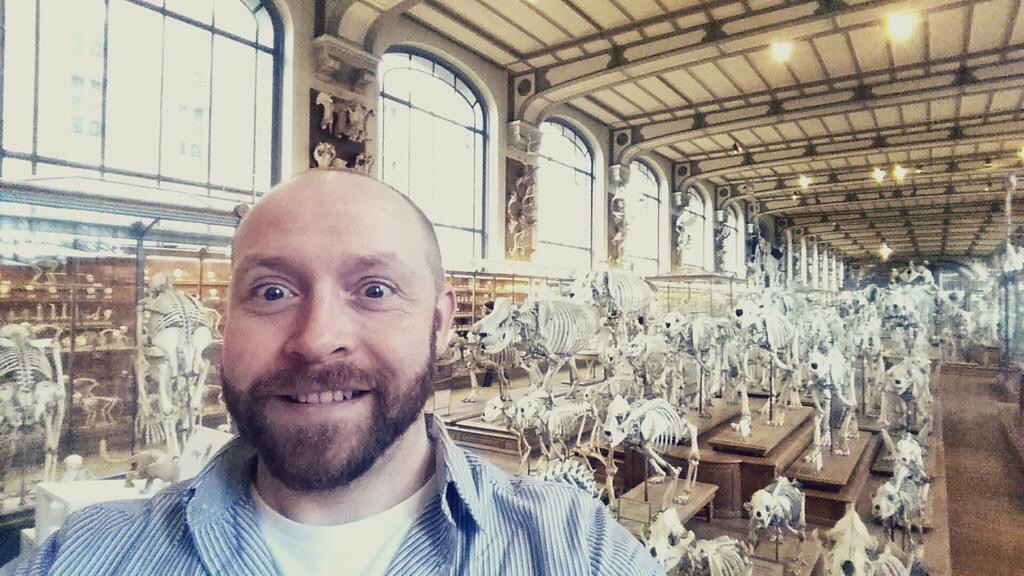
The Perils of Potholing – Get Well Soon Julian Carter

Star organiser of this year’s SPNHC/NatSCA/GCG Conference Julian Carter has written a very detailed account of his recent accident while potholing in the Aven de Hures. It’s compelling and hard to read without wincing. Get well soon Julian – we all wish you a speedy recovery and are delighted to hear that you are on the mend:

The Fall
I lie confused, disorientated. The mind is furiously trying to figure out where I am, how did I get here? Involuntary groans leave my body from the shock, pain and confusion racking me…

Gradually the thinking clears and I’m looking up. I see the outline of the 40m deep shaft I’ve just fallen down. A large gaping sphere of blackness in the middle of the light coming off my helmet light which is lying just behind my head somewhere.

Amongst the first coherent thoughts are ‘I survived falling down that!?’. The next is the sudden awareness I’m at the edge of the rift that is the next pitch. Quickly my bloodied hands find the pitch rope and clip it into my chest ascender.

Read more…

Jules receiving the Special Service Award at SPNHC2014

Jules receiving the Special Service Award at SPNHC2014

An Interview with the Next Generation

Last week we covered the history of Charles Jamrach: a Victorian animal trader who, though his methods would be considered questionable today, was nevertheless the source of many museum and zoo specimens in his day.

Today I’d like to talk about the future – specifically the fresh lay-enthusiasts who could one day be museum professionals. At the RSPB Conference last week, Nick Clegg said that “Many young people now know more about playing Angry Birds on their phone than they do about spotting real birds when they’re outside”. That may well be true but there is hope for the next generation, with lots of up and coming young naturalists.

I caught up with two of them to ask them about their passion for natural history: Melanie and Sam.

Sam's mounted swallow

Sam’s mounted swallow

1. What first got you interested in natural history collection?

Melanie:

“The thing that first really got me interested in natural history collecting was seeing Ben Garrod‘s series Secrets of Bones on tv. I was still a little bit freaked out by bones and skulls before seeing this series. This made me see bones as interesting. I have always had a massive love for animals and wildlife, so this helps me to see them from a new angle.”

Sam:

“Well when ever i see an animal i wonder how i can learn more about it, sure you can look online and in books but nothings works as well as … Looking at whats behind its beauty skills and adaptation, the bones and the feathers.”

2. How big is your collection today?

Melanie:

“My collection total stands at 70, but I am continuing to find new specimens constantly. This includes: Great Bustard, buzzard, owls, polecat, mink, African striped weasel and African pygmy hedgehog.”

Sam:

“My collection at the moment consists of 45-47 skulls, 1-5 hundred feathers and all sorts. It’s still growing.”

3. What is the specimen that you are most pleased with and why?

Melanie:

“I don’t really have a single specimen to answer this question. But I have a collection of 4 owls inside (2x tawny, 1x barn, and 1x Eurasian scops) and they are by far my favourites. I also have a third tawny owl rotting at the moment. Owl skulls are especially interesting to me as I love owls when they are alive!”

Sam

“My favourite and most amazing cleaned specimen is my swallow skeleton. I’m incredibly pleased with it as i articulated it myself and the skull is very interesting in the way it is shaped.”

4. What are the top 3 on your wish list?

Melanie:

“The top three specimens on my wish list are all owls: a snowy, great grey, and an eagle owl; but any skulls are always welcome in my collection.”

Sam

“My top 3 specimens on my most wanted list would be a puffin, a green woodpecker, and a seal.”

5. What has been the best advice that you have been given so far?

Melanie:

“The best advice I have been given so far was from Jake McGowan Lowe, he has helped me loads with my collection, from a good way of documenting it, cleaning advice, identifying and even the legal side of things!”

Sam

“I think the best advice anyone has ever given me is to simply just ignore when people say that it’s morbid to collect dead animals”

Melanie's owl skulls.

Melanie’s owl skulls.

6. How do you document your specimens?

Melanie:

“I document my specimens by giving each of them a tag with their name, English specie name, date they came into my collection, ID number and who found it. Each specimen then has half of a A4 sheet of paper with all of its details on it. Occasionally if its a rare skull it has a full A4 page of information linked to it by its ID number.”

Sam

“I keep a record of all my skulls hand written in my notebook and digitally on a record list and a picture profile.”

7. Has a student or scientist wanted to study one of your specimens as part of their research?

Melanie:

“No-one has yet wanted to study one of my specimens for research. I wouldn’t mind them coming and handling my specimens at all and would find it a complement if they wanted to know more about something in my collection. I would be careful about who takes them though: they are my pride and joy after all!”

Sam

“If someone wanted to study one of my specimens i would be happy for them to study them and not only that but i would be honoured.”

8. Do you see this as a hobby or would you like to get a natural history-related job someday?

Melanie:

“I see it as a hobby but I also would love to become a zoologist or osteologist one day! So being able to have a collection of my own specimens is really useful and I really love doing it!”

Sam

“when im older i would like a natural history related job and this is not just a hobby its my way of learning more about nature.”

9. If someone were to question whether your specimens were collected ethically, what steps are you taking to demonstrate that they are?

Melanie:

“The measures I take to prove that my specimens were ethically acquired are: take photos if I can of any injures to prove that it was not shot; write down where it was found/who I bought it from, and where it came from. I keep documents linked to all my specimens with all of this info on it, and also try to acquire only car killed or naturally found specimens. I have one grey squirrel that was shot, and have kept the bullet with it and taken notes about it. Its really important to keep all of this written down and have it to hand so that if I needed to I could prove how it died. I also do lots of research into whether or not I need any licences to be able to keep that particular skull.”

Sam:

“Well I take photos of where they are found and keep them a folder that shows where it was found sometimes who was there and proof of the death from the bones.”


So you can see there’s a lot of enthusiasm for the subject material, which should always be encouraged. The idea As long as amateur collectors are informed and guided by the subject specialists towards conscientious and ethical collecting this can only be a positive thing. If you would like to learn more about these young collectors and their collections, they are very active on Twitter and Sam’s collection has it’s own blog at Nature Based.

Charles Jamrach: Exotic Animal Collector

Charles-Jamrach-Shop

The week before last saw historian Elle Larsson speaking at PubSci. The talk centred around the exotic animal trade and, in particular, the life of Charles Jamrach: a trader of animal specimens – both living and dead.

Charles’ father was an entrepreneur from Hamburg who noticed that sailors were bringing back exotic animals in the hull of their ships and selling them. There was such huge interest in these peculiar beasts that sailors were able to retire from the profits. Jamrach Senior wanted a cut of the action. It soon became apparent that London was the hub of the exotic animal trade and Charles moved to London in 1840 to set up his business after the death of his father.

Charles began forming a network of contacts and runners between Liverpool, Marseilles, and Bordeaux. He was soon able to boast that he could get ‘any animal except a Koala’. The relationship between Koalas and gum trees had not been fully realised at this point and three unsuccessful attempts to secure one had resulted in failure. Jamrach was forced to concede this one shortcoming. Jamrach was buying between a shilling and five pounds, depending on the specimen. With the middle men involved it was no longer possible for a sailor to make his fortune selling exotic animals as the profit was split among too many people. Even Jamrach sometimes had to take a lower asking price for one of his animals than he had originally paid for it: He was certainly not guaranteed a better price later and the cost of keeping the animal in sellable condition was not cheap.

He sold living specimens to zoos and private collectors, dead specimens to museums. Whatever these groups turned down, the taxidermists picked up. In late Victorian London there was a fashion for furniture made from animal parts. People would choose an animal (often still alive) that they wanted turned into cutlery, a chair, or piano and the poor beast would be sent to the taxidermist for production. It is hard to imagine such a situation today, though the culinary world still has a “choose live product” remnant of these bygone days.

There’s one area in which Charles Jamrach reminds me of Archcancellor Ridcully, from Terry Pratchett’s Discworld – in the sense that they both did their bit for endangered species… by keeping them that way: in 1851 Jamrach acquired a quagga for the Zoological gardens. In 1883 the quagga was declared extinct in the wild.

The interest in unusual wildlife had a political motive in many cases: a zoo of the British Empire showcasing species from elsewhere was not just introducing the public to animals they had never heard of, it was showing the dominion that man had over the animal and the empire had over the animals’ home land. On one occasion a bengal tiger managed to back out of a poorly made transport crate and run off down the road – grabbing hold of a young boy. Jamrach managed to subdue the tiger with his truncheon but the boy’s parents still, understandably, sued. Jamrach was now famous: not only was he bringing back animals that represented empiric might, he now personally symbolised Britain beating down the tiger, symbol of rebellion against it.

Not everyone was a fan of Jamrach: awareness of animal welfare was in its infancy but this was the generation that saw it develop – the RSPCA was formed during the late Victorian era during Jamrach’s lifetime and he received a good deal of complaints abou the way his animals were treated. Complaints about Jamrach centred around the cramped transport conditions, stressed overcrowding of predators near their prey, and the malnourished states they reached London in. This was a time when the accepted wisdom for “reforming” a vicious and malnourished crocodile was to tie it down and force feed it. It is unclear whether Jamrach participated in this but he escaped criticism by dying in 1891 – the year that the practice was challenged. He left a vast sum of £7108 inheritance to his son: the equivalent of half a million pounds in today’s money.

To learn more about Elle Larsson’s research, visit the animal history museum – an online exhibition about the trade.

100 Years Aboard the Ark…

By Dr. Ebony Andrews
Calderdale Museums

Left: An 'escapee' taxidermied grey wolf on the fringe of the 'Living Planet' gallery, Great North Museum: Hancock (2010). © Image by the author; Right: 'Abel's Ark', Hancock Museum (c.2004). © Archives of the Natural History Society of Northumbria, Great North Museum: Hancock.

Left: An ‘escapee’ taxidermied grey wolf on the fringe of the ‘Living Planet’ gallery, Great North Museum: Hancock (2010). © Image by the author; Right: ‘Abel’s Ark’, Hancock Museum (c.2004). © Archives of the Natural History Society of Northumbria, Great North Museum: Hancock.

For the past four years I have been researching changes in the use, display and interpretation of taxidermy in three regional museums in the North of England. These museums are: Leeds City Museum, Museums Sheffield: Weston Park (more commonly known as ‘Weston Park Museum’), and the Great North Museum: Hancock, Newcastle, (previously the Hancock Museum). The culmination of this research is the completion of my PhD thesis, entitled: Interpreting Nature: Shifts in the Presentation and Display of Taxidermy in Contemporary Museums in Northern England (2013).

In the study, I mapped out some of the wider trends in changes to the display and interpretation of museum taxidermy spanning roughly the last century across all three of the case study museums, but with a particular emphasis on the more recent display histories (from 1950-2013).One of the primary aims of my research was to challenge the idea that the unpopularity of museum taxidermy displays at different points in history, but particularly following the rise of the conservation movement in the UK, was exclusively related to the ‘controversial’ materials of taxidermy’s construction (ie. the use of animal derivatives). Rather, I proposed that much of the perceived ‘problem’ with taxidermy, both public and institutional in the latter part of the twentieth century, could be attributed not only to what was being presented, but also to a significant degree, to how it was being presented. In other words, how and through what mechanisms, public museums were interpreting their taxidermy collections for their public audiences.

Left: The 'Bird Room', Hancock Museum (c.1966) © Archives of the Natural History Society of Northumbria, Great North Museum: Hancock; Right: 'Bio-Wall' display (detail) featuring 'Sparkie' the budgerigar (centre bottom), from 'Living Planet', Great North Museum: Hancock (2011). © Image by the author.

Left: The ‘Bird Room’, Hancock Museum (c.1966) © Archives of the Natural History Society of Northumbria, Great North Museum: Hancock; Right: ‘Bio-Wall’ display (detail) featuring ‘Sparkie’ the budgerigar (centre bottom), from ‘Living Planet’, Great North Museum: Hancock (2011). © Image by the author.

In a period where museum taxidermy is once again being afforded a considerable amount of attention, my research investigates some of questions that are now being asked about recent shifts in the use of taxidermy in museums along with some of the issues now facing museums in regard to the presentation of historical collections. My thesis is available through White Rose eTheses Online, see: http://etheses.whiterose.ac.uk/6637/ or simply go to http://etheses.whiterose.ac.uk/ and search the database by author or publication title to gain access to the complete document. Access to this resource is free, and you are not required to register your details to use it. With full colour illustrations and an extensive bibliography, I hope my thesis may be of use to those interested in the history of the display and interpretation of taxidermy, the impact of shifting cultural and ethical positions on the popularity of taxidermy, and the fascinating politics of both past and present approaches to the display of taxidermy in regional museums.

Accessing Staffordshire Lepidoptera

by Don Steward, Curator (Natural History),

The Potteries Museum & Art Gallery, City Centre, Hanley, Stoke-on-Trent ST1 3DW

email: don.steward@stoke.gov.uk

In 2013 the Potteries Museum & Art Gallery, Stoke-on-Trent Museums (PMAG) were awarded an Arts Council England PRISM Fund grant for the purchase of 4 dedicated insect storage units containing a total of 80 glass-topped entomological drawers to provide conservation quality enclosures for a collection of moths and butterflies, part of Designated Natural History collections held at PMAG. The cabinets and drawers were purchased from Preservation Equipment Ltd.

The 4 insect cabinets installed in biology store

The 4 insect cabinets installed in biology store.

Work has started on the long-term task of transferring a collection of c.8000 specimens amassed by the former Staffordshire Lepidoptera Recorder, Richard G. Warren. It is an amazing resource waiting to be utilized. Over a period of 40 years up until the late 1990s Warren collected specimens locally in this County that is pivotal in the north / south distribution of species. The data associated with these specimens is significant in plotting the distribution of Lepidoptera nationally.

Using volunteer and core staff, the Warren collection is now being systematically moved into the new cabinets and drawers that are housed in the dedicated and environmentally controlled biology store within PMAG. The ultimate aim is for each species to be in individual Plastazote-lined card trays within the drawers. They are arranged according the Bradley & Fletcher 1986 indexed list of British butterflies and moths. Already work experience and volunteer students from the Staffordshire University MSc. course in Ecology and Conservation are involved in collection cataloguing and management to extend their taxonomic knowledge.

Lycaenidae being arranged in the new drawers.

Lycaenidae being arranged in the new drawers.

The new storage will facilitate the long term preservation of the specimens, allow access to specimens and the data associated with them. It will standardise access and we hope to continue this approach to other collections in the future to eliminate a backlog of collections held in user unfriendly hinged wooden storage boxes.

Data associated with specimens is being recorded electronically for the first time. This information will be batched in suitable units and sent to the Staffordshire Ecological Record which records and publishes species data in map form to a dedicated website and passes the data onwards to the National Biodiversity Network (NBN).

Mark Ashby, Joanne O'Keeffe and Lindsay Selmes, Staffordshire University MSc student volunteers sorting lepidoptera.

Mark Ashby, Joanne O’Keeffe and Lindsay Selmes, Staffordshire University MSc student volunteers sorting lepidoptera.