Collections at Risk

The biggest problems facing collections today are almost certainly posed by reductions in funding. The financial support for museums of all sizes has been decreasing every year, with jobs being lost and stored collections often bearing the brunt of cuts, since they are usually out of sight and therefore out of mind for many decision makers.

Hidden treasurers? Specimens in storage can be overlooked by decision makers in favour of public-facing elements of museum business.

Hidden treasurers? Specimens in storage can be overlooked by decision makers in favour of public-facing elements of museum business.

NatSCA has been to trying to keep track of threats to collections and offer our support in an effort to make the vital role of collections, and the people with the skills to care for them, more clearly recognised by management. Much of this work in the UK has been alongside our colleagues in the Geological Curators Group.

The first issue of our new online publication NatSCA Notes & Comments provides a case study of decline from the Midlands, written by Geoffrey Hall. Although the picture painted is bleak, there have been some small wins, as Ludlow have since acknowledged the importance of maintaining a geologist to manage their globally important geology collection.

We have also been looking at the wider societal role of collections and have been working to raise their profile at a variety of levels, including internationally, alongside the Society for the Preservation of Natural History Collections. Our message about the importance of collections is being heard by a wider and more influential audience, something that is reflected in this week’s Nature, which features an article about the importance and decline of collections.

If you know of any collections that are at risk from staff loss or disposal, please let us know by editing our Natural History Near You map or emailing us at advocacy@natsca.org

Bill Pettit Memorial Fund: Discovery Collections Project

The Bill Pettit Memorial Award was set up a few years ago by NatSCA to support projects including the conservation, access, and use of natural science collections. One of the recent projects we have been able to help with was the curation of some amazing specimens from the voyage of the Discovery. Hear more about the project from Tammy below.

David Gelsthorpe

20150128_114015

In early 2013 we set about organising the task to begin with the curation of the largest, most recent and least organised of the three collections – that of the ECOMAR collection. The start of the ECOMAR project coincided with commissioning of the new UK Royal Research Ship James Cook officially named by the Princess Royal on 6 February 2007. The first ECOMAR cruise departed from Southampton on 13 July 2007. The ECOMAR project was designed to investigate the Charlie Gibbs Fracture Zone area which lies approximately mid-way between Iceland and the Azores. Four super stations were defined (two north of the Charlie Gibbs Fracture Zone and two to the south), all had the same bottom depth (2500m) and were revisited during voyages by the R.R.S. James Cook and the R.R.S. Discovery during the years 2007–2010 to replicate sampling, time-series investigations and flux studies.

The Discovery Collections have no full-time curatorial post and we rely on the goodwill and interest of students and other volunteers (including scientific visitors and work experience volunteers) to help with cataloguing, labelling, respiriting, and general curatorial jobs. The samples, though incredibly valuable should be considered at risk. I look after the collections in as much that I manage the visitors to the collections, host students, and manage public enquiries, visits and displays of the specimens. I am also a taxonomist employed to conduct research, describing new species and studying the ecology of the deep-sea benthic fauna. I was employed for four years to work on the ECOMAR program to describe the ecology of the scavenging fauna of the area. I therefore had a particular interest in the curation of this collection.

We employed Amanda Serpell-Stevens, to work on this project, but we had funds for only 8 weeks of her time. Thus the project was reduced from cataloguing the three large collections to just one. When Amanda’s contract ended there was still much reshelving and reordering of the material to be carried out which was carried out on an ad hoc basis by myself, a retired member of staff, Mike Thurston, and Amanda who returned on a voluntary basis to continue work on the project.

20150128_113759

The project began by working shelf by shelf to curate and to catalogue (in paper record) what was held including location and size of each jar, and to change containers for those specimens that were in plastic containers or inappropriate sized jars. The preservative was also replaced in most of the jars and a new label produced for each specimen, as many were poorly labelled. This curation and cataloguing process took the majority of the 8 weeks, with just enough time remaining to enter the data into Excel.

With the availability of a digital catalogue the task of reorganising the lots into taxonomic order was greatly eased. This meant adjustment of shelf heights to incorporate the various sizes of tubs and jars (some of the lots are 20 litre tubs full of holothurian specimens of a single species), and removing all the specimens in turn, which were then replaced first by taxonomic order then by station order using Excel to sort the data. The spreadsheet was updated with the new locations of the specimens as we progressed. The final part of the process involved cross referencing the specimens with the newly published papers and updating the names where they had changed (on both the specimen labels and in the spreadsheet).

There were numerous new species described during the ECOMAR project, which meant further problems in allocating the correct new name to specimens in the collections variously named as e.g. Peniagone sp. nov ‘pink’. While holotypes have been registered in the NHM, London, the rest of the material needs updating to current knowledge, a process which is often neglected, despite it being referenced in the many new publications resulting from the project.

It is very satisfying to have the ECOMAR collection properly curated and to know that I can locate any specimen needed easily. In total we curated, relabelled and catalogued a total of 1300 lots comprised of 1148 smaller jars, 88 tubs (between 5 and 20 litres) and 64 loan specimens. We plan to publish a detailed analysis of this work for the NatSCA journal, including a list of available species, and will make the catalogue available online when time and funding allow. In the meantime interested parties can contact Tammy Horton (tammy.horton@noc.ac.uk) for a copy.

Dr Tammy Horton
Ocean Biogeochemistry and Ecosystems
National Oceanography Centre,
Waterfront Campus,
European Way, Southampton SO14 3ZH
UK

Museum Selfie Day

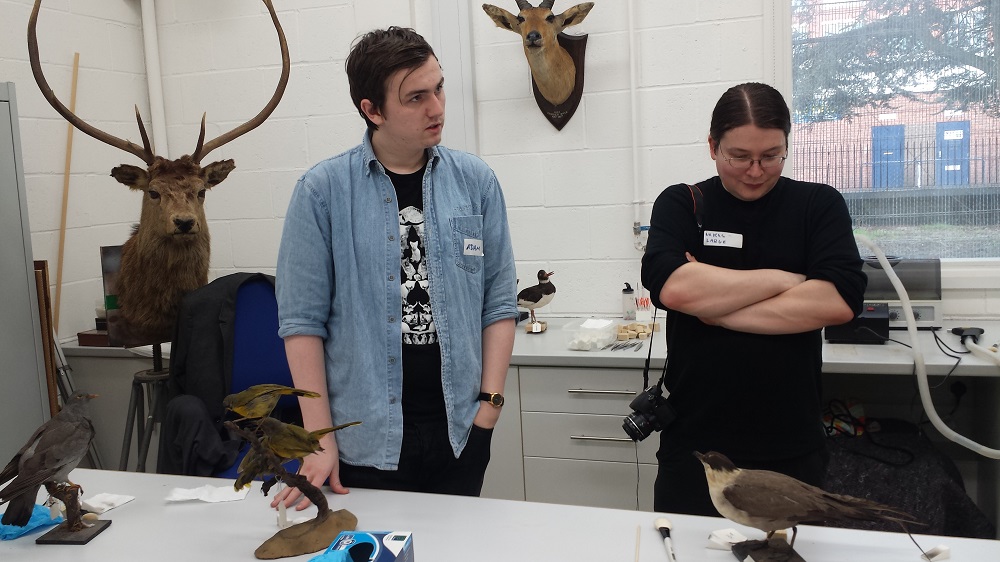
Our Chair looking Poe-faced with a Raven

Our Chair looking Poe-faced with a Raven

I freely admit that I have mixed feelings about this cultural event: I don’t take many pictures of myself except when there’s a bird perched on me. I don’t like photographs of people when they know there’s a camera on them. I do like museums though and it’s a great way to discover new ones. It’s also a great way to ensure museum visitors because you can’t take a photograph of yourself with a museum specimen unless you’re at the museum with the specimen (or very good at Photoshop but shhh – visiting a museum is quicker anyway). Since the golden years of polaroids and film rolls people have been going abroad and taken photographs of themselves at places. Who hasn’t sat through a relative’s slideshow as they talk you through their highlights: “that’s me by the Taj Mahal”; “that’s me holding a ‘Peshwari Naan'”; “That’s me in the corner”; and so on? Clearly validating that we were there fulfills some basic need in us and why shouldn’t that need be satisfied in a museum with all its fascinating specimens that a person could be “also there” with?

As long as selfies are done with respect for the irreplaceable objects you are posing with, there is no harm in it. Unfortunately that’s not always the case with some people. Remember that people will want to have their photograph taken with that awesome fossil in 100 years time and you can do your part to make sure that’s possible by being very careful.

Have a great day in the museum everyone.

Derby Museums Need You

Thanks to Jonathan Wallis for bringing this to our attention.

In 2015 Derby City Council will be cutting funding for Derby Museums by 26%. Would that it were an isolated incident for Derby, or indeed the country at large. This is not the first time that the plight of the East Midlands has been brought to NatSCA’s attention, nor the first time they’ve been discussed by the members.

There is much that needs to be done but something we can all do is sign the no Cuts to Derby Museums petition.

The financial value of museum objects

In the museum sector there’s a bit of unwillingness to discuss the financial value of objects. After all, museums are not run as salerooms and their focus is on the other sorts of value that collections hold.

Of course, for some artworks it can be hard to ignore the massive price tags that they sometimes carry and there are some good arguments that in our materialistic society, which has become increasingly focussed on economics, there are sound reasons for including financial value in considerations about collections. An interesting discussion about this between two NatSCA stalwarts, Jan Freedman and Mark Carnall, was recently published by the Museums Association.

Worth £175 million today. Card Players (5th version ca.1894-1895) by Paul Cezanne is the most expensive painting in the world. For now... (image from Musée d'Orsay)

Worth £175 million today. Card Players (5th version ca.1894-1895) by Paul Cezanne is the most expensive painting in the world. For now… (image from Musée d’Orsay)

For those of us who work in museums, we normally only consider a specimen’s price-tag when acquiring new material, deaccessioning material or dealing with insurance valuations for exhibitions and loans.

When acquiring specimens, the consideration is about whether an asking price is fair and an appropriate amount to spend in the context of institutional priorities and budget. When deaccessioning, the consideration is rather more complex and is linked to appropriate methods of disposal and the motivations for disposal. Deaccessioning shouldn’t be done in order to make money, but disposal by sale may be an option as long as the processes involved in the decision meet professional standards.

The controversial disposal by sale of the statue of Sekhemka has caused problems for Northampton Museum & Art Gallery. (Image of the statue on display c.1950s - uploaded by Bibilovski, 2012)

The controversial disposal by sale of the statue of Sekhemka has caused problems for Northampton Museum & Art Gallery. (Image of the statue on display c.1950s – uploaded by Bibilovski, 2012)

When assessing these sorts of values it can be very useful to look to private auctions for a guide, which take place every so often at a variety of auction houses. For natural history it can be worth checking Sotheby’sBonhams and Summers Place. However, auctions tend to deal with the more showy objects, rather than the scientific specimens that museum staff often have to deal with, especially for research loans.

Insurance valuations are slightly different, since these may not simply relate to the market value of an object, but could take into consideration the cost of conservation if the object is damaged, or the cost of going into the field to collect a similar specimen to replace it if it’s the sort of specimen that doesn’t come up for sale. Either of these possibilities may be far more expensive than a likely sale value.

One of the issues with putting a price on objects is that it may make them more obviously attractive to criminals. For instance, a sudden spike in the street value of illegal rhino horn in parts of Asia around 2009 led to a massive increase in the prices of antique rhino trophies at auction, until special measures were introduced to stop this loophole in trade. In addition it has led to the targeted thefts of hundreds of specimens from collections around the world.

Taxidermy rhino with the horn removed and sign explaining the problem of thefts from museum specimens. (Image by Dr John Hutchinson, 2013)

Taxidermy rhino with the horn removed and sign explaining the problem of thefts from museum specimens. (Image by Dr John Hutchinson, 2013)

Of course, by being aware of the changing value of specimens and therefore the changing risk of theft, museums are able to take steps to ensure that appropriate security measures are put in place to properly care for their objects. So although the financial value of objects can be complex to address, it is clear that there is a need for museums to know how much their collections are worth, since other people may be only too aware.