Fight at the museum: filming and fees

This post is a late addition to our series of write-ups from the 2015 NatSCA Conference.


Fisticuffs are threatened between Paolo Viscardi and Jack Ashby, in the Grant Museum of Zoology's Micrarium.

FIGHT!

(Twitter notes on discussion Storified here: https://storify.com/Nat_SCA/natsca2015-tweet-along-day-one-morning)

There was an ongoing disagreement between Jack Ashby (of the Grant Museum of Zoology, UCL) and Paolo Viscardi (at the time of the Horniman Museum and Gardens, but coincidentally now also of the Grant Museum) that finally came to a head-to-head debate at the 2015 NatSCA conference. The proposition put forward to frame the debate was: “This house believes that public museums should not charge for filming when the production content aligns with the museum’s objectives”.

As with any debate, there were terms and conditions that needed to be clarified to avoid the argument from becoming mired in semantics or polemics, so it was mutually agreed that filming conducted primarily for promotional purposes (for example, in a programme that was directly about the work of the museum) and filming that only used the museum as a backdrop (for example, in an advert for a fast food restaurant) be excluded from discussion, since the former would be justifiably free and the latter would always be expected to pay a fee.

Round 1: Delivering your mission?

Paolo in proposition

The first point made was that public museums maintain collections for the benefit of their audiences, so where the use of the collections in filming supports the mission of the museum, it allows the collections to reach a wider audience, helping to fulfil their potential. In order for this to be worthwhile the museum should always be named, but need not always be paid.

Jack in opposition

So Paolo is arguing that working with film crews for free is simply another way of delivering a museum’s mission. To unpick that, let’s look at a typical museum mission statement. This one is from the Horniman Museum:

To use our worldwide collections and the Gardens to encourage a wider appreciation of the world, its peoples and their cultures, and its environments.

It is very easy for a production company to meet this aim, which means that the museum could easily give away a lot of money to these companies. But should they?

I would argue there are three things museums should be compensated for to pay for by film crews:

  • Staff time
  • Reduced productivity
  • The intellectual property (IP) inherent in the objects and displays.

It’s very easy to put a price on staff time, relatively easy to put it on reduced productivity but very hard to put it on IP. But it’s the IP that most interests the film crews.

For the sake of argument, let’s say the staff and productivity costs of a day of filming are £500 – that could be two members of staff, costing £50 per hour for five hours, plus two school groups you didn’t book in, plus not being able to use the phone for a day.

That is how much the Museum is paying to facilitate a film crew, and doesn’t include the value of the IP.

If a film company were undertaking a project outside the museum that closely shared the museum’s objectives, and they asked you to donate that same £500, you would send them packing.

It really is the same thing.

Filming companies are commercial entities, who make money. Don’t let anyone tell you otherwise. Whatever you charge, they will make money off of your collection.

It’s not right that other people profit from your collection if the museum is left out of pocket.

Round 2: The marketing value?

Paolo in proposition

Jack is right to point out the costs of filming, but he hasn’t factored in the benefits that can be gained. This is possibly because it can be very difficult to put a value to the benefits in financial terms. If filming results in a positive message about your organisation, your staff and your collections – in line with your mission – then it can raise awareness about your organisation and demonstrate its value to potentially huge new audiences.

Of course, TV audience sizes will vary, but to get a sense of potential numbers reached, the BBC4 Secrets of Bones series, which used collections from all over the UK, had a weekly viewing figure of 494,000 between February 17th and 23rd 2014*. How much would you expect to spend on advertising to reach a similar audience? Keep in mind that the cost of a single 30 second advertising slot on one of the ITV channels averages £2,932 – a figure calculated from the 2015 ITV spot cost rates, which vary from £50 to £16,540 depending on the time of day and region.

Another example of the potential audience reached by featuring in a TV programme is illustrated by the One Show broadcast on 4th June 2014 featuring an interview about cat anatomy in the Horniman Museum & Gardens Study Collections Centre. This had an audience of 3,610,000 viewers that week*. Put in perspective that means a specimen which had been off display for several decades was used to engage more than 4 times the number of people who visited the Horniman that same year (859,698 – taken from the Horniman annual report 2014-15), at a time when museums are being encouraged to make their stored collections more accessible. Compared to the amount of work required to supervise public tours of museum stores, prepare exhibitions, or administer loans, providing access for a film crew is remarkably cost effective for the potential engagement outcome.

When it comes to reporting, how might this kind of exposure be viewed by your trustees or the local councillors responsible for funding your service? For large organisations with high-profile activities it may not be so important, but for some smaller organisations with less exposure it may count for a lot more. Of course, I’m not saying that all filming in museums should be free of charge, but where the filming is sympathetic to what the organisation is trying to achieve, I think that the benefits can outweigh the costs.

Jack in opposition

It’s easy to see why this kind of argument is tempting – these are impressive numbers. It’s the same line the production companies use when trying to con you out of charging a fee.

However, I strongly believe that simply appearing in documentary as a venue has extraordinarily small impact on visitor numbers – or at least one that we haven’t been able to measure. Comments like “I saw you on the One Show” appear extremely infrequently in our visitor studies. I have never encountered a non-marketing production that generated any useful audience development. (But I do recognise that not all profile raising activity is about real life visitor figures.)

As much as they may try to tell you otherwise, I don’t believe that the simple “honour” of being seen on the BBC translates to strategic marketing. In all likelihood, the people that already know you are the ones that recognise you on TV, not new audiences.

Not only that, but it is essentially impossible to guarantee that mention of the museum’s (correct) name makes it into the final cut, and in my experience many companies won’t commit to doing so in the contract (for the logistical reason that they can’t keep track of all the people they might agree to include as editing progresses). This means you may think you’re getting good coverage, but then it ends up simply saying “I’m in this museum” on the final show, and you scream yourself hoarse at the TV (this has happened to us more than once, but fortunately we were paid so all was not lost).

To end, I can’t get away from the most important point of all:

Even if you do share their values, AND they agree to mention the museum’s name every thirty seconds, the production company is STILL willing to pay (whatever they tell you). Film crews ALWAYS have a locations budget, except perhaps News (please tell me if I’ve been sold a lie on that one!).

I feel bad pointing this out, but the Grant Museum also featured well in Secrets of Bones, and the One Show, with plenty of name credits. The thing is, they paid us.

The point is that you can meet your shared aim AND get paid. No brainer.

Thoughts from the floor:

Different organisations have different levels of demand for filming, so there are different degrees of cost and potential benefit. Bristol and the Grant Museum get lots of requests, so they become a major drain on resources and get plenty of exposure of their collections. Collections that aren’t situated near TV production companies get a lot less interest and may benefit far more from the exposure – and not charging may help encourage their use.


*Figures obtained from the BARB database [http://www.barb.co.uk/]


Jack Ashby is the Manager of the Grant Museum of Zoology

Paolo Viscardi is the Curator of the Grant Museum of Zoology, and that the time of the conference was the Deputy Keeper of Natural History at the Horniman Museum and Gardens.

NatSCA Digital Digest

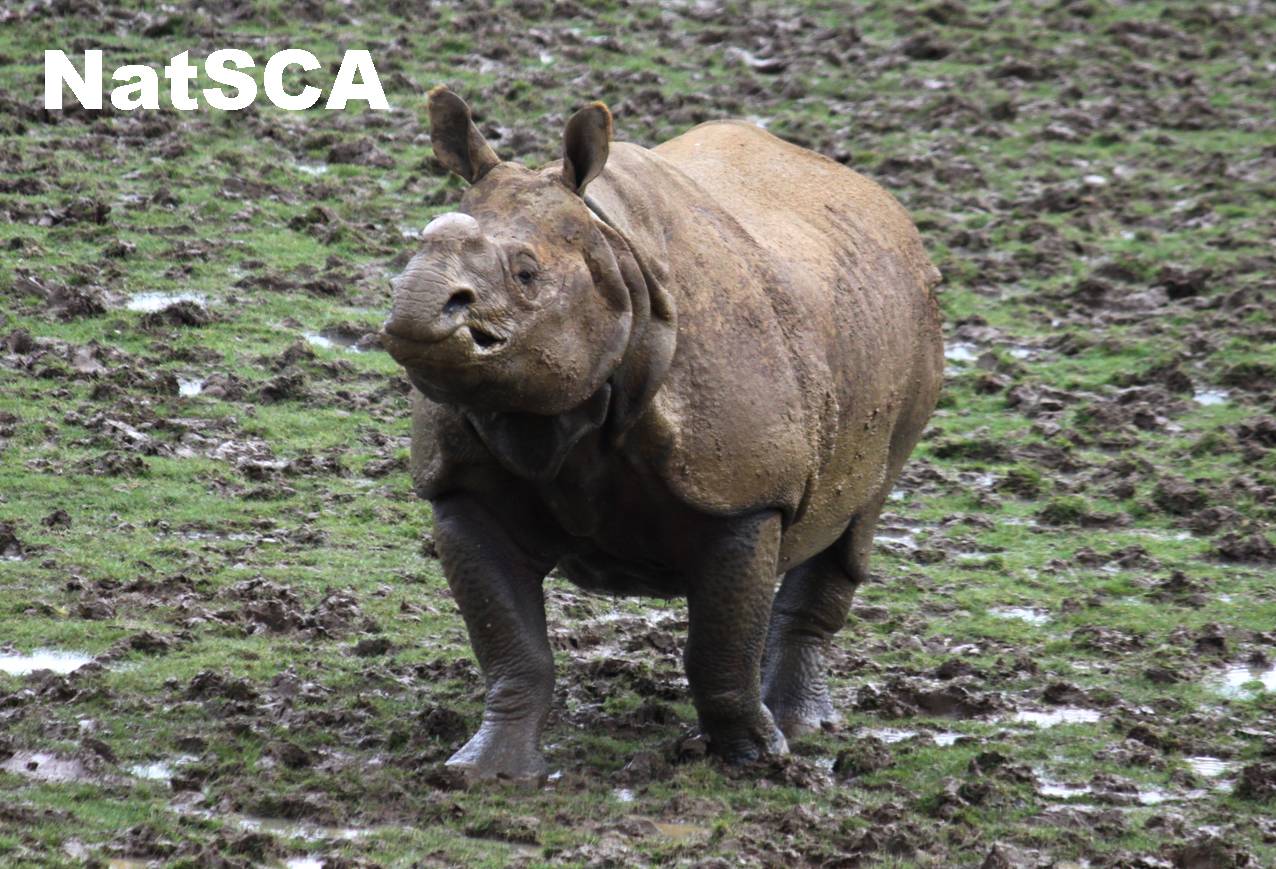
Greater one horned rhino (C) E-L Nicholls

Greater one horned rhino (C) E-L Nicholls

Jobs and Traineeships

Post Doctoral Research Assistant- Origin of Land Plants, at the Natural History Museum. Applications for this externally funded two year project close on 7th December 2015.

Education Assistant; Bookings Administrator and Family Programming Officer, at the Oxford University Museum of Natural History. The position is for 3 years and deadline for applications is 12pm on 16th December.

Events and Exhibitions

Call for papers for the April 2016 conference Objectively Speaking at the British Museum. The conference is set to explore four main themes:

  1. How can museums connect collections with classroom and academic teaching?
  2. How can objects facilitate creative teaching practice?
  3. What is the impact and opportunity of digital technology for object based teaching?

The deadline for proposals is 12pm on 15th January 2016.

A day conference on 11th December called Conservation Matters in Wales – ‘Conservators in Action’ is taking place at the National Museum Wales, in Cardiff. It will include presentations, short tours, and drinks in the pub afterwards (optional!)

Around the Web

Got literary inspiration to find or time to kill? Check out 100 Best Museum and Curator Blogs.

Rachel Petts graces the PalaeoManchester blog with beautiful sharks teeth (I’m not biased) (that might be a lie) as she introduces us to a collection of Eocene Chondrichthyan fossils, found in the UK, and recently donated to Manchester Museum. Hooray!

NatSCA Digital Digest

natsca

Conference

We will be holding our 2016 annual conference & AGM on 21st and 22nd April, generously hosted by Derby Museums. The venues will be The Silk Mill and Derby Museum & Art Gallery. So, it goes without saying, Save The Date!

Events

On 29th October there is a talk at the Natural History Museum on one of my favourite things: curatorial research!
‘Curatorial research gets a bad name when it serves personal ends, but can it help unlock collections for wider engagement?
This talk is based on a project to understand the life and work of a Victorian ornithologist, Henry Dresser.
Held at the Flett Events Theatre, from 2.30–3.30pm. Click here for details.

Speaking of my favourite things, the Wildlife Photographer of the Year exhibition is open at the Natural History Museum. If, like me, you’ve been avoiding social media so you get to see the images for the first time at the exhibition, you can now do so.

Around the Web

Did you know Manchester Museum has an important collection of almost 17,000 earwigs? A type catalogue of this fantastic resource has been published with a description of the collection and its history and is freely downloadable here.

The Love London Awards hosted by Time Out and voted for by the general public has issued its shortlists. In the Bloomsbury, Fitzrovia and Holborn area ten museums and collections are jostling for position, you can click here to vote. Two of the ten are natural history collections, and could be voted for, by you, if you so desired, just saying…

The Symposium of Vertebrate Palaeontology and Comparative Anatomy is often referred to as the friendly conference. Not just palaeontology, the conference also covers comparative anatomy and thus attracts a natural history audience as well. However the guise under which the conference is going to continue into the future is currently under debate, and those with an interested are being invited to comment.

Derby Museums showcases 200 year old Captain Cook shells

200 years after being collected, a group of sea shells with links to Captain Cook’s voyages have been fully documented and photographed for the first time, and put on display in Derby Museum & Art Gallery, thanks to one of the museum’s Super Nature volunteers, Hannah Maddix. Donated to the museum in 1961, along with original documents dating to 1815, they are key to unlocking the secrets of 18th century shell studies. Fred Woodward, former president of the Conchological Society of Great Britain and Ireland, said: “The collection could be considered an equivalent to the Rosetta Stone since it contains shells with common names and Latin names not only used by Humphrey in his catalogues but also numbered by Humphrey himself, which until now has not been known.”

Shell. Image: Derby Museums

Image: Derby Museums

The shells have a fascinating history. They were bought by a Mrs Borough in 1815 from George Humphrey, a London dealer in shells and ‘curiosities’ who in turn had bought shells collected on Captain Cook’s second and third voyages of discovery to Australia and New Zealand in the 1770s. It is almost certain that the Australian and New Zealand shells in the collection came from Captain Cook’s voyages. George Humphrey was one of the world’s first conchologists, and wrote numerous catalogues of important shell collections. The shells in Derby Museum have tiny numbers written on them by George Humphrey, and his original lists survived with the collection. This unique combination of actual specimens related to original lists provides a missing link for modern shell specialists, allowing them to translate long forgotten 18th century shell names into their modern equivalents.

Rachel Atherton, Co-production Curator at Derby Museums said:

“This wonderful collection of shells not only links to Captain Cook and the discovery of a continent, but also give us a glimpse into the early scientific study of shells.”

Shell. Image: Derby Museums

Image: Derby Museums

Hannah Maddix, who catalogued the collection, said:

“It was such a delight to research these shells and discover that we have specimens collected from all over the world. For over two hundred years they have remained desirable and beautiful objects, commonplace and yet still precious.”

The Borough family was once a prominent Derby family, originally called Borrow, living at Castlefields House, before moving to Chetwynd House, Shropshire in 1803. Mrs Borough’s shell collection was passed down in the Borough family until they were donated to Derby Museums in 1961, along with six Joseph Wright oil paintings and a portrait of Isaac Borrow, twice Mayor of Derby in 1730 and 1742.

The shells are on display in Derby Museum’s new nature gallery ‘notice nature feel joy’.

Caring for your Bones – No Calcium or Exercise Required!

In our modern, health-conscious society, just about everyone knows that properly caring for one’s own bones involves adequate ingestion of certain nutrients (calcium, vitamin D, vitamin K) and maintaining bone mineral density through exercise – or so the common wisdom goes, anyway. What about caring for someone else’s bones, however? When that “someone else” turns out to be vertebrate animals whose bones have wound up in a museum collection, the answer involves neither mineral supplements nor resistance training exercises, although saliva might come into the picture (more about this below)!

I learned all about the basics of curating an osteological collection at the NatSCA event entitled ‘Bone Collections: Using, Conserving and Understanding Osteology in Museums’, held at the University Museum of Zoology in Cambridge on September 8, 2015. The day involved a workshop focused on cleaning bone specimens, talks touching on osteology from both biological and museological perspectives, and a series of posters presenting various case studies concerning the treatment of skeletal material (ranging in nature from modern to sub-fossil and fossil) that required cleaning and repair.

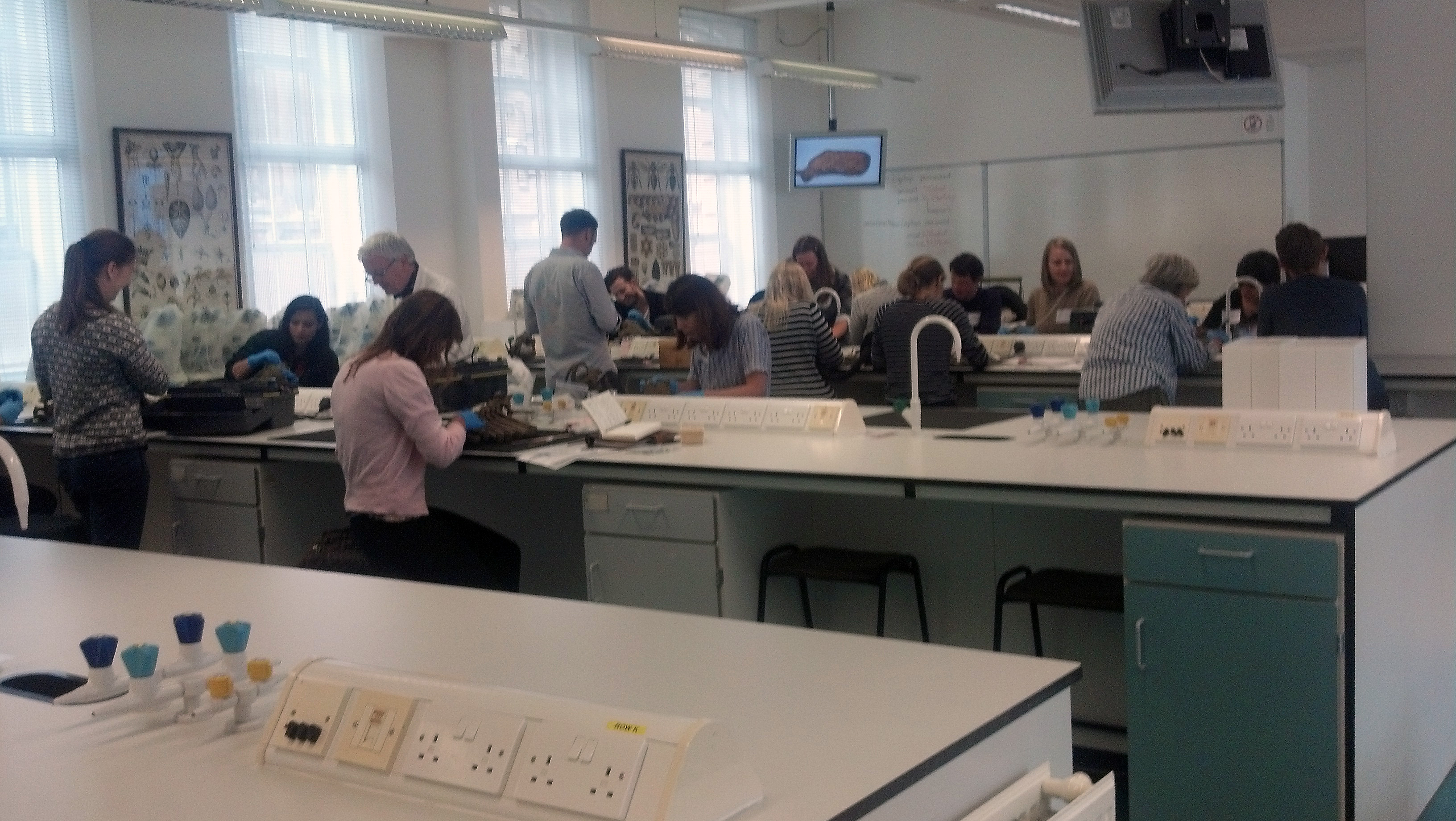
Workshop participants busily trying out various techniques for cleaning osteological specimens that had just been demonstrated on the monitors seen overhead.

Workshop participants busily trying out various techniques for cleaning osteological specimens

At the Canadian Museum of Nature (CMN), where I am employed as a research assistant and collections manager, we have an extensive osteological collection that was established through the collaboration of the museum’s vertebrate zoology staff and the researchers who operated the now defunct Zooarchaeology Identification Centre (ZIC). Use of our osteological comparative material has declined greatly since ZIC ceased to operate in 1996, and relatively few zooarchaeologists working in Canada are aware of our holdings, which is a shame as the osteology collection represents a great national resource that would benefit archaeological research in the country. I am setting out to change this situation.

Having a research background in zooarchaeology – something I have in common with Kathlyn Stewart, head of the CMN Palaeobiology Section – I would love to see the rebirth of an active zooarchaeology programme at the museum. Kathy and I are joining forces to foster growth of the osteology collection in several directions, including expanding the number of specimens to include taxa that are currently underrepresented, increasing knowledge of the collection as a comparative research tool in the archaeological community, and developing CMN-based zooarchaeological research projects.

The Bone Day in Cambridge was therefore the perfect opportunity for me to gain hands-on experience in the care and maintenance of osteological collections.  I spent many years working with osteological collections as a research aid, but I have had little experience in curating such collections. Supported in part through a generous NatSCA bursary, I was able to attend the workshop and conference, affording me the occasion to investigate several topics in greater depth with osteology experts and fellow museum workers. Most important for my goals was learning about techniques for the care of bone and the preparation of skeletal specimens from carcasses.

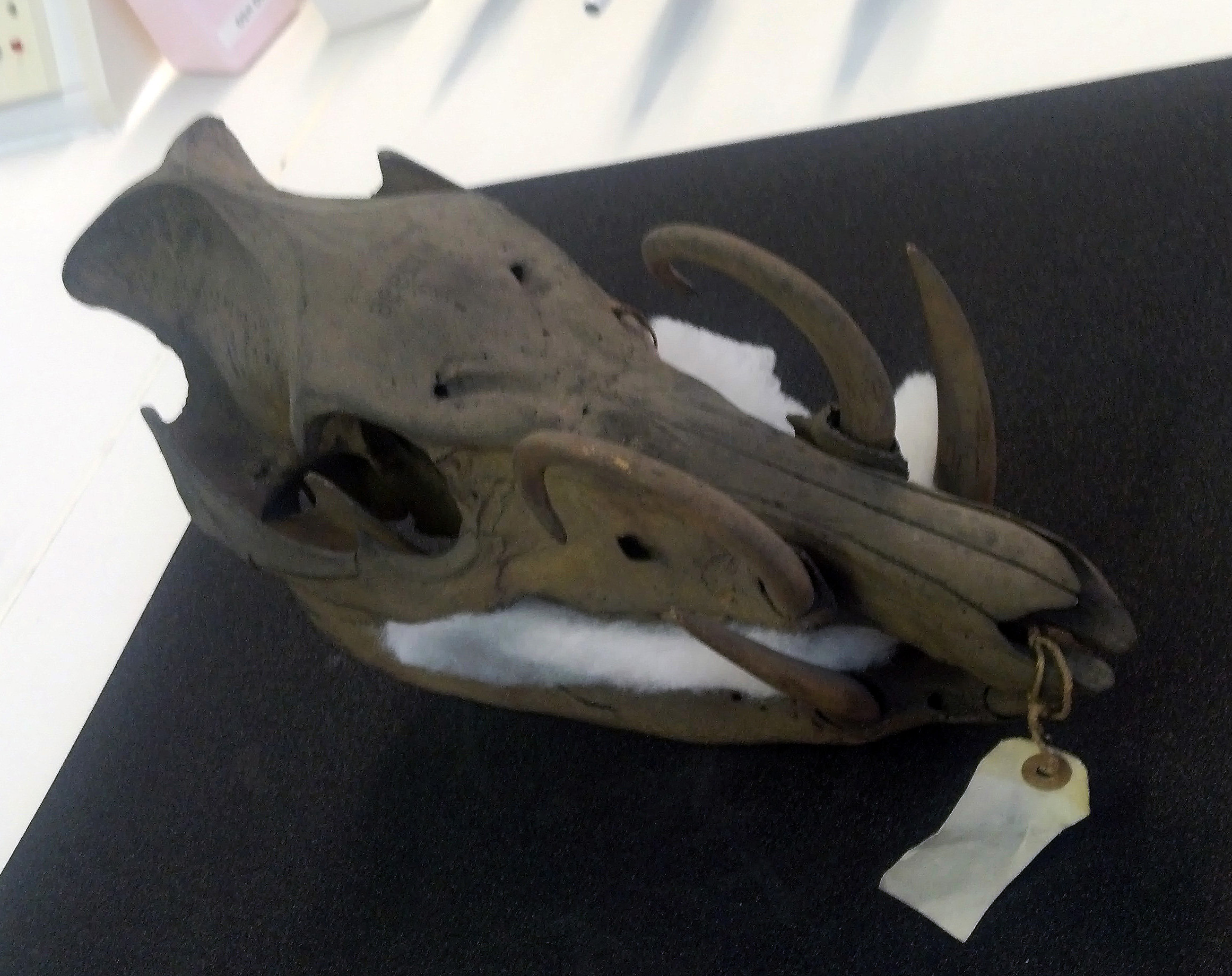
The skull of a babirusa, and Indonesian wild pig, used in the workshop to test cleaning methods.

The skull of a babirusa, and Indonesian wild pig, used in the workshop to test cleaning methods.

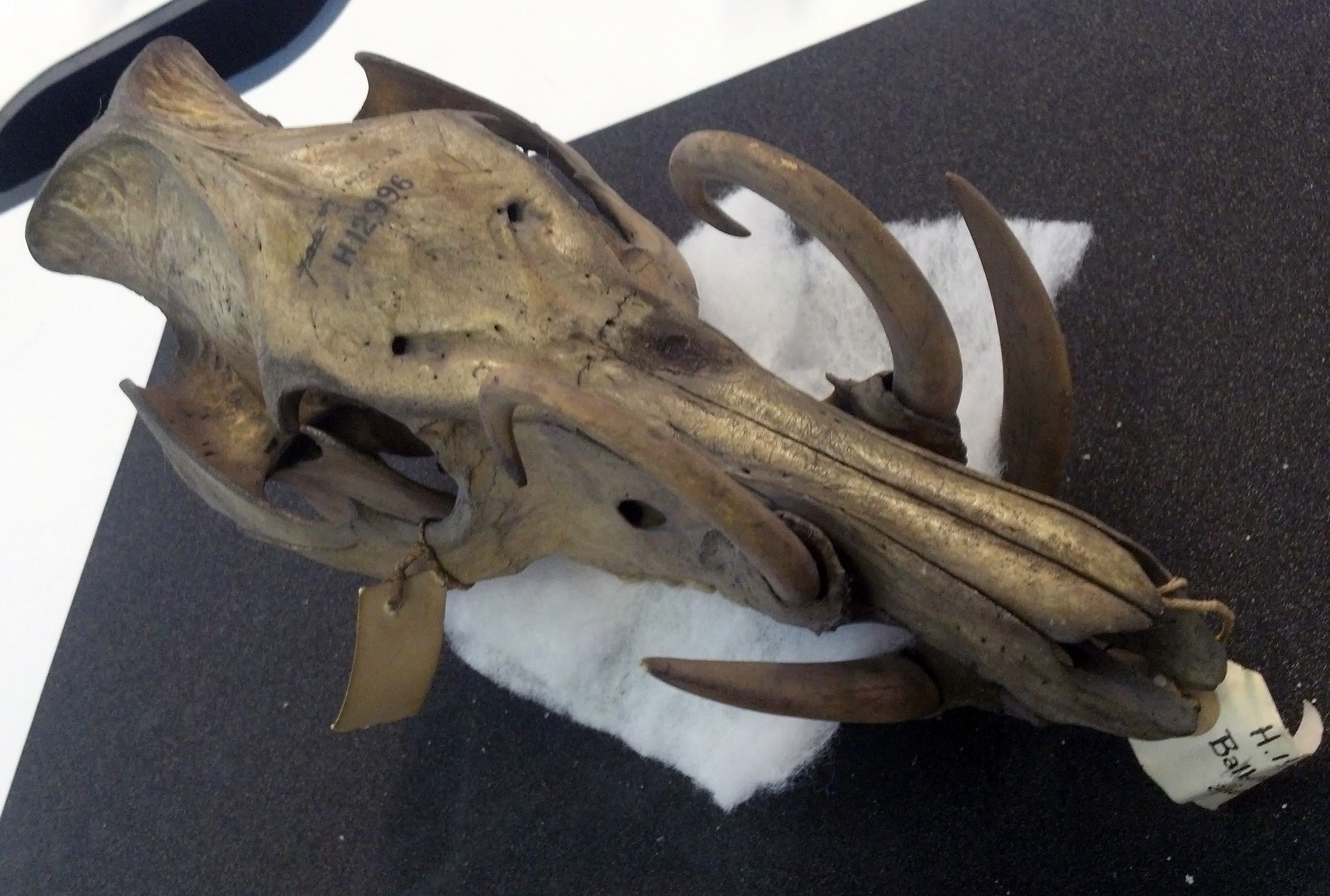
The babirusa skull after a cursory cleaning using brushes, smoke sponge, swabs dipped in Synperonic A7, and yes, even some spit.

The babirusa skull after a cursory cleaning using brushes, smoke sponge, swabs dipped in Synperonic A7, and yes, even some spit.

The day began for me with the morning bone cleaning workshop, where we were introduced to some of the safest and most effective ways of removing deposits that accumulate on the surface of bone specimens, ranging from dust and dirt to bone grease and adipocere (a waxy substance that develops from fats such as bone grease under certain conditions). Gentle brushing and vacuuming, combined with the use of products such as smoke sponge and Groom/Stick natural rubber, remove a significant amount of particulate matter from the surface of bone. For stubborn accumulations, especially those involving bone grease, ethanol solutions and surfactants such as Synperonic A7 (an alcohol ethoxylate) work wonders. Surprisingly, saliva is also an effective cleaning agent, the enzymes in human spit serving quite well to loosen up agglomerations of dust and oil!

The afternoon talks, which included an overview of the importance of osteological collections for archaeological work as well as a discussion concerning an enzyme-based method for skeletonising carcasses, were particularly relevant for me with regard to resurrecting zooarcheological research at the CMN. I believe that several of the presenters from the conference’s slate of lecturers, as well as the leaders of the workshops, are considering submitting blog posts about their contributions to the osteology event, so I will refrain from providing any additional details here. Rather, I will encourage you to stay tuned for future entries concerning the care of bone.

I learned a great deal during the NatSCA Bone Day and made several fruitful contacts with NatSCA members, making it well worth the time and effort of “crossing the pond” from Canada to the UK. I certainly look forward to continuing my association with NatSCA into the future.  Many thanks to the organisation for sponsoring the osteology event and kindly providing support for my attendance, and I hope that I will be able to work with NatSCA to hold a similar ‘bone day’ here in North America sometime soon—I know it would be well received!

Scott Rufalo, Canadian Museum of Nature